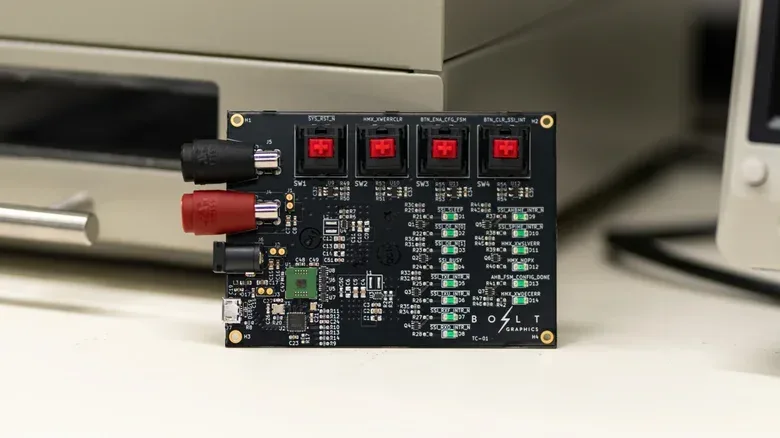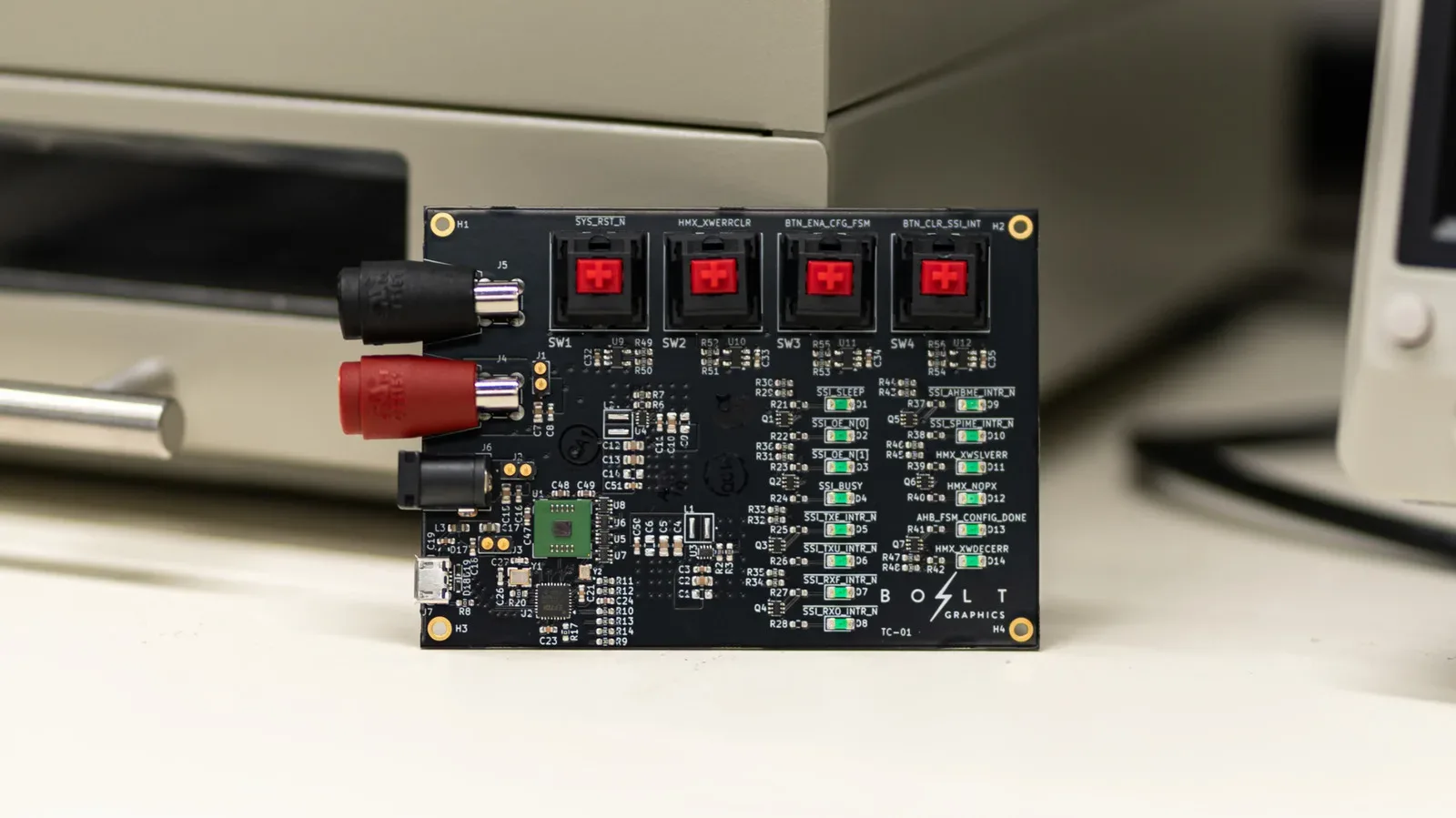
There is a familiar rhythm to big GPU promises: first come the architectural claims, then prototype demonstrations, then silicon that actually powers on, and only much later—if all goes well—a card that developers and buyers can use. Bolt Graphics has reached that third step for its Zeus project. The startup says its first 12nm test chip, fabricated by TSMC, powered on and operated without problems in mid-October.
That is real progress, not a finished graphics card. The working test chip is a tiny 6mm² device intended to prove part of Bolt’s design, while the planned Zeus GPU is a separate product expected to use TSMC’s N5P manufacturing process. Bolt is aiming for volume production in 2028, leaving a substantial stretch of engineering, software and manufacturing work between this milestone and a product that could plausibly challenge established PC GPU makers.
For PC gamers, the short version is simple: Zeus is interesting because of its unusually aggressive rendering and memory ambitions, but it is not hardware to plan a build around. The more important immediate story is that a young GPU company has moved its specialized hardware work from an FPGA prototype to functioning custom silicon—while still needing to substantiate the performance figures attached to the eventual card.
What Bolt has demonstrated so far
The test chip’s focus is dedicated acceleration for electromagnetic simulation. That kind of work models how electromagnetic fields behave, which can be relevant to designing equipment including radar sensors and camera lenses. It is not the same thing as showing a full gaming GPU rendering a modern game.
Its specifications also make clear that this is a targeted proof point rather than a miniature Zeus board. Bolt says the chip measures 6mm² and consumes 1.4 watts. Previously, the company ran its work through an FPGA that used 35 watts.
FPGA means field-programmable gate array: a chip that can be reconfigured after manufacture. It is useful for prototyping because engineers can revise a design without ordering new custom silicon, but it is generally not the final form factor for a mass-market graphics product. A custom chip that performs the intended task at a far lower stated power draw can be an encouraging sign that the hardware concept has translated beyond the earlier programmable prototype.
Still, power alone is not a complete performance story. Bolt has not released benchmark results for this test chip. It says the chip exceeded internal expectations, but prospective customers and enthusiasts do not yet have independently repeatable measurements for speed, accuracy, efficiency across workloads, or software behavior. Those details matter particularly for a company whose broader claims are unusually large.
Zeus is a different, more ambitious chip
The eventual Zeus GPU is described as a PCIe card built around RISC-V processor cores and Bolt’s own path-tracing hardware. RISC-V is an open-standard instruction set architecture. In practical terms, it defines a common language that processors can use to execute instructions, while leaving companies room to create their own implementations around it.
The rendering side is where Bolt’s gaming pitch becomes especially noteworthy. Path tracing is a rendering technique that simulates the routes light rays take through a scene. It can produce more realistic lighting, reflections and shadows, but it is computationally demanding. In games, dedicated ray-tracing or path-tracing hardware is designed to tackle parts of that burden faster than conventional general-purpose processing.
Bolt has previously claimed that Zeus could provide up to 10 times the path-tracing throughput of Nvidia’s GeForce RTX 5090, along with up to 10 times existing GPU rendering performance and 300 times the speed in electromagnetic simulation. Throughput here means the quantity of light-ray work the rendering system can process over a given period. These are company claims, not independently tested results, and there are no public benchmarks in the available details that establish like-for-like performance against an RTX 5090.
That distinction should not be treated as a minor disclaimer. A graphics processor is judged by far more than a headline theoretical measurement. For gaming, meaningful comparisons would eventually need to cover supported games, resolutions, image settings, frame rates, image quality, power use, drivers and stability. For studio, engineering and scientific users, the relevant test may instead be the speed and correctness of a particular renderer, simulation package or pipeline. Until hardware and software are available for independent testing, the claims are best understood as targets rather than demonstrated results.
The unusual memory proposition
Zeus cards are also planned to combine soldered LPDDR5X memory with DDR5 SO-DIMM slots, the compact modules commonly found in laptops. Bolt says this design would let owners expand a card to as much as 384GB of memory.
That is a notable proposal because memory capacity can be a hard limit for large rendering scenes, simulations and other professional workloads. If a workload cannot fit in the available memory, the consequences can include slower operation or the need to reduce the size and complexity of the job. The planned capacity is therefore central to Bolt’s initial appeal to studios, engineers and scientists.
But capacity and graphics performance are not interchangeable. A final assessment would require more information than the maximum memory figure: memory bandwidth, latency, supported module configurations, software compatibility, total board power and the behavior of real workloads would all shape the practical result. Bolt has supplied the expansion concept and ceiling, not the full set of answers needed to evaluate it.
Why manufacturing choices matter
Bolt says its shipping-oriented Zeus processor will be made on TSMC’s N5P process, while the newly powered-on test silicon uses 12nm. The company selected N5P, a process introduced in 2020, in an effort to avoid competing for constrained wafer capacity with chipmakers pursuing the most in-demand manufacturing nodes.
A process node is the manufacturing technology used to fabricate a semiconductor. It is often summarized with a number such as 12nm or 5nm, but that label should not be read as a simple universal measure of performance. Design choices, clock speeds, memory systems, packaging and software all affect the eventual product. Bolt’s use of a mature N5P node may be a supply-focused trade-off: the company is prioritizing an attempt at accessible production capacity rather than positioning the node itself as the entire performance argument.
The road to volume production is nonetheless long. Powering on test silicon can validate part of a design, but a complete card must integrate the final chip, memory approach, board design, cooling, firmware, drivers and manufacturing process. The company has opened a Taipei office to work more closely with manufacturing partners, reflecting the practical supply-chain work still required before a 2028 production target can become a retail or enterprise reality.
Gaming depends on software as much as silicon
Bolt’s stated first market is professional: studios, engineers and scientists. Gaming and AI are planned later. That ordering makes sense given the showcased electromagnetic-simulation hardware and the promised large-memory configuration. It also gives the company a narrower set of workloads to support before confronting the consumer GPU market.
Moving into games would create a different class of challenge. A gaming graphics card needs much more than fast hardware; it requires a mature software stack able to work reliably across thousands of existing titles, engines, graphics APIs and PC configurations. Drivers, game-specific compatibility, development tools and feature support can determine whether an impressive architecture translates into an enjoyable player experience.
This is why a future comparison with Nvidia and AMD would not be settled merely by one path-tracing benchmark. Developers need reliable tools, while players need games that launch, perform consistently and render correctly. It is the same broad ecosystem question behind current conversations about components and memory capacity, including why PC gamers are questioning how computer memory is valued and used. Hardware specifications matter, but the surrounding platform determines much of their real-world worth.
Commercial interest is promising, not proof
Bolt said in April that more than 14,000 businesses, developers and individual users had registered for its early-access program, and that it had a product pipeline exceeding $500 million. It did not identify customers. It also claimed Zeus could lower computing costs by as much as 17 times compared with current hardware.
Those figures suggest the company sees substantial interest in the problems it is trying to address, especially in rendering and simulation. They do not confirm final demand, contracts, delivered products or the cost savings a particular user will realize. Cost-of-compute comparisons depend on the workload, electricity use, purchase or rental cost, utilization, software requirements and the time needed to complete a job. As with the performance assertions, independent validation will be needed.
Reports also indicated that Bolt was seeking roughly $100 million at an approximate $700 million valuation shortly after the test-chip update. Financing is particularly consequential for a hardware startup with a multiyear path to production: graphics hardware development, software development and manufacturing preparation are resource-intensive, and 2028 remains the company’s stated production horizon.
What to watch next
The successful power-on is best viewed as an early technical checkpoint, not a verdict on Zeus. The most revealing next disclosures would be concrete and comparable: benchmark methodology, independently tested results, supported software, driver progress, final memory details, power targets and evidence that the N5P Zeus chip has progressed beyond concept material.
For now, Bolt has shown that its dedicated electromagnetic-simulation approach can run on its own small custom chip, with a stated 1.4-watt draw rather than the 35 watts of its prior FPGA setup. That is a credible reason to keep watching. It does not yet verify a 10-times gaming or path-tracing leap, solve the software challenge of PC gaming, or turn a 2028 production plan into a product. Zeus has powered on in the narrow but important prototype sense; the far harder work is turning that spark into a dependable GPU platform.