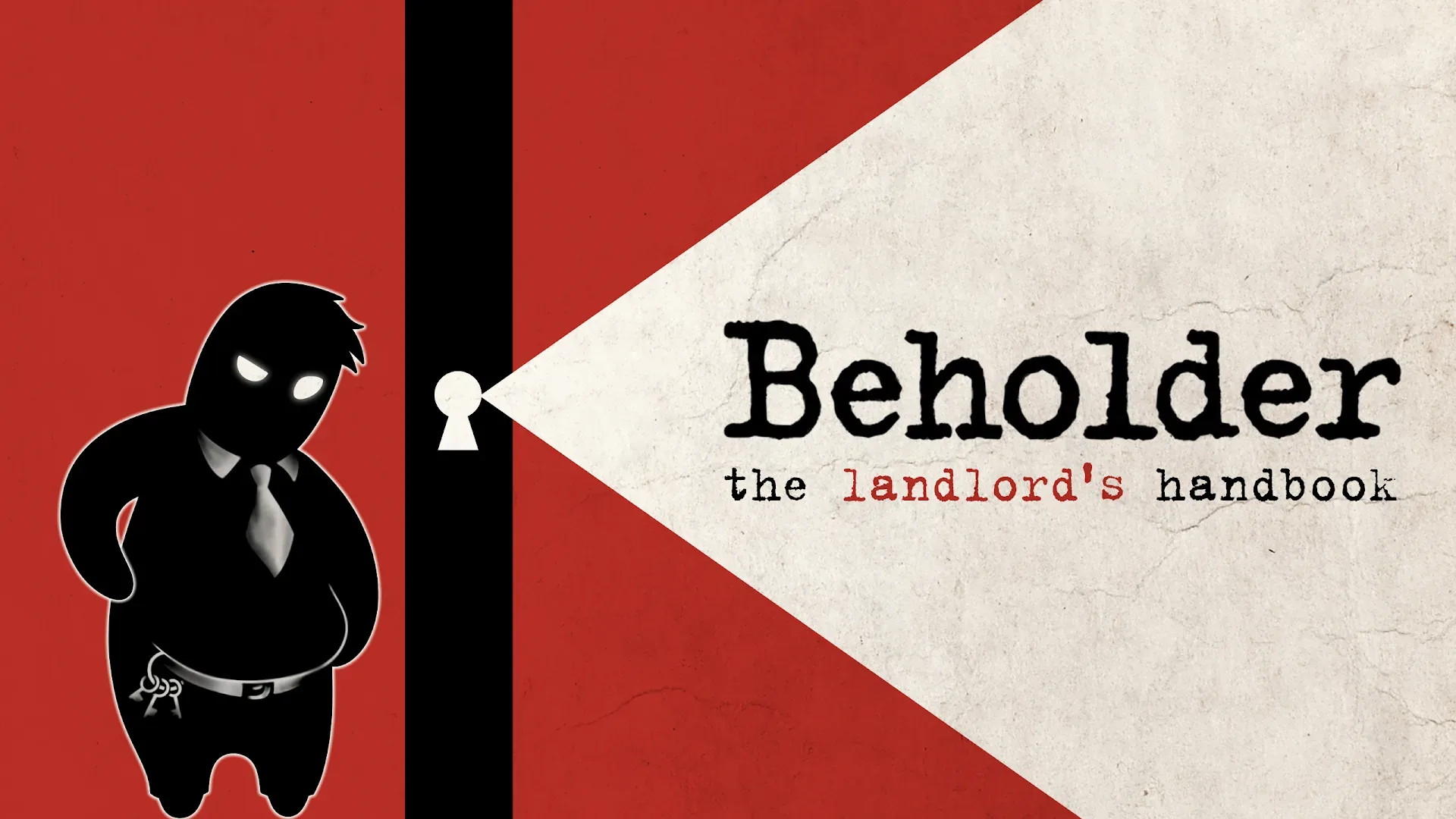
Beholder: The Landlord’s Handbook, a new digital comic set in the Beholder universe, is scheduled to arrive on Steam on November 9. Its release is part of the series’ 10th-anniversary celebration, with further anniversary-related announcements still to come.
The project is not presented simply as a conventional comic book with a Beholder logo on the cover. Instead, The Landlord’s Handbook is framed as an illustrated field manual issued by the Ministry for inexperienced apartment managers. That premise gives the comic a deliberately bureaucratic angle: readers are being positioned as recipients of an official-looking document whose purpose is to instruct, normalize and administer scrutiny of the people living behind closed doors.
For a series built around observation, reporting and the uncomfortable power held by a landlord under an authoritarian system, that framing is a natural fit. The handbook’s stated focus includes overheard conversations, forbidden habits and tenants’ private lives. Its apparent “advice” is therefore part of the fiction’s larger surveillance apparatus, rather than neutral household-management guidance.
A comic built around an in-universe document
An in-universe document is a fictional object that supposedly exists inside the story’s setting. Rather than standing outside that world to explain it, the object speaks in the voice of one of its institutions or characters. Here, the Ministry field-manual presentation lets the comic communicate its setting through directives, instructional material and institutional language.
The approach also combines two forms of storytelling. Sequential storytelling means a narrative unfolds through an ordered sequence of illustrated panels or scenes, as in a traditional comic. The Landlord’s Handbook pairs that sequential material with instructions and advice written from within Beholder’s world. The result is intended to feel less like a detached encyclopedia and more like a piece of official propaganda that happens to reveal the lives it is designed to monitor.
That distinction matters. A fictional guide can turn procedures into characterization. Rules about what to hear, notice or document do more than establish how the Ministry works; they expose what that authority considers suspicious. The more ordinary the behavior being placed under examination, the sharper the setting’s dark humor can become.
The comic’s premise also creates a tension between the tone of a handbook and the subject it covers. Manuals typically promise clarity, best practices and confidence for newcomers. In this case, the novice manager is being guided toward surveillance of neighbors and tenants. The format invites the reader to see how oppressive conduct can be made to sound routine when it is expressed as administrative procedure.
What the handbook is set to explore
The announced material points beyond apartment doors: conversations that can be overheard, habits that may be prohibited, and the personal circumstances of tenants. These are intimate details rather than grand political declarations, which is central to the premise. Surveillance becomes most invasive when it reaches ordinary domestic life—the things people expect to remain private at home.
Related coverage includes Beholder: The Landlord’s Handbook Brings a Ministry Manual to Steam on November 9.
Beholder has long used the apartment building as a pressure point for this kind of scenario. The landlord role is inherently close to the residents’ routines, while the Ministry framing places that proximity in the service of official oversight. The Landlord’s Handbook appears designed to explore that arrangement through a different medium, using an illustrated manual rather than presenting its ideas solely through a game structure.
Readers should not assume, however, that the comic has been announced as a new game, a gameplay expansion or a guide to completing existing Beholder titles. It has specifically been described as a digital comic. Its “handbook” concept is a storytelling device rooted in the setting, not an indication that it is a strategy guide or a walkthrough.
That makes its Steam release notable in practical terms. Steam is frequently associated with games, but it can also serve as a destination for related digital releases. For Beholder followers, the listing offers a direct platform connection to the series while keeping the project’s format distinct from a playable entry.
Shadowy art and dark humor remain part of the pitch
The Landlord’s Handbook retains the series’ shadowy visual identity, dark humor and familiar faces. Those elements are important to the project’s stated identity because they prevent the manual concept from being merely a dry fictional dossier. The imagery and returning characters should give the institutional material a recognizable Beholder atmosphere, while the humor can underscore the absurdity and cruelty embedded in the Ministry’s rules.
Dark humor uses comedy to address unsettling, grim or morally uncomfortable material. In a surveillance-focused fictional setting, it can work by treating harsh intrusions and petty prohibitions with the detached tone of administration. The joke is not that privacy violations are harmless; it is that an authoritarian institution can package them as sensible, ordinary responsibilities for a new employee.
The shadowy style serves a related function. A surveillance story is concerned with what is visible, what is hidden and who is allowed to look. An illustration style built around darkness and obscured spaces can make that concern tangible. Doors, rooms and fragments of private life can carry narrative weight even before the text spells out why the Ministry is interested in them.
The reference to familiar faces suggests that the comic will have recognizable links to the broader Beholder world. No full character roster or plot outline has been detailed, so expectations should remain measured: the announcement establishes continuity of tone and visual identity, but does not specify exactly which characters appear or how the handbook’s story is structured from beginning to end.
Why the format suits Beholder
The strongest aspect of the announcement is how closely the format matches the fiction. A government-issued manual is a useful vehicle for a setting concerned with institutional control because it can make ideology feel mundane. A rulebook does not need to shout. It can quietly define what counts as acceptable behavior, who must watch whom, and what information should be treated as actionable.
For readers, that can create a more active form of interpretation. The stated instructions may be presented as official common sense, but the surrounding illustrations and stories can reveal their human consequences. The reader is asked to understand both the Ministry’s preferred version of events and the private realities that the manual reduces to suspicious “habits” or reportable details.
It is also an efficient way to celebrate a series anniversary without implying that every commemorative project must take the form of a major new game release. A digital comic can revisit an established setting, present familiar faces and broaden the world’s perspective through a compact, purpose-built format. In this case, the landlord handbook itself becomes the narrative hook.
Those following the PC release calendar can also find broader daily coverage in our October 21 games release roundup, though The Landlord’s Handbook is separately scheduled for November 9.
Release details and what remains unknown
The confirmed release information is straightforward: Beholder: The Landlord’s Handbook launches on Steam on November 9. It is an all-new digital comic tied to the 10th anniversary of the Beholder series, and it uses the form of a Ministry-issued reference book for novice apartment managers.
Beyond that, several details have not yet been specified. There is no stated price, no announced length, no complete contents list and no detailed explanation of how the comic will be presented within Steam. The anniversary plans are likewise not complete; additional announcements are planned for a later date.
For now, the clearest expectation is a story-driven, illustrated companion piece that turns Beholder’s bureaucratic surveillance culture into the object readers hold in their hands—or, in this instance, open on their Steam library. The Ministry may call it training. The premise makes clear that the tenants will likely experience it very differently.