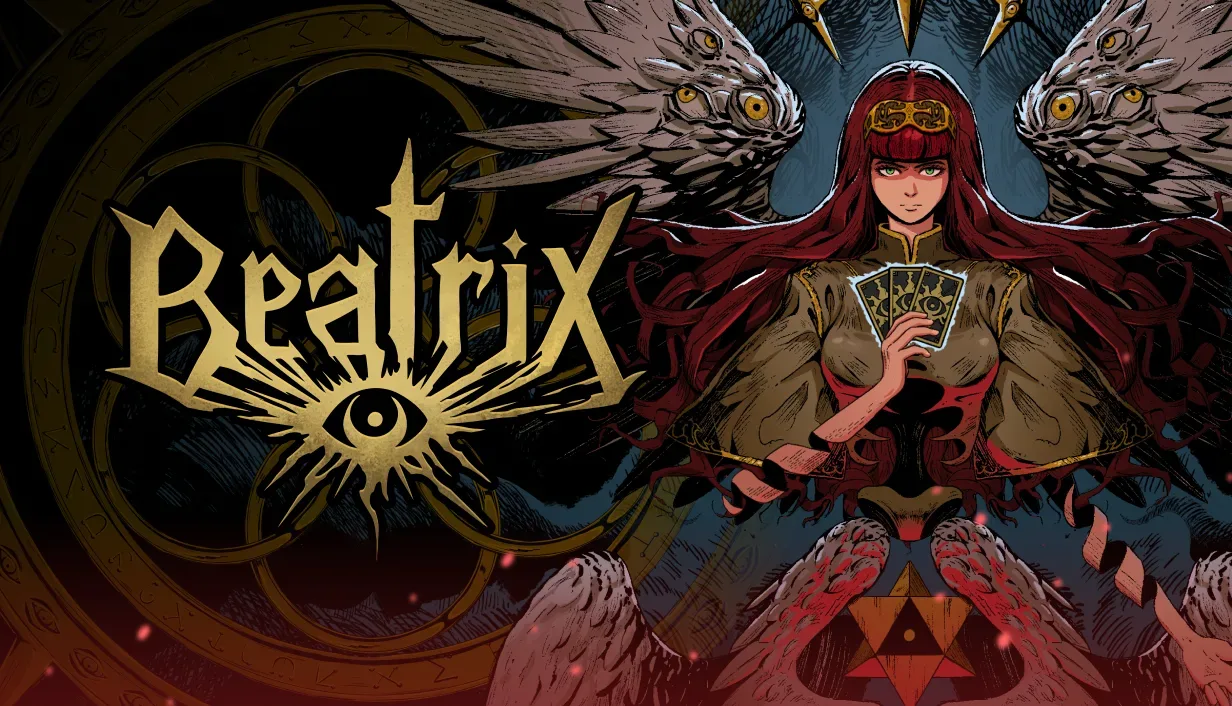
Beatrix has received an updated Steam demo for Steam Next Fest, putting extra emphasis on making its unusual card-and-grid combat easier to understand before asking players to master it. The dark-fantasy roguelite board-builder comes from Tambù Digital, and the revised demo is available during the event running from October 19 to October 26, 2026.
The update addresses several parts of the player experience at once: onboarding and tutorials have been improved, run progression has been refined, battles have received updates and fixes, and the interface, performance and audio have all been polished. That is a substantial list for a demo, but it also makes sense for a game whose central pitch is more involved than simply playing cards from a hand.
Beatrix combines card-based combat with a battlefield that players construct and manipulate. Rather than treating the board as a static backdrop, the game makes its layout part of the decision-making. Players can surround enemy cards on the grid to turn them to their own side, while special field effects known as Canons can change the rules in play and open up further strategic options.
A card game where the board is part of the deck
“Board-builder” is the useful phrase here. In a conventional card battler, much of the tactical question is contained in the cards themselves: what they cost, when they can be played, what they target, and how they combine. Beatrix adds a spatial layer. Positioning, adjacency and the shape of the battlefield matter because they can determine whether an enemy card is enclosed and converted.
That means a move can have two jobs. It may advance an immediate combat plan, but it can also establish part of a future surround. Conversely, an apparently safe enemy card may become vulnerable once the player has developed the right border around it. The supplied details do not define every rule of conversion, so players should not assume exactly how many spaces, card types or placement restrictions are involved. What is clear is the key strategic hook: enemy cards are not merely obstacles to remove; the grid can let players bring them over to their side.
That distinction gives the game a potentially different rhythm from a card battler built only around damage and defense. A player may be weighing the value of a card not just as an effect, but as a piece of battlefield geometry. A powerful placement could be the one that completes a surround, blocks an opponent’s useful space, or creates a better foundation for a later turn.
The term roguelite signals a run-based structure. In practical terms, a run is a self-contained attempt with its own evolving progress and decisions. The demo update specifically refines progression to improve run flow. No detailed account of the available progression systems has been provided, so it would be premature to claim exactly how rewards, encounters or long-term unlocks work. Still, improving flow is especially important in a run-based strategy game: players need to understand why they are making choices now and how those choices carry them through the current attempt.
Canons appear built to make every board less predictable
Beatrix also uses powerful field effects called Canons. These alter the rules of play and create additional strategic opportunities. A field effect is, broadly, an effect that applies to the board or the conditions of a battle rather than belonging only to one individual card. In a game where surrounding and territory already matter, rule-changing effects can make the same arrangement of cards behave differently from one battle to the next.
That is the feature to watch for players who enjoy systems that force a plan to adapt. A Canon could make a placement more valuable, complicate an established pattern, or introduce a new route to exploiting the grid. The precise effects have not been detailed, so the sensible expectation is variety rather than any specific mechanical outcome. What is confirmed is that Canons are intended to change the play space itself, not simply add another ordinary card effect.
Analysis: Beatrix’s design appears to rely on players learning several connected ideas at the same time: card-based combat, spatial construction, enemy conversion through surrounding, and field-level rule changes. That combination is why tutorial quality is not cosmetic. If a newcomer understands a card’s text but not why its location matters, they may miss the game’s central tactical promise. If they understand positioning but not how a Canon changes the current rules, a seemingly logical move may produce an unexpected result. Better onboarding can therefore be as important as an individual balance adjustment.
The demo update focuses on clarity, flow and feel
The updated demo includes an improved onboarding experience and tutorial. Onboarding is the early sequence through which a game introduces its controls, vocabulary and core loop. Good onboarding does not necessarily mean explaining everything immediately; it means giving players enough information to make an informed decision, then building understanding as new complications arrive.
For Beatrix, a useful tutorial needs to communicate more than basic card play. It has to show how the grid can be used offensively, how surrounding an enemy card changes ownership, and why a Canon can alter priorities. The revision does not promise that every system will be exhaustively explained, but the stated focus on accessibility suggests an effort to make the early experience more legible.
Progression has also been refined to improve run flow. “Flow” in this context is not a claim about difficulty becoming easier. It is about pacing: how smoothly players move through decisions, battles and the evolving structure of a run. In a roguelite, unclear progression can make choices feel disconnected or leave players unsure what their next objective is. Refinement can help each step feel like part of a coherent attempt rather than a collection of isolated fights.
Battle updates and fixes are included as well. The announcement does not enumerate individual changes, so there is no basis to identify a particular mechanic as rebalanced, repaired or redesigned. The practical takeaway is simply that the combat portion of the demo has been revised alongside its instruction and progression, rather than being left untouched while presentation alone changes.
There are also numerous interface refinements. An interface is the information and control layer between player and game: menus, visual indicators, tooltips and other feedback that tell players what is happening and what actions are available. This is especially relevant in a strategy title with a changing board state. Interface clarity can reduce needless friction by helping players see ownership, placement relationships and active conditions without having to guess.
Performance optimisations and audio improvements round out the update. Performance work generally concerns how reliably and smoothly software runs, while audio improvements can cover the clarity and impact of the game’s sound presentation. No benchmarks, platform specifications or exact audio changes were supplied, so these are best read as broad polish efforts rather than promises of a particular technical target.
What Steam Next Fest players can use the demo to assess
The new demo gives interested players a focused way to judge whether Beatrix’s mix of ideas clicks for them. The most important questions are likely to be conceptual rather than numerical: Does the tutorial make the surround-and-convert system understandable? Does manipulating the battlefield feel meaningfully different from merely selecting strong cards? Do Canons create engaging tactical pivots? And does the revised progression make a run easy to follow?
Players who enjoy card games but are less familiar with grid-based strategy may find the updated onboarding particularly useful, because it should establish why spatial decisions matter. Meanwhile, players drawn to tactical boards may want to see whether the card component expands their options rather than simply adding layers of rules. The appeal is in the interaction between those systems, not in either one existing alone.
Steam Next Fest is a natural venue for that kind of test. Demos allow players to sample a core loop before deciding whether to keep the game on their radar. Beatrix can be wishlisted on Steam to follow its development and receive future updates. Readers browsing other event demos can also see another Steam Next Fest demo update with a very different RPG focus.
What is confirmed, and what remains to be discovered
Confirmed details are straightforward: Beatrix is a dark-fantasy roguelite board-builder with card-based combat; players can turn enemy cards to their side by surrounding them on the grid; Canons are powerful field effects that change the rules of play; and the latest demo brings tutorial, progression, battle, interface, performance and audio improvements.
Less certain are the deeper particulars that will shape long-term strategy. The available information does not specify the size or structure of the card pool, the exact conditions for surrounding cards, the breadth of Canon effects, how long runs are, or what form any progression takes beyond the stated refinement. Those are the details the demo can help illuminate, but they should not be filled in with assumptions.
For now, the update’s most encouraging element is its focus on the points where an inventive hybrid can succeed or stumble: teaching players the rules, giving runs a satisfying pace, and presenting a busy tactical board clearly. Beatrix’s premise asks players to think about cards as battlefield pieces and the battlefield as an active system. The refreshed demo is designed to make that proposition clearer from the opening moves.