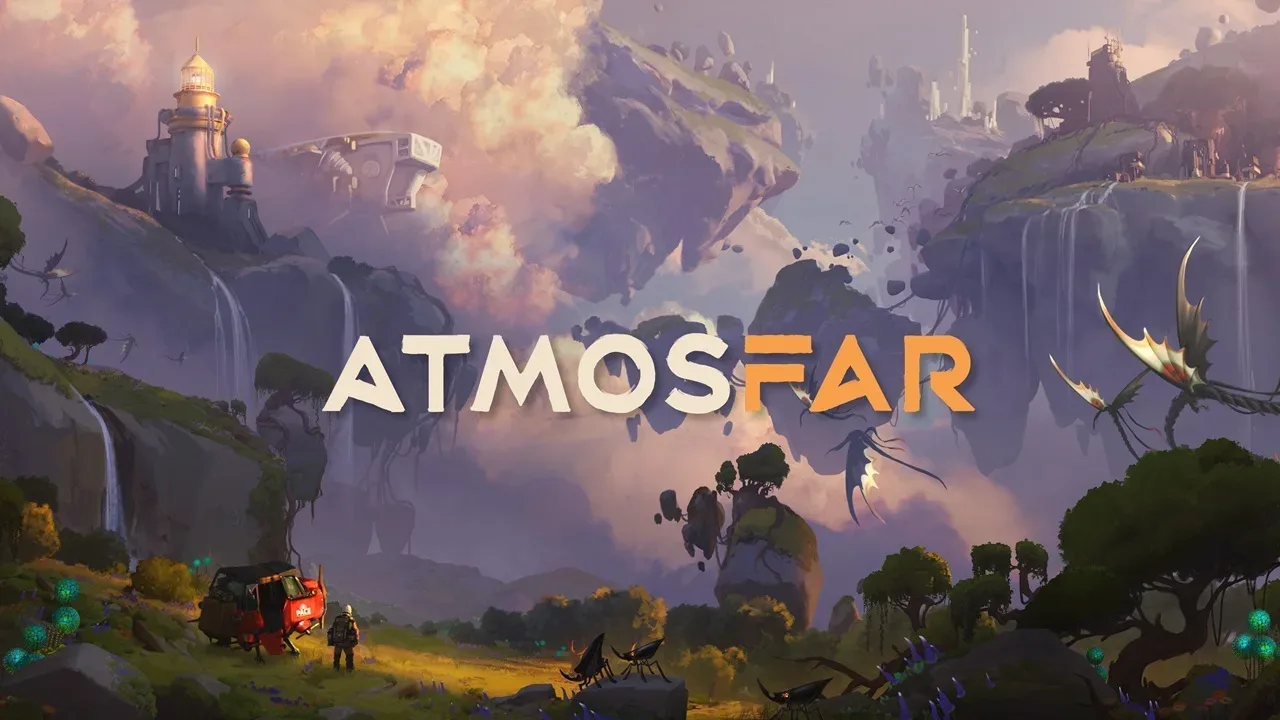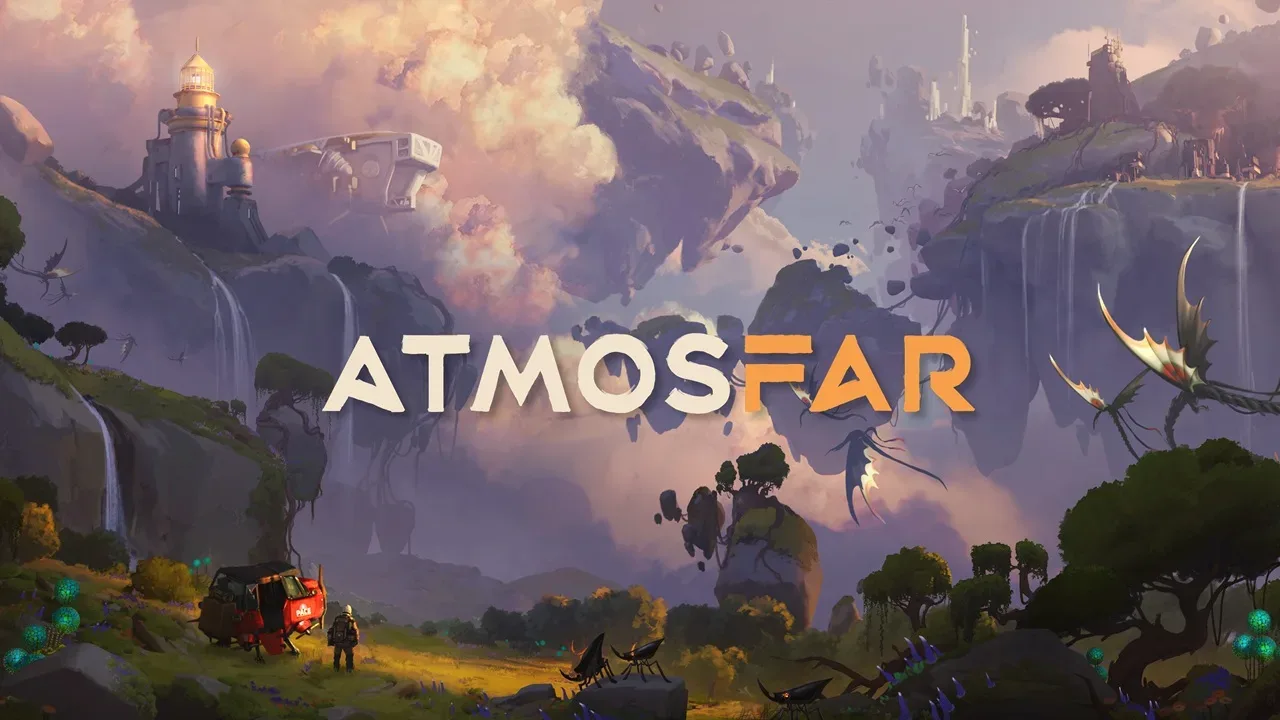
ATMOSFAR, the skyborne science-fiction survival game from Apog Labs and Shueisha Games, is scheduled to enter Steam Early Access on October 29, 2026. The project has also crossed 400,000 Steam wishlists, having added 100,000 of those in the past week.
That is substantial pre-launch attention for a game that combines several demanding ideas: aerial piloting, survival resource management, mobile-base customization, exploration on foot, changing biomes, and online co-op for two to four players. A newly released gameplay overview trailer lays out the broad shape of that experience, centered on moving through the alien world of Tycos in a fleet of flying craft rather than building around one fixed settlement.
Players interested in the visual overview can view the official ATMOSFAR gameplay trailer.
A survival game built around staying airborne
ATMOSFAR is set on Tycos, an alien world tied to the mystery of humanity’s furthest outpost. The stated objective is not simply to endure its conditions, but to investigate what happened there. That gives the survival framework a narrative direction: gathering supplies and expanding capability are connected to reaching new places and uncovering the fate of the outpost.
For more context, explore Muay Thai Xtreme Brings Live Bouts, Demos and Creator Tournament to Gamescom Asia 2026.
Its defining mechanical idea is the use of aircraft as the center of progression. Rather than presenting travel as a short bridge between a home base and expeditions, ATMOSFAR puts flight directly into the daily survival loop. The game includes several named vessels:
- Utility Wasp
- Hauler Wasp
- Fighter Wasp
- Cloud Cruiser, a large customizable mobile airbase
The names suggest distinct operational jobs, although detailed statistics, upgrade trees, combat rules, or individual vehicle limitations have not been specified. What is clear is that the fleet structure should make vehicle selection part of planning. A utility-focused craft, a cargo-oriented hauler, and a fighter imply that transport, material movement, and protection are intended to be different considerations rather than one catch-all flying-machine role.
The Cloud Cruiser changes the meaning of base-building
The Cloud Cruiser is described as a large, fully customizable mobile airbase. In practical terms, a mobile base is a player headquarters that travels with the expedition. That matters because traditional base-building often asks players to establish a permanent foothold and repeatedly venture outward from it. ATMOSFAR’s structure instead points toward repositioning the hub itself as exploration moves across Tycos.
“Fully customizable” establishes the Cloud Cruiser as more than scenery or a mission terminal, though the currently available details do not define the available rooms, cosmetic options, construction rules, or resource costs. Players should therefore avoid treating it as confirmation of any particular building system. The safe takeaway is that customization is a core advertised component and that the Cloud Cruiser is intended to function as the group’s principal mobile base.
That arrangement potentially ties several systems together. A long journey can require a safe operational center; resources collected on expeditions need a reason to be transported; and specialized aircraft become more useful when they support a shared vessel with its own ongoing needs. The game’s design pitch is strongest where those systems overlap: flying is not just traversal, base-building is not isolated construction, and ground exploration feeds back into the airship operation.
Ground expeditions remain part of the loop
Despite the focus on airborne vessels, ATMOSFAR also includes ground expeditions. The game is therefore not solely about piloting above the surface. Players will move between aerial exploration and on-the-ground activity while managing resources and developing their mobile base.
This division gives Tycos two distinct scales. From the air, the important questions are likely to concern routes, distance, weather, the role of each craft, and where the Cloud Cruiser should be positioned. On the ground, exploration can focus on securing materials and investigating locations related to the human outpost. The exact hazards, creatures, equipment, crafting steps, and combat systems have not been detailed, so those remain open questions for Early Access.
The contrast is nevertheless meaningful. Games that ask players to leave a vehicle and explore on foot have to make both modes useful. If the aircraft only delivers players to ordinary survival tasks, the flight premise can feel disconnected. ATMOSFAR’s stated focus on resource management and a movable airbase suggests a clearer relationship: expeditions obtain what the airborne operation needs, while the fleet enables expeditions that may otherwise be difficult to reach.
Weather is presented as an active danger, not a backdrop
Tycos is described as containing diverse biomes and extreme weather phenomena, including ferocious jetstreams and turbulent thunderstorms. A biome is a major environmental region with its own visual identity and conditions. In a survival game, biome variety often changes what players encounter or need to prepare for, but ATMOSFAR has not yet outlined the specific rules attached to each region.
The weather examples are more immediately revealing because they concern flight. A jetstream is a fast-moving current of air. In the context of a flying-survival game, it signals that the airspace itself may affect how players travel rather than functioning as a neutral backdrop. Thunderstorms similarly suggest unstable, dangerous conditions for a fleet whose main infrastructure is airborne.
Neither example confirms a particular flight model, damage mechanic, or navigation penalty. Still, weather being singled out in the game’s overview indicates that it is meant to shape the experience. For players, that could make route planning and timing as important as simply having enough resources to depart. For co-op crews, it also creates a natural reason to coordinate: one player may be managing the vessel while others focus on other expedition or base responsibilities, though exact crew roles have not been announced.
What two-to-four-player co-op means so far
ATMOSFAR supports online co-op for two to four players. This is a useful scope detail: it is designed around a small crew rather than a large persistent server population. Its collection of systems—specialized aircraft, mobile-base customization, resource management, weather, and ground expeditions—provides several plausible reasons for a team to divide attention.
However, support for co-op should not be read as confirmation of every common multiplayer convenience. The available information does not establish how sessions are hosted, whether solo play is supported, how saving works, whether progress is shared, whether players can freely use separate vessels, or how difficulty scales. Those are especially important practical details for a survival game, but they have not been provided.
What can be said now is that the game’s premise suits a small group. A mobile airbase is an obvious shared focal point, and a fleet creates room for multiple responsibilities. The appeal will depend on whether those responsibilities feel interdependent rather than merely simultaneous. Early Access is likely to be the period in which players can best assess how consistently the game turns its co-op concept into meaningful group play.
What the wishlist milestone indicates—and what it does not
Steam wishlists let users flag interest in a game before release and receive platform notifications connected to launch or promotions. Reaching 400,000 wishlists, including a reported gain of 100,000 in a week, is a notable indicator of awareness before ATMOSFAR’s Early Access arrival.
It is not, however, a sales figure, player-count forecast, or review score. A wishlist reflects intent or curiosity at a moment in time; it does not guarantee a purchase. The milestone does show that the combination of airborne survival, science-fiction exploration, and co-op has drawn a large audience well before the October 29 date.
For an Early Access game, that attention has practical implications. The first players will be evaluating not only the premise, but also the state of the systems that underpin it: flight feel, resource balance, the usefulness of base customization, the value of ground expeditions, performance, and the reliability of online co-op. Those specifics should be judged once the game is available rather than inferred from wishlist totals or trailer footage.
The key questions for the Early Access debut
ATMOSFAR’s announced feature set is unusually interconnected. It is not enough for the Cloud Cruiser to look impressive, or for the Wasps to have distinct names. The launch will need to show how the game handles the links between vehicles, mobile-base decisions, gathered resources, hazardous weather, and the search for humanity’s distant outpost.
Until then, the most concrete picture is straightforward: players will explore Tycos using a fleet that includes the Utility Wasp, Hauler Wasp, Fighter Wasp, and a customizable Cloud Cruiser; they will undertake ground expeditions; they will contend with varied biomes and severe weather; and they can do so in online groups of two to four. Steam Early Access begins October 29, 2026.