Anyone with a PC gaming desk knows the cable situation can evolve from “perfectly manageable” to “why does this look like a defeated robot?” in approximately one new accessory. A phone needs a top-up before bed. A controller has quietly reached one bar. Wireless earbuds are making their tiny low-battery plea. Then a laptop, handheld, tablet, or capture-device-adjacent gadget joins the queue. Suddenly, the humble spare wall socket is being asked to run a small power station.
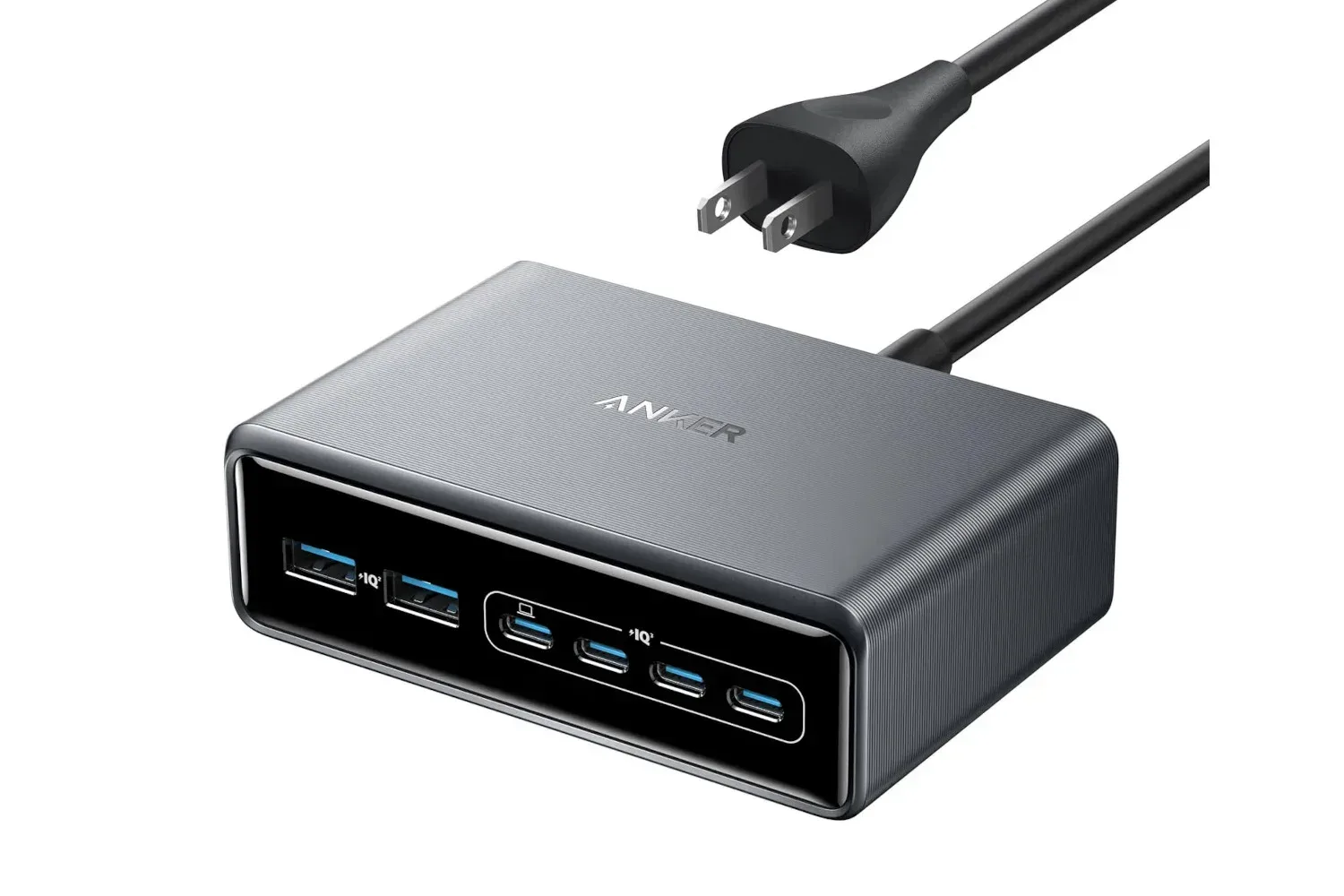
That makes a desktop charger with enough ports and enough total capacity more useful than another single-device brick. The Anker Prime Six-Port Charging Station is currently listed at $56, reduced from its usual stated price of $80. That is a $24 difference, or 30% off the reference price, for a unit built around a shared 200W output and a mixed selection of modern and older USB connections.
The headline is straightforward: this is a charging hub intended to put several power needs within reach at once, whether the desk is used for work, PC gaming, streaming setup tasks, or the nightly ritual of getting every portable device ready for the next day. It is not a glamorous purchase in the way a display or mechanical keyboard can be, but it may be one of the pieces of desk hardware that gets used most often.
Six ports for a crowded desk
The station has four USB-C ports and two USB-A ports, for six connections in total. All six can be used simultaneously. That split matters because USB-C has become the common connector for newer phones, tablets, laptops, headphones, handhelds, and many controller accessories, while USB-A remains relevant for a surprising amount of established gear and existing cables.
For a gaming-oriented desk, the mixed port selection can prevent a familiar kind of low-stakes frustration: needing to choose which device deserves the only convenient fast-charge slot while older cables and peripherals occupy separate wall adapters. A single central station gives those devices a shared home instead. It can also make a desk easier to reset after a session—unplug the device, put it away, and leave the cable where it belongs rather than hunting behind furniture for its dedicated charger.
The stated 200W figure is the charger’s total available output, rather than a promise that every plugged-in device receives 200W at once. Actual charging behavior will depend on the connected hardware, the port in use, cable capabilities, and how the station distributes power when multiple items are attached. That distinction is worth keeping in mind for anyone buying around a specific laptop charging requirement. High aggregate capacity is especially helpful when several devices need power together, but buyers should still confirm their device and cable support the charging level they expect.
Why 200W shared output is useful
A high-capacity desktop charger is largely about reducing adapter clutter. Rather than filling a power strip with separate bricks for a laptop, phone, headset and other accessories, the charging hardware is consolidated into one smaller desktop unit. That can free outlets, shrink the visible cable pile, and make a multi-device setup less awkward to manage.
There is a practical use beyond a fixed PC station, too. People who move between a workstation, a bedside table, and a packed bag often end up keeping chargers in each location or repeatedly relocating one. A six-port model can serve as a central overnight charging point for a household’s smaller electronics, or as the desk-side solution for someone whose work and entertainment gear overlap.
The four USB-C connections are the key part of the layout for newer equipment. They offer more flexibility than a configuration dominated by USB-A, particularly as laptops and many recent personal devices rely on USB-C charging. The pair of USB-A ports avoids treating old cables as immediate e-waste. It is a sensible transitional combination: newer equipment can use the newer ports, while legacy accessories still have a place.
If a new portable computer is also part of the setup, readers may want to compare its charging needs carefully. Our coverage of M5 Pro and M5 Max MacBook Pro deals is a reminder that premium laptops and their power requirements can become a substantial part of any desk-budget calculation. A charger’s port count and total wattage are useful specifications, but compatibility with the individual machine remains the deciding detail.
Safety features and desk placement
The product is described as including multiple safety protections, including temperature monitoring intended to help prevent overheating and overcharging. Charging hardware should not be bought solely on a claim list, but thermal oversight is an important feature in a product designed to support multiple devices at the same time. It is particularly relevant for a charger likely to sit on a desk or nightstand for extended periods.
That does not remove the need for basic charging common sense. Cables should be in good condition, the station should have reasonable ventilation, and users should avoid treating a crowded extension lead as an invitation to create their own side quest in electrical engineering. The station’s safety design is intended to manage charging conditions; it is not a reason to ignore damaged cords or unsuitable power setups.
The charging station is also described as compact for its capacity. Exact dimensions are not provided here, so prospective buyers should verify them if desk space is unusually tight. Still, the basic appeal is clear: a unit that can sit near a monitor stand, laptop riser, or bedside surface without demanding the footprint of a traditional power strip full of adapters.
A deal that makes more sense for the right setup
At the stated $80 regular price, a 200W six-port charger is a more considered accessory purchase. At $56, the case becomes easier for people who are already juggling several USB-charged devices. The $24 reduction is meaningful because a charging station is rarely the item someone wakes up intending to buy; it tends to become necessary only after the collection of loose chargers reaches critical mass.
Still, this will not be essential for every player. Someone who primarily uses a desktop PC, charges one phone, and has no laptop or expanding accessory collection may be better served by a less capable and less expensive charger. Similarly, this is a charging station, not a replacement for a surge-protected power strip where AC outlets are the requirement. Its value is concentrated in USB charging flexibility, shared wattage, and consolidating compatible device power into one place.
For households or desks with several USB-C devices, a laptop, and lingering USB-A accessories, the specification mix is more compelling. It can help keep the gear that supports gaming—phones used for authentication or chat, headsets, controllers, handhelds, keyboards, mice, and portable computers—from competing for scattered sockets and mismatched bricks.
Warranty and what to check before buying
The Anker Prime Six-Port Charging Station includes a stated 24-month warranty. That coverage adds some reassurance for hardware likely to see frequent use, though shoppers should review the applicable terms before purchasing.
Before deciding whether the $56 listing fits the desk, a quick checklist can prevent the wrong kind of bargain:
- Count the devices: Six ports are valuable only if several devices genuinely need routine charging in the same place.
- Check connectors: The unit provides four USB-C and two USB-A connections; make sure existing cables align with that mix.
- Check laptop requirements: Confirm the computer supports charging over USB-C and review its preferred power level.
- Remember power sharing: The 200W figure is shared across connected devices, so simultaneous use changes the available power distribution.
- Review the retailer listing: Prices can change, and product details, compatibility notes, warranty conditions, and included accessories should be verified at checkout.
The listed $56 price puts a notably capable six-port desktop charging option below the stated $80 standard cost. For a workstation where charging cables have become a second peripheral ecosystem, four USB-C ports, two USB-A ports, 200W of total output, and a 24-month warranty make a persuasive combination—provided the connected devices and cables match the intended use.
Shop the products
Check current price, model and availability at the retailer.