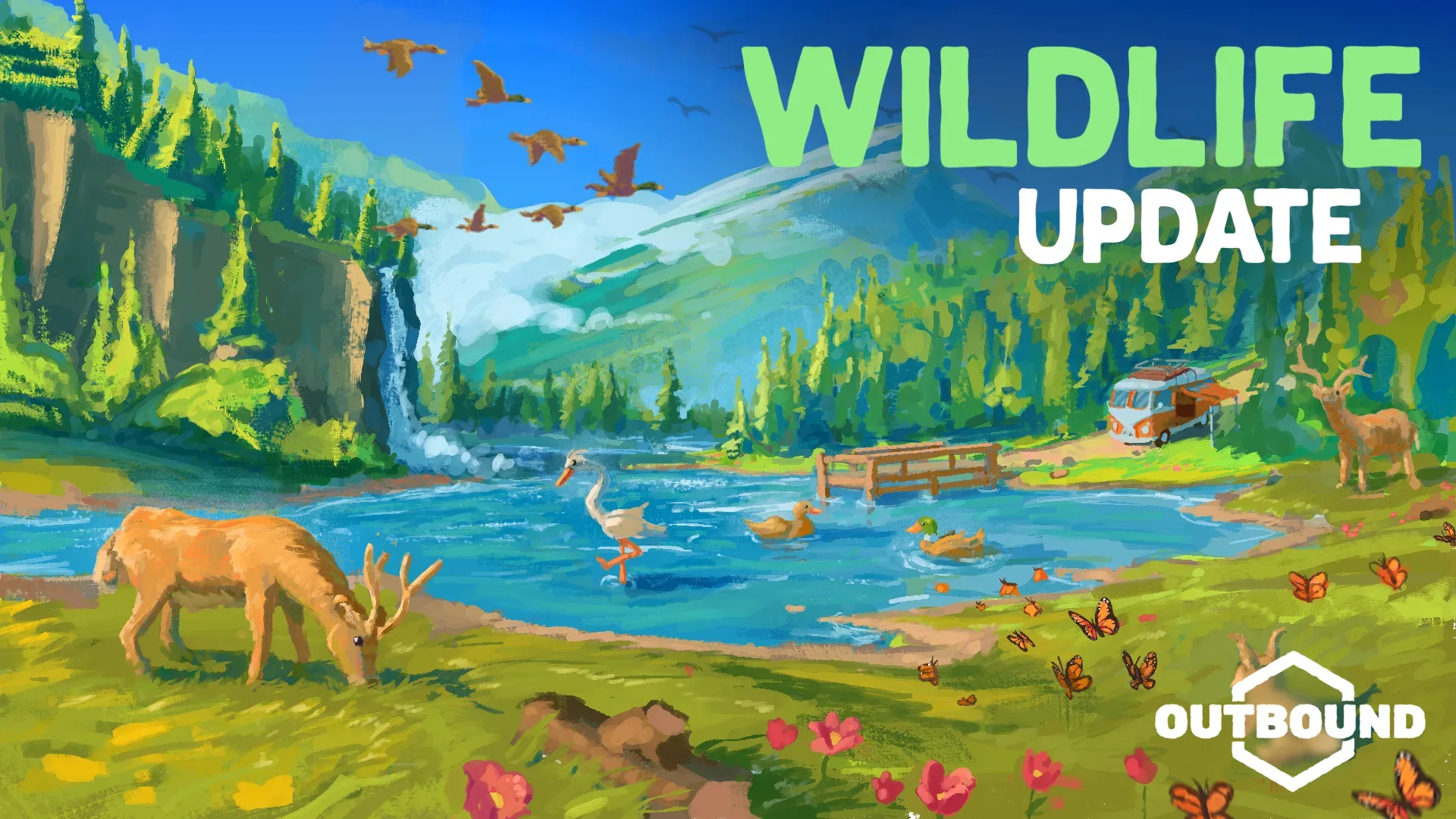
Outbound has received the free Say Cheese! Wildlife Update, adding 34 animal species across its four biomes alongside a photography system built around finding, framing and documenting wildlife. Square Glade Games and publisher Silver Lining Interactive released the update on September 22, 2026, for Steam, Epic Games Store, PlayStation 5 and Xbox Series X/S.
Nintendo Switch and Nintendo Switch 2 versions are expected to receive the update soon, though a specific date has not been provided. The update also includes usable fixed binoculars, a new wooden building foundation, a small fishing-interface adjustment, and decorative items designed by Kickstarter backers.
It is a meaningful expansion for a game centered on an off-grid journey and a mobile sanctuary: animals are not merely additional scenery. The new systems give players a reason to look more closely at each biome, identify what they have not yet encountered and build a visual record in the game’s journal.
A camera turns wildlife sightings into progression
The headline addition is a craftable camera. Players can get its blueprint from the new Wildlife Outpost in the first biome, providing an early route into the update’s central loop. Once crafted, the camera can be used to photograph animals encountered throughout the world.
Rather than working as a simple screenshot button, the camera has several adjustable settings:
- Exposure/Brightness: controls how light or dark the image appears.
- Depth of Field focus points: determines the area held in focus, while other portions of an image can appear softer.
- Saturation: adjusts the intensity of colour.
- Contrast: changes the separation between lighter and darker areas.
- Zoom: brings a distant subject closer in the frame.
Those options matter because the photography feature is doing two jobs at once. It is a creative tool for composing an image, but it is also connected to a recognition and record-keeping system. Every snapshot is saved to the player’s library, creating an in-game archive of the journey rather than leaving photographs as fleeting moments.
The technical language is worth separating from what it means in play. Depth of field is the range of a scene that appears sharp. A narrow focus can make a nearby animal the visual priority while its background softens; a broader focus can keep more of the surrounding landscape clear. Exposure, saturation and contrast are image-presentation controls, so they should give players room to make a bright field, shaded area or distant subject look closer to their preferred style. The update does not establish that changing these settings affects whether a species can be registered, only that the camera includes them.
How the Wildlife Journal works
The Wildlife Journal is the practical companion to the camera. It now shows previews that help players identify animal species they have not documented. When an animal is visible through the camera, automatic detection identifies that it is in view. A player who frames it and takes a clear picture can then log that species as “collected” in a new journal tab.
Related coverage includes Outbound’s Say Cheese! Update Adds 34 Animals and a Photography System.
In this context, “collected” refers to completing an in-game documentation entry, not acquiring a physical item or capturing an animal. The stated objective is photographic tracking: see wildlife, identify it, line it up clearly and add it to the journal.
That makes the update more structured than a general fauna increase. The 34 unique species are spread through four biomes, and journal previews provide a clue-driven way to work out which entry is still missing. A player pursuing completion can use the journal to narrow their search instead of treating every visit to a biome as an unfocused hunt for a chance encounter.
A straightforward wildlife-documentation route
- Reach the Wildlife Outpost in the first biome and obtain the camera blueprint.
- Craft the camera, then use it while travelling through the four biomes.
- Check the Wildlife Journal previews to identify animals that have not yet been logged.
- Use the camera’s automatic detection to confirm an animal is in view.
- Frame the animal clearly and take the shot to register the species in the new journal tab.
- Review saved images in the player library as well as the journal’s collected status.
There are sensible distinctions to keep in mind. Camera detection helps identify animals in the viewfinder, but the species is only said to enter the journal after a clear, properly framed photo is taken. Seeing an animal from afar therefore is not necessarily the same as completing its journal entry. Likewise, the supplied details do not specify species names, biome-by-biome distributions, rarity, behaviour or completion rewards, so players should not assume that the 34 entries are evenly divided or unlocked in a fixed order.
Binoculars support the search from a distance
The update adds another observation tool: static binoculars placed around the world can now be used for long-distance viewing. Unlike the craftable camera, these are fixed locations rather than equipment described as part of the player’s inventory.
Their practical role is easy to read even without further specifics. Binoculars can help players survey a distant area before moving toward a possible photo subject, while the camera handles the actual shot and journal registration. That creates a small chain of actions—spot, approach, frame, document—that fits the wildlife focus without suggesting that binocular use itself logs an animal.
It also gives the world’s static points of interest a clearer purpose. Players do not need to treat every outward-looking view as merely decorative when it can also be a useful place to scan an area. The update does not say where binoculars are located, how many there are, or whether all biomes have them, so those details remain unknown.
Building and fishing adjustments arrive alongside the animals
Say Cheese! is not exclusively about taking photographs. One of the most direct building additions is a solid wooden foundation with a closed wooden floor. It has been added to the build menu and does not require a blueprint.
That final point is significant for accessibility within the building system. Players can use the foundation without first locating or unlocking an associated plan. A closed floor also broadens the available base-building look compared with a foundation style that leaves space open below the structure, although the update details do not spell out its material costs, dimensions, structural rules or whether it changes building performance.
Fishing gets a smaller but potentially welcome interaction change: the fishing prompt now appears only when the player is standing still. This is a quality-of-life adjustment, meaning it refines interaction behaviour rather than adding a new major activity. By tying the prompt to a stationary state, it should reduce instances of the fishing instruction appearing while a player is moving around nearby. No other fishing changes are specified.
Decorative charms and plant pots are also in the update
The update includes Kickstarter backer-designed charms and animal-shaped plant pots as in-game decorative items for the mobile sanctuary. These are distinct from the Wildlife Journal’s photographic collection tracking. The charms and pots are objects intended to personalize the player’s space, while photographed animals populate the journal’s new wildlife tab.
That distinction gives the update two complementary forms of expression. The camera library lets players preserve how they saw the world; the decorative items let them alter how their own mobile space looks. Details such as the exact designs, number of items and acquisition method have not been specified.
Platform availability and Steam discount
As of the update’s September 22 release, Say Cheese! is available at no extra cost on Steam, Epic Games Store, PlayStation 5 and Xbox Series X/S. Switch and Switch 2 players are currently waiting for their version, with the update described as arriving soon rather than dated.
Outbound is also listed at a 20% discount on Steam. Since no end date or sale price has been provided, prospective PC players should check the Steam listing for the live offer and its terms before purchasing. For another recent look at the PC release slate, see Delverium entering Steam Early Access with eight-player survival sandbox play.
For existing Outbound players, the essential change is that animal-watching now has an explicit gameplay loop and an editable visual toolset around it. The update provides the camera early through the first biome’s Wildlife Outpost, gives players journal previews and automated viewfinder detection to guide the search, and supplements that loop with distant observation points. The building, fishing and decoration additions round out the patch, but the 34-species journal remains the clearest new reason to revisit the game’s four biomes.