Nothing’s next audio product is not merely another set of wireless earbuds. The newly revealed Ear (note) is positioned as the company’s first “AI-native” device, combining conventional listening with built-in tools intended to turn spoken material into usable notes.
The central pitch is straightforward: Ear (note) can transcribe and summarize in-person conversations, phone calls, online meetings and voice memos. It is also expected to function as a traditional audio product, including support for Hi-Res audio. Nothing has confirmed a December 8 launch date, but it has not yet provided a price, full technical specifications, or a detailed breakdown of how the transcription and summary features will work in practice.
That leaves Ear (note) in an interesting position. The concept is clear, while many of the details that will determine whether it is a practical productivity tool remain unanswered.
A pair of earbuds built around spoken notes
Earbuds are normally framed around listening: music playback, calls, isolation from the surrounding world, and convenience while moving around. Ear (note) adds a second job. Nothing wants the product to help capture the information that passes through a person’s day, then convert that spoken material into text and condensed takeaways.
In this context, transcription means creating a written record from speech. Summarization is a separate step: an AI system reduces that record into a shorter account of the main points. Those are related functions, but they solve different problems. A transcript can preserve detail but take time to review; a summary can make a discussion easier to scan but, by its nature, leaves out material.
The categories Nothing has named show the breadth of its ambition. A voice memo is a deliberately recorded personal thought. A call and an online meeting are structured conversations that may contain decisions, follow-up tasks, or background discussion. An in-person conversation is potentially the least formal use case, and therefore the one where a quick physical control may matter most.
Nothing describes the device as a new take on personal productivity and as part of a wider aim to create a hardware “context layer” for AI. Put less abstractly, the company is proposing that AI should sit closer to the real-world moments that produce information, instead of requiring someone to later move that information into a dedicated note-taking workflow.
Ear (note) is designed to bring recording, transcription and summarization closer to everyday conversations and experiences.
Related coverage includes Nothing Ear (note) Earbuds Put AI Transcription and Summaries in the Case.
The case appears to be part of the product’s identity
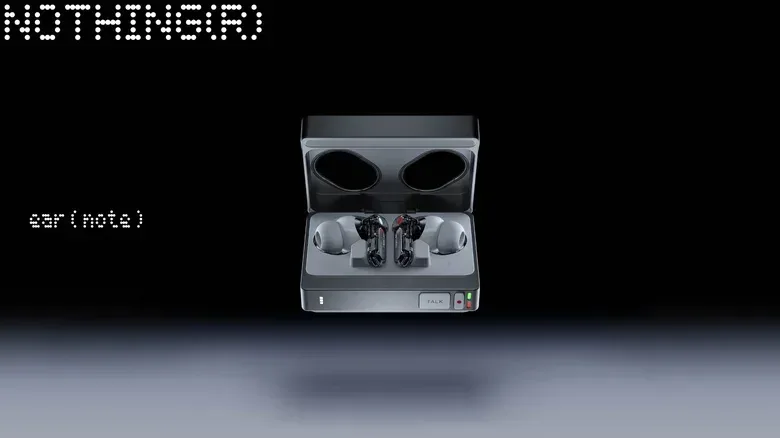
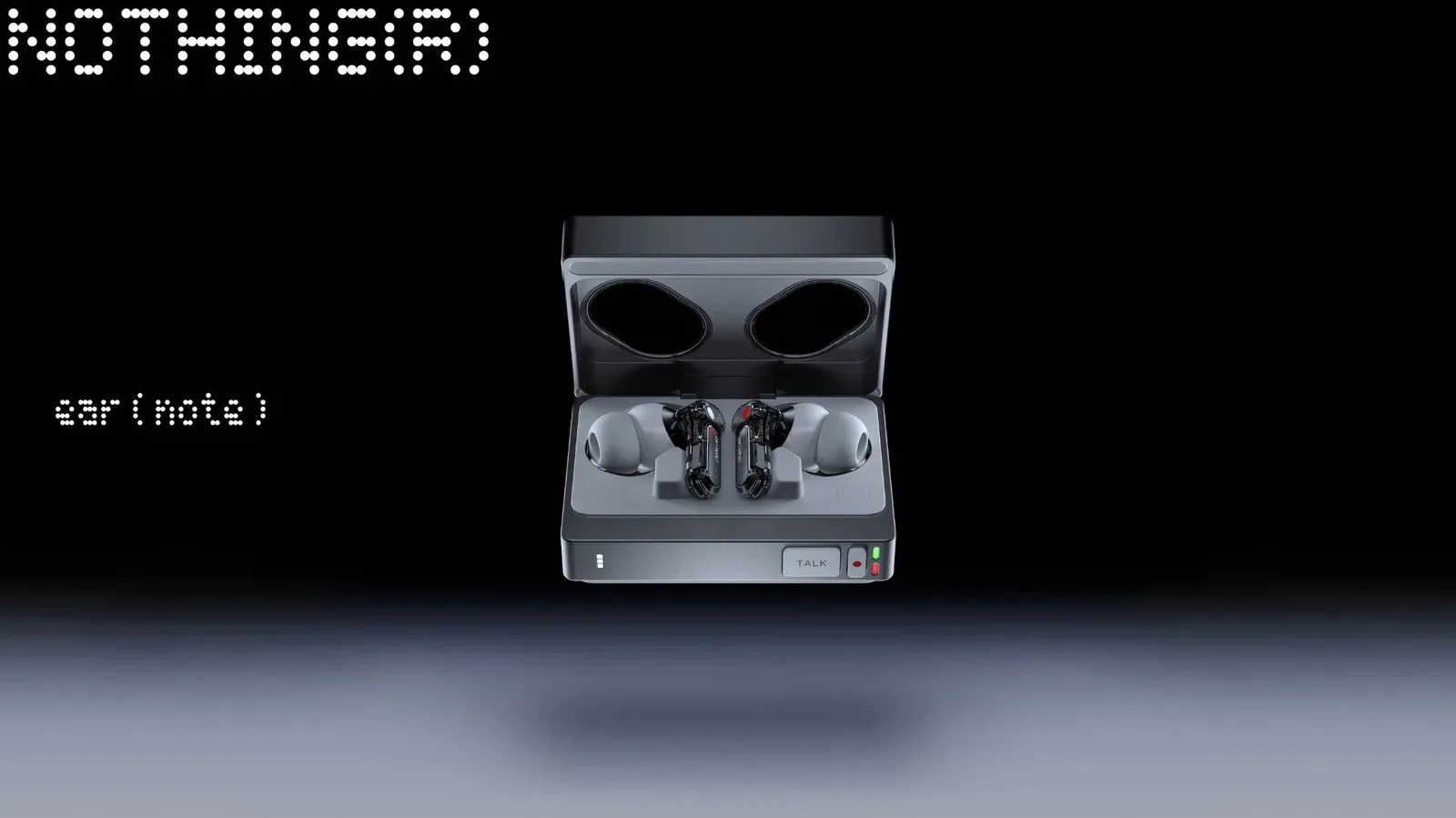
The Ear (note) case has a Sony Walkman-inspired appearance, including an aluminum finish and two controls along its bottom edge: Record and Talk. The supplied details do not explain exactly what each button does, so it would be premature to assign them specific functions beyond their names. Still, their presence is notable.
Dedicated controls can make a feature feel more intentional than one buried in a companion app or accessed through a sequence of taps. For a product concerned with capturing fleeting speech, physical buttons also fit the broader premise: a useful note-taking device needs to be ready at the point an idea, request, or conversation occurs.
The design could be just as important as the AI branding for people who already like Nothing’s hardware aesthetic. The company has made the case an active part of the Ear (note) proposition rather than treating it solely as a charging container. In the limited information available so far, the case is where the product’s recording-oriented identity is most immediately visible.
What has been confirmed—and what remains unknown
There are several firm points, but prospective buyers should separate those from assumptions that often attach themselves to early AI hardware announcements.
- Confirmed: Ear (note) is a pair of earbuds from Nothing.
- Confirmed: It is described as the company’s first AI-native device.
- Confirmed: The product is intended to transcribe and summarize in-person conversations, calls, online meetings and voice memos.
- Confirmed: Traditional audio playback and Hi-Res audio support are part of the stated feature set.
- Confirmed: The aluminum case has Record and Talk buttons and a Walkman-like design direction.
- Confirmed: Launch is set for December 8.
- Not yet disclosed: Price, complete specifications, and the finer operational details behind the note-taking system.
Those omissions are not minor. Audio hardware is usually judged on areas such as sound, fit, battery life, microphones, connection behavior and controls. For an AI-focused product, there is another layer of practical questions: transcription quality in different situations, the form in which notes are delivered, how summaries are presented, and what controls users have over recordings. Nothing has promised additional details, but none of those points have been specified yet.
It is also unknown from the currently announced information whether all forms of capture are handled in the same way. A voice memo, a remote meeting, a phone call and speech in a room are different audio scenarios. Ear (note) has been announced as supporting all of them, but the product’s performance across those situations cannot be inferred before the company provides fuller information.
AI note-taking earbuds are becoming a recognizable category
Nothing is entering a space that already has at least one direct example. Plaud introduced the AI-oriented Plaud One earbuds in August, showing that transcription-led earbuds are beginning to emerge as a distinct device category rather than an isolated experiment.
That matters because “AI-native” is a positioning statement, not a technical specification by itself. The relevant question for users will be how naturally a product combines its AI utility with its day-to-day role as headphones. Ear (note) will need to make sense when a wearer simply wants to listen to audio, and it will need to make its note features easy enough to reach for when listening is not the priority.
Nothing’s differentiation, based on the information available, starts with design and controls. The Walkman-inspired case is more expressive than a generic charging shell, while Record and Talk make the product’s productivity intent visible. The other differentiators—performance, workflow, price and detailed capabilities—remain to be established.
Why the distinction between recording and notes matters
The promise of an AI notetaking product is not simply that it can preserve audio. Phones and computers already allow people to record speech. The appeal is reducing the work between capturing words and doing something with them.
A raw recording asks the user to listen again. A transcript makes searching and reading possible. A summary is meant to cut through the length of a discussion and foreground its main content. Ear (note) is being presented as a device that addresses those later stages as well as the initial recording.
That is why the exact workflow will be important once it is explained. Different users may value different outputs: a complete written record, a compact recap, or both. Someone making an individual voice memo may want a fast summary; someone reviewing a longer meeting may prefer access to the full transcript as well. Nothing has said that Ear (note) can transcribe and summarize the listed forms of speech, but it has not detailed the output or management experience.
For now, the sensible reading is that Ear (note) is an audio product with a productivity layer, not a fully understood replacement for every existing notes app, recorder or meeting tool. The company has announced the direction; the December 8 launch should clarify the implementation.
A December launch with key questions still open
Nothing’s announcement arrives ahead of December 8 after considerable pre-launch attention. The reveal resolves the core mystery around the device: it is a pair of earbuds, not a more unusual piece of standalone AI hardware. But it also redirects attention to whether the company can make recording and AI-generated notes feel as immediate as its marketing suggests.
The Ear (note) name itself signals the intended blend. “Ear” retains the familiar headphone identity, while “note” makes the additional purpose explicit. This is not an attempt to disguise a recorder as an audio accessory; it is an effort to place a recorder, transcription tool and summarizer inside an accessory people may already carry every day.
For the wider hardware market, the announcement is another example of AI features moving into specific everyday objects rather than appearing only as software on a phone or computer. For Nothing, it is an attempt to make that shift distinctive through industrial design and dedicated controls. Readers watching the next wave of gaming-adjacent consumer technology can also keep an eye on broader industry updates, including this look at platform-specific game award shortlists.
Until Nothing releases its remaining specifications and pricing, Ear (note) is best understood as a clearly defined idea with an incomplete spec sheet: Hi-Res-capable earbuds, a conspicuous recording-focused case, and AI tools meant to convert spoken moments into transcripts and summaries. December 8 is when the company is set to fill in the rest.