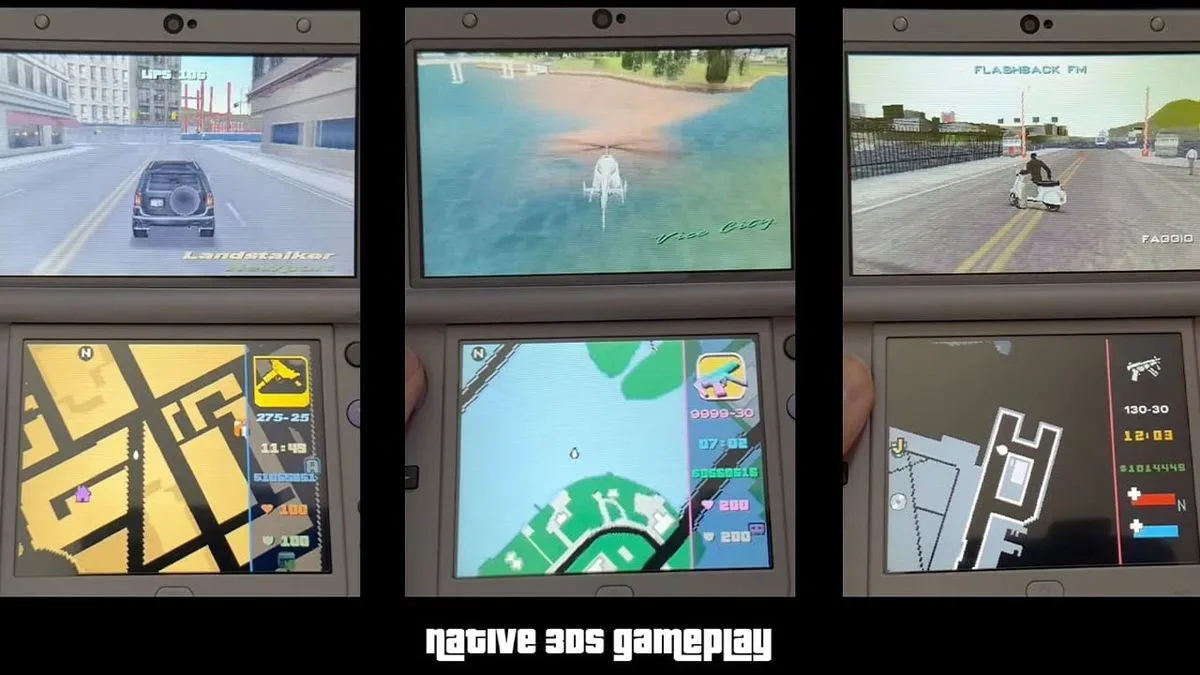
Grand Theft Auto III, Grand Theft Auto: Vice City and Grand Theft Auto: Liberty City Stories are now represented in a fan-made Nintendo 3DS project called the reGTA Collection. Created by EpicReds0817, the work adapts the reverse-engineered re3, reCV and reLCS versions of the games for compatible members of Nintendo’s later 3DS hardware family.
The headline is amusingly improbable: three large, open-world Grand Theft Auto games running on a discontinued handheld. The practical details matter more, though. This is not a conventional retail compilation, not a simple download-and-play package, and not a project for every 3DS model. It is a build-it-yourself port with clear hardware requirements, a legal-game-file requirement, and a stated gap in optional-content verification.
For people with the right system and the technical confidence to assemble the builds, the project’s appeal is obvious. Its changes are not limited to forcing old games onto a smaller screen. Each title has a dedicated lower-screen presentation, controls restructured for the handheld, map display options, touch input and a cheat-code keyboard. Those choices aim to make the dual-screen hardware part of the experience rather than leaving it as an awkward afterthought.
What the reGTA Collection actually is
The project draws on three reverse-engineered efforts: re3 for GTA III, reCV for Vice City, and reLCS for Liberty City Stories. Reverse engineering, in this context, refers to community work that recreates or studies the technical behavior needed to run software in a new form. Here, that work is the foundation for adaptations targeting Nintendo’s handheld hardware.
That distinction is important because the reGTA Collection does not include the commercial game data needed to play. Users are expected to build the ports themselves and supply a legally acquired ROM for each game. The supplied material includes runtime overrides and HOME Menu artwork, but it does not include the executables or the devkitARM toolchain.
In plain terms, this means the project is closer to a technical assembly process than a polished all-in-one release. A toolchain is the collection of software used to create a working build for a target device. The absence of devkitARM from the package means prospective users must obtain and configure the required development components themselves rather than expecting a ready-made executable.
That setup will naturally limit the audience. It also establishes an important boundary: the port materials and the game content are separate pieces. Anyone assessing the project should avoid treating its availability as an official reissue of these games for 3DS hardware.
New Nintendo 3DS hardware is a requirement, not a recommendation
The reGTA Collection requires the additional processing power and memory available in the New Nintendo 3DS family. Compatible systems are the New Nintendo 3DS, New Nintendo 3DS XL and New Nintendo 2DS XL, along with systems capable of playing 3DSX builds.
Related coverage includes reGTA Collection Brings GTA III, Vice City and Liberty City Stories to New Nintendo 3DS Hardware.
Original 3DS and 2DS models are not supported. That is one of the most consequential details in the project’s release information, especially because “3DS” is often used as casual shorthand for several related machines. In this case, the distinction is decisive. Owning a standard 3DS or original 2DS is not enough.
There is a useful practical lesson for anyone revisiting aging hardware: check the precise model before spending time on installation steps. A New Nintendo 3DS-family label is central to compatibility here, while the original models lack the headroom the port needs. The project’s ambitions may concern old games, but its baseline is specifically the more capable revision of Nintendo’s handheld line.
The lower-screen additions also make particular sense on that hardware. Maps can be placed on the second display rather than repeatedly occupying the main play view, while touch controls provide another input path. The included cheat-code keyboard is especially notable as a handheld quality-of-life feature: entering text-based cheats through a dedicated interface is a more natural fit than attempting to map that task solely to physical controls. Readers interested in another recent example of developers engaging openly with cheat functionality can see how Valheim approached achievement restoration through a dev command.
GTA III: blue interface, streaming work and crash fixes
GTA III uses a dark-blue lower-screen interface in the reGTA Collection. Its listed technical work includes faster loading and smoother streaming, the removal of motion blur, corrected vehicle materials, and fixes for several crashes.
Streaming is the ongoing loading of game-world material while a player moves through it. In a city game, the ability to bring in needed data efficiently is closely tied to keeping the world functional during travel. The project specifically identifies smoother streaming and faster loading as goals for this version, though it does not provide benchmark figures. It is therefore safest to regard these as stated port improvements rather than make unsupported claims about exact performance.
The removal of motion blur is also a concrete visual choice. Motion blur is an effect used to soften or streak fast movement. Its absence may make the image read differently on the handheld screen, but whether that is preferable will depend on individual taste. More objectively, vehicle-material corrections and crash fixes target presentation and stability issues rather than adding new game content.
For the final mission, the build lists “Push It to the Limit” as its music selection. That is a specific project detail rather than a broader promise about the game’s entire audio presentation, so prospective players should keep their expectations focused on what has actually been identified.
Vice City: a pink touchscreen identity and visual repairs
Vice City receives a pink lower-screen interface, distinguishing it immediately from GTA III’s blue layout. Its listed changes include faster loading, restored particles and vehicle highlights, fixes for character and vehicle polygons, water seams, and crashes associated with flight.
Several of those terms describe visible parts of a 3D game world. Polygons are the geometric building blocks used to form characters, vehicles and environments. A polygon fix can therefore address an object’s shape or rendering. Particles are small visual elements used for effects, while vehicle highlights refer to light-responsive details that contribute to a vehicle’s appearance. Water seams are unwanted visible joins or discontinuities in water rendering.
Collectively, those fixes suggest attention to the parts of a city game players repeatedly see while driving, moving through the world and taking to the air. Still, the project description does not offer a comprehensive accounting of every graphical or gameplay difference. The more cautious reading is that these are named repairs, not a guarantee that every legacy issue has been eliminated.
Vice City’s final mission is listed with “Self Control” as its music. Like GTA III’s listed mission track, it is one of several title-specific details that give the project separate identities rather than treating the three games as identical technical conversions.
Liberty City Stories has the broadest stated campaign work
Liberty City Stories is the entry with the most substantial campaign-related note. The project completes the previously unfinished reStories/reLCS campaign implementation for New Nintendo 3DS hardware. It also uses a red lower-screen interface and lightweight vehicle reflections.
The listed fixes cover missions, saves, world changes, cutscenes and vehicle bugs. That scope is particularly meaningful because these systems are intertwined in a story-driven open-world game. Missions and cutscenes structure progression; saves preserve it; world changes can reflect the consequences or state of that progression. Fixes in these areas speak directly to the feasibility of completing the central campaign on the target device.
“Lightweight” vehicle reflections point to a compromise designed for the handheld environment. The description does not define the exact rendering method or compare it with other versions, so it would be inappropriate to infer more than the stated intent: reflections are present in a less demanding form. The build also supports custom text cheats and lists “Chase” for the final mission’s music.
Most importantly, the main story of Liberty City Stories is described as playable all the way through, alongside the main stories of GTA III and Vice City. That is the core achievement of the collection. It establishes a campaign-complete target for all three games on supported New Nintendo 3DS-family machines.
The major caveat: optional activities have not been fully verified
Campaign completion should not be confused with complete verification of every possible activity. EpicReds0817 has indicated that side missions and other optional activities have not yet been verified. That limitation applies to how the collection should be discussed and approached.
For a player focused on story progression, the stated main-campaign status is encouraging. For completionists, players who prioritize side activities, or anyone intending to test every corner of each city, the unverified status is material. It does not mean those activities necessarily fail; it means the project does not currently make a confirmed claim that they have all been checked.
This is a healthy example of uncertainty being named rather than buried. Fan projects can be technically impressive without being feature-complete in every respect, and the distinction lets users decide whether the current build meets their needs. It is also a reminder to keep backups of saves where possible when experimenting with a project that lists save-related fixes and still has unverified optional content.
A handheld conversion built around trade-offs
The reGTA Collection’s most interesting design decision may be its willingness to adapt. It restructures controls, assigns each game a separate lower-screen color scheme, makes room for maps and touch input, and identifies targeted improvements and corrections across the trilogy. Rather than presenting the 3DS merely as a smaller display, the project uses the machine’s second screen and touchscreen as part of the interface.
There are boundaries on every side of that achievement. Only newer 3DS-family hardware qualifies. Users must build the ports and add legally acquired game ROMs. The package does not provide executables or the devkitARM toolchain. And while all three main stories are described as playable through to completion, optional activities remain unverified.
Those caveats do not diminish the underlying technical curiosity: GTA III, Vice City and Liberty City Stories have been adapted to run on New Nintendo 3DS hardware through community-led reverse-engineering work. For technically minded owners of the compatible models, it is a project worth understanding on its actual terms—an ambitious, user-built handheld port collection with clear requirements, deliberate interface changes and honest limits around what has and has not yet been tested.