Observer: System Redux – Limited Edition is scheduled to arrive physically for Nintendo Switch 2 on October 28, 2026. The cartridge release gives Bloober Team’s first-person cyberpunk detective horror story a new boxed edition, with Meridiem designing and manufacturing the package.
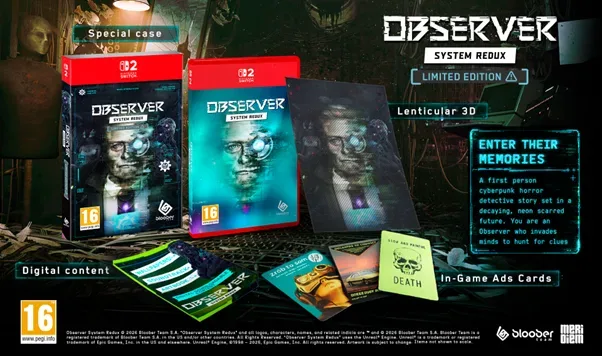
This is more than a standard game case with a more dramatic name stapled to it. The Limited Edition includes the Nintendo Switch 2 cartridge, a special case, a lenticular 3D postcard, in-game advertising cards and digital content. That places the release at the meeting point of a physical console-game edition and an in-universe presentation piece: the included ad cards are especially appropriate for a story about corporate power, neural technology and an oppressive future.
For people tracking physical Switch 2 releases, the key detail is simple: this edition is explicitly described as a cartridge release rather than a download code packaged in a retail box. That distinction can matter to buyers who value shelf copies, collectors who want the game media itself included, or players who simply prefer a physical game to accompany any downloadable material.
A detective story where the evidence is inside someone’s mind
Observer: System Redux is set in 2084, after a succession of catastrophes has transformed society. The Nanophage, a digital plague, killed many augmented people. A subsequent war left entire regions devastated. Corporations then filled the power vacuum, establishing exploitative empires in the ruins.
That premise supplies the game’s central tension. Technology is not merely environmental decoration in this version of the future; it is inseparable from identity, health, memory, policing and control. Virtual realities, neural implants and mind-altering drugs are common forms of escape, but the game’s world does not treat a person’s inner life as private. Even a thought can become a place to investigate.
Players take the role of Daniel Lazarski, an Observer portrayed by Rutger Hauer. An Observer is a corporate instrument capable of hacking into suspects’ minds. Lazarski’s work involves entering dreams, uncovering fears and retrieving memories to move an investigation forward. It is a detective framework, but one whose clues are emotional, fragmented and potentially distorted rather than simply left at a crime scene.
What “neural detective” means here
The term neural detective describes the game’s investigative role. Rather than relying only on external traces, Lazarski accesses what a suspect felt, thought or remembered. In practical narrative terms, that allows evidence to emerge from subjective recollection. A memory may contain a clue, but it can also carry fear, trauma or the warped logic of a dream.
The approach fits cyberpunk horror particularly well. Cyberpunk commonly examines how powerful institutions shape life through technology and commerce. Horror, meanwhile, turns vulnerability and uncertainty into pressure. Observer: System Redux combines those ideas by making the human mind both an investigative resource and an exposed territory. The detective has extraordinary access, yet that access is also an intrusion enabled by the corporate system he serves.
The supplied details describe Lazarski as a tool of corporate oppression, not an uncomplicated hero. That framing matters. The game’s mystery is not only about extracting the right clue; it also asks players to inhabit a role built around violating the boundaries of people who are vulnerable, desperate or unable to resist.
The Dream Eater and the game’s horror vocabulary
A central device is the Dream Eater, which lets Lazarski enter the minds of the dead and dying. Through those invasions, players relive final moments, traverse neural mazes and search for information. “Neural maze” is an evocative description of a mind-space shaped by memory and perception rather than dependable physical geography.
That makes the device a clear bridge between the game’s detective mechanics and its horror atmosphere. A conventional investigation usually moves from place to place, gathering physical testimony and objects. Here, the decisive location may instead be a person’s final experience. The value of the clue is inseparable from the disturbing circumstances of retrieving it.
The setting further raises the stakes. Augmentation is widespread enough that a digital disease can kill augmented people, and neural technology is integrated into the broader culture. In such a world, a hacked mind is not a far-fetched anomaly. It is the darkest extension of a society already accustomed to implants, virtual experience and technological dependence.
In 2084, escape through virtual reality, drugs and neural implants is common—but privacy of thought is no longer guaranteed.
That is the essential promise of the game’s setting: neon-lit futurism stripped of any reassuring polish. The future is decaying rather than triumphant, the corporations are crooked rather than visionary, and the tools that might offer relief can also make people easier to exploit.
What comes in the Nintendo Switch 2 Limited Edition
Meridiem’s Nintendo Switch 2 Limited Edition contains the following announced items:
- A physical Nintendo Switch 2 cartridge of Observer: System Redux.
- A special case for the release.
- A lenticular 3D postcard, using an image treatment that changes with the viewing angle to create a sense of depth or motion.
- In-game ad cards, physical cards built around the game’s fictional advertising aesthetic.
- Digital content.
The announcement identifies digital content as part of the package, but does not specify its exact form. Buyers looking for a particular add-on should avoid assuming it means a soundtrack, art book, cosmetic pack or expansion: those details have not been provided.
Likewise, “Limited Edition” establishes the product name and a bundle of extras, but no edition size or numbered-run information has been stated. It is therefore best understood as a special packaged edition, without drawing conclusions about total production quantity or future scarcity.
Why the cartridge detail is worth separating from the extras
Physical-game announcements can involve several different arrangements: a disc or cartridge can hold the game, a package can include a code, or a product can combine physical media with digital bonuses. This release is specifically identified as a Nintendo Switch 2 cartridge edition, so the game itself is represented by physical media. The digital content is an additional component, not the only stated route to the game.
That clarity is useful in a market where packaging can look like a conventional physical release while relying substantially on code redemption. Buyers interested in regional compatibility and code-based content still have reason to read product details closely. Questions around boxed software and region matching can be consequential, as seen in the broader discussion of code-in-box rules and imported games. No region or redemption terms for this particular edition have been detailed here, so those specifics remain unconfirmed.
A fitting package for Observer’s fictional world
The extras appear selected to reinforce the fiction rather than simply accumulate unrelated items. A lenticular postcard suits a game concerned with altered perception and unstable realities. The ad cards are a natural extension of the setting’s corporate dominance: advertising is not a neutral background detail in a world where corporations have seized influence in the aftermath of catastrophe.
That cohesion is important for a collector-focused edition. The case, postcard and cards can function as physical artifacts of the game’s atmosphere, not merely as a list of bonuses. They emphasize the contrast at the heart of Observer: System Redux: a stylish, high-tech future whose visual surface is inseparable from decay, surveillance and coercion.
For players new to the game, the most relevant expectation is not an action-led cyberpunk power fantasy. The announced description centers on first-person investigation, psychological horror and mind-hacking. Daniel Lazarski’s ability to enter memories is presented as a means of uncovering evidence, while the Dream Eater turns dead and dying minds into unsettling investigative spaces.
For returning fans and physical-edition buyers, the October 28 release offers a Nintendo Switch 2 cartridge presentation with an accompanying set of themed materials. The announcement confirms the date, platform, cartridge format and listed contents; it does not provide pricing, pre-order information, a production total or further detail on the digital content. Those are the boundaries of what is currently known.
What is clear is the game’s identity. Observer: System Redux puts players in a grim 2084 where human memories can be entered, mined and weaponized. Its Limited Edition takes that premise off-screen with a physical package designed around the same uneasy marriage of sleek technology, corporate imagery and psychological dread.