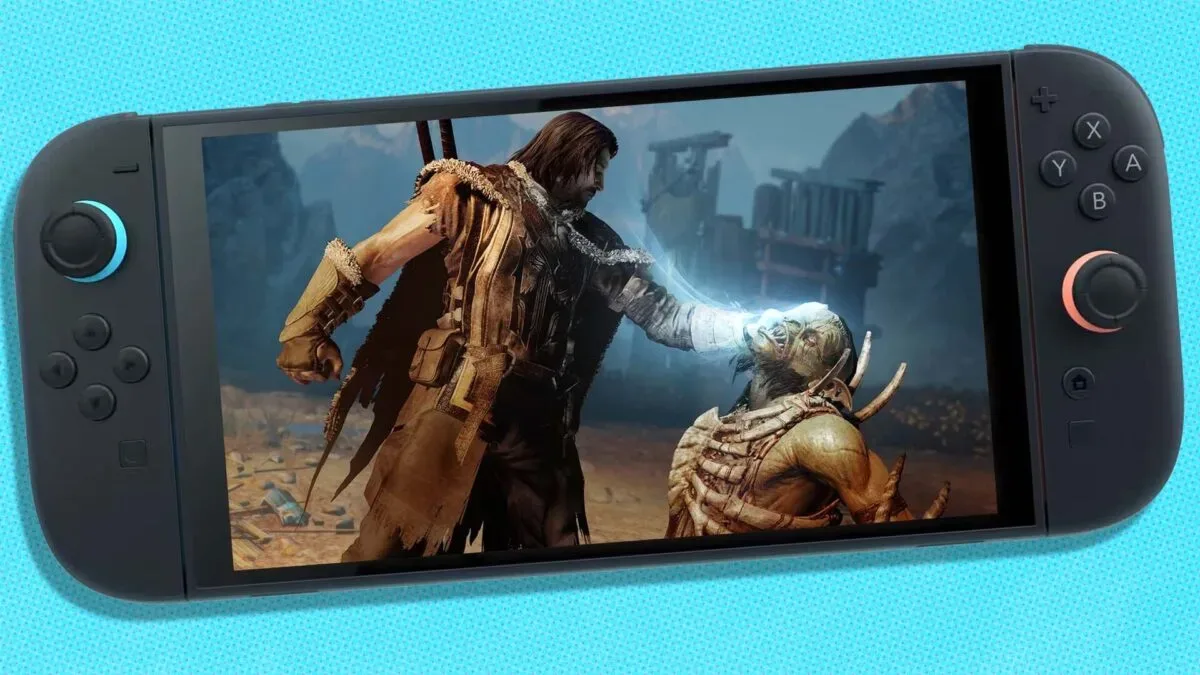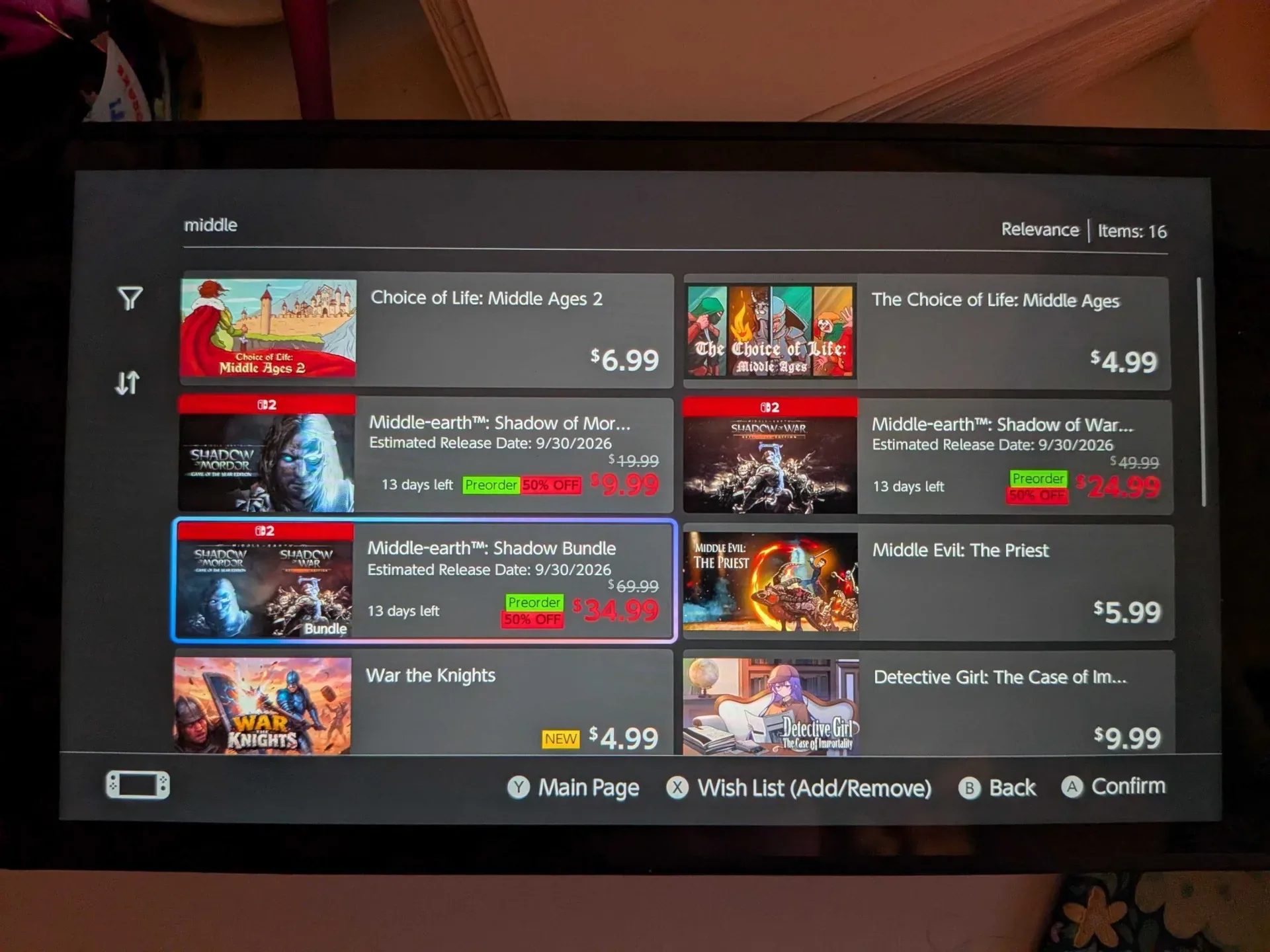
Middle-earth: Shadow of Mordor and Middle-earth: Shadow of War are coming to Nintendo Switch 2 on September 30. Store pages for both games appeared on the Nintendo Switch 2 eShop before Aspyr subsequently released a short trailer, turning an unexpected listing into a very real double dose of Uruk-related workplace drama.
The releases are notable for a simple reason: neither game has previously appeared on a Nintendo system. The pair originally launched in 2014 and 2017, respectively, after making their names across PC, Xbox, and PlayStation. For fans who have wanted the series on Nintendo hardware, this is the long-awaited arrival of two games built around one unusually personal idea: enemies that do not simply vanish into the background after a fight.
Both Switch 2 editions include their expansion or Season Pass content. The eShop pricing lists Shadow of Mordor at $20 and Shadow of War at $50, while a bundle containing both is $70. For the two-week introductory sale period, those prices fall to $10, $25, and $35 respectively.
Two games, one famously vindictive enemy system
The defining feature of both games is the Nemesis system. In practical terms, it tracks enemies a player encounters. Those enemies can grow stronger between meetings, remember prior clashes, and respond to the tactics used against them. A foe that survived a battle is therefore not necessarily an interchangeable replacement in the next encounter; the system is designed to make a later confrontation feel connected to what happened before.
For more context, explore A$AP Rocky Plays Stockholm Again During the Don’t Be Dumb World Tour.
That premise is a major reason the games remain distinctive years after their original releases. Many action games have elite enemies, rival characters, or recurring bosses. The Nemesis system’s role here is to carry forward the relationship between player and opponent. Winning, losing, escaping, or leaving someone alive can shape the next meeting. The result is a framework intended to generate stories from play rather than relying only on fixed story scenes.
It also explains why a Nintendo debut matters beyond another pair of catalogue ports. This is not merely a chance to put two well-regarded Middle-earth action games into a new digital storefront. It gives Switch 2 players access to a central design idea that has long been associated with the series: the possibility that an enemy remembers precisely why they have a grudge.
What is included, and what the prices mean
There are three ways to buy into the Switch 2 releases:
- Middle-earth: Shadow of Mordor — $20 standard price; $10 during the initial two-week sale.
- Middle-earth: Shadow of War — $50 standard price; $25 during the initial two-week sale.
- The two-game bundle — $70 standard price; $35 during the initial two-week sale.
At both the standard and sale prices, the bundle equals the combined cost of buying the two titles separately. That means the decision is less about finding an additional bundle discount and more about whether a player wants both chapters immediately. The important inclusion is that each game comes with its expansion or Season Pass material already incorporated, so buyers are not being presented with a base-game price followed by a separate listed add-on requirement.
The sale offers the clearest entry point for anyone new to the series. At $10, Shadow of Mordor is the lower-cost way to see whether its action and enemy-rivalry structure clicks. At $35, the bundle covers both games and their included additional content during the same promotional window. Players who know they only want the later game, meanwhile, can choose Shadow of War on its own for $25 during that period.
Why the timing stands out
The route to this news was slightly unusual. A Reddit user first noticed the eShop pages, where there had been no previously announced Switch 2 versions. Aspyr then released a short trailer while attention was gathering around the listings. The September 30 date is therefore not an old rumour resurfacing; it is a near-term release attached to live storefront pages and a trailer.
Aspyr is known for work bringing Tomb Raider and Star Wars titles to other platforms, making it a natural name to watch on a project that brings established games to a new console. But the available information is focused on the essentials: the release date, the editions’ included expansion content, and their digital pricing. No further platform-specific feature list has been detailed here, so expectations about performance, controls, or other technical differences should remain separate from what has actually been confirmed.
That distinction is useful whenever an older game reaches a new platform. A port is a version adapted for different hardware, but the word alone does not establish resolution, frame rate, interface changes, or any other technical characteristic. For now, the confirmed appeal is the games themselves, their complete-content positioning, and their first appearance within Nintendo’s ecosystem.
A first Nintendo stop for a celebrated pair
Shadow of Mordor arrived in 2014, followed by Shadow of War in 2017. Both were widely acclaimed by critics and players, and each has already been available on PC, Xbox, and PlayStation. Their move to Switch 2 finally closes the Nintendo-shaped gap in that platform history.
For someone approaching them fresh, the simplest expectation to bring is not an elaborate checklist of unconfirmed port features. It is an action-focused Middle-earth experience whose signature mechanic gives enemies continuity. The tracked foes can become more powerful after encounters and react to the prior battle. That gives defeat and survival a potential narrative aftertaste: an enemy may return not as anonymous opposition, but as somebody shaped by a previous run-in.
For returning players, the appeal is more straightforward. These are complete versions of two familiar games reaching a platform where they have never been available before. The September 30 launch puts both on the eShop at once, so there is no staggered wait between the two entries. Players can begin with Shadow of Mordor, jump directly to Shadow of War, or buy only the installment they prefer.
The practical takeaway for Switch 2 owners
If the September 30 release date is the deciding factor, the immediate choice is whether the introductory pricing is worth acting on. The discounts reduce each title by half, and the complete-content inclusion means the listed purchases cover the games alongside their expansion or Season Pass material. The sale is described as lasting two weeks, so anyone interested in the reduced prices should pay attention to the eShop promotion window rather than assume it will remain indefinitely.
The other headline is historical rather than financial: this is the first Nintendo outing for either game. After years on PC, Xbox, and PlayStation, the two Middle-earth releases are arriving together on Switch 2 with the system that made their enemies memorable still at the center of the pitch.
For additional release-date coverage, see this Switch 2 launch report.