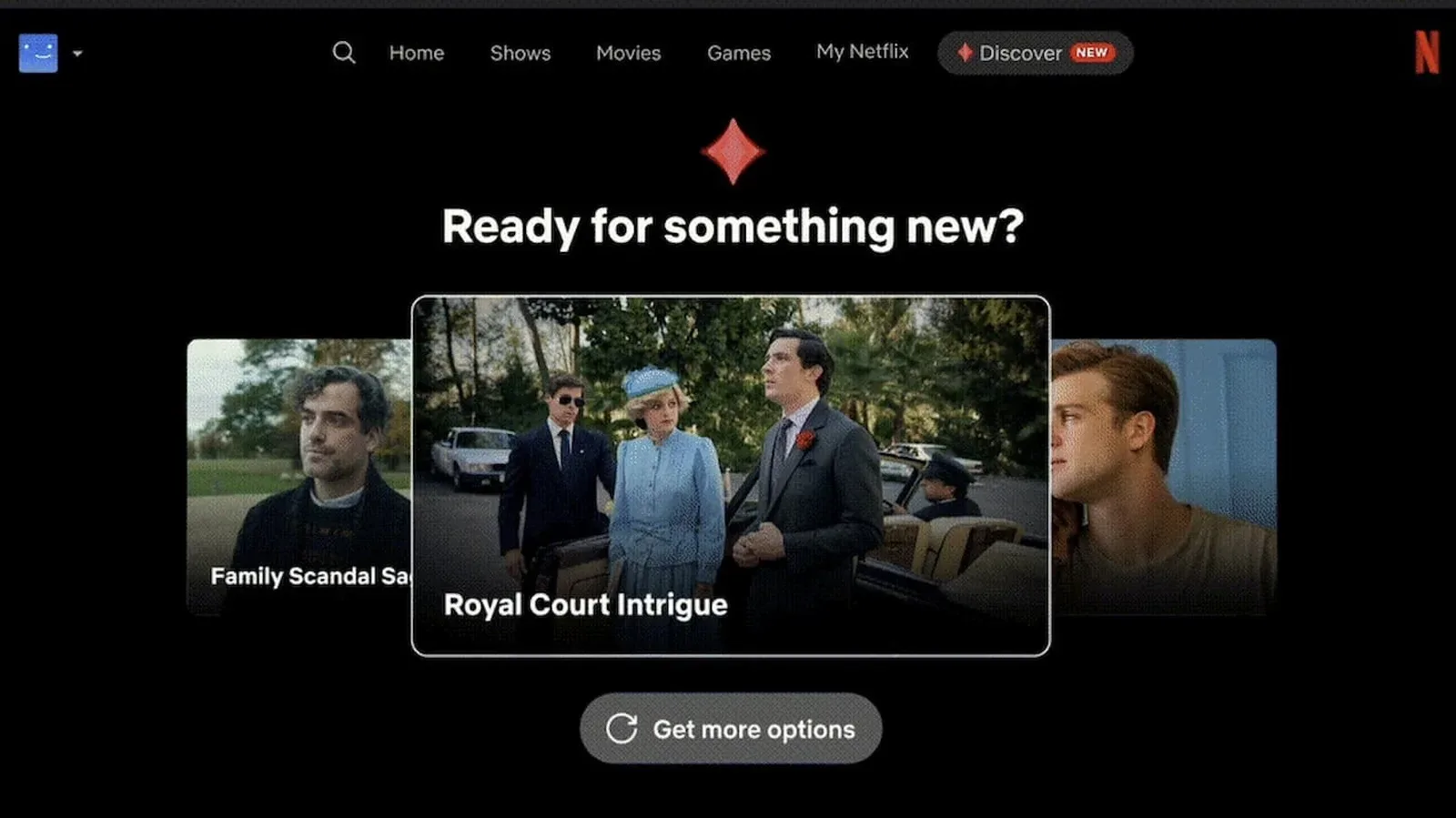
Netflix is testing a new way to answer one of streaming’s most familiar questions: not whether there is anything available to watch, but whether there is anything that fits right now. The feature, called AI Discover, is rolling out to eligible members in the US who use Netflix in English on supported TVs, with a broader gradual release planned in the weeks ahead.
Rather than beginning with a title, actor, genre, or a long shelf of artwork, AI Discover begins with a small set of themes. Netflix’s examples include Outsmart Everyone, Family Scandal Sagas, and Royal Court Intrigue. A viewer picks a theme, receives recommendations connected to it, and can then move through increasingly specific themes in search of a film or series. If the route is a dud, a Something Different option starts another path.
It is a modest change to the familiar recommendation interface, but an interesting one. The apparent goal is not simply to add another row of suggested programming. It is to give people a way to express situational intent: a mood, the people in the room, or the amount of time available. Netflix says its prompts can also draw on recent viewing activity and currently popular choices.
Where AI Discover lives and how the flow works
AI Discover sits at the far right of the top navigation bar in Netflix’s TV app. Once opened, it presents its initial set of themed prompts. Selecting one produces recommendations and more narrowly framed themes, creating a branching route toward something to play.
That distinction matters because conventional streaming discovery often starts with an enormous catalog and asks the person watching to reduce it themselves. AI Discover instead asks for a looser signal first. “Royal Court Intrigue,” for example, is not a traditional catalog filter in the way that “drama” or “historical” might be. It is a compact description of a desired flavor of viewing.
The available evidence does not establish every theme the feature can generate, how many titles appear in each step, or the precise information used to rank any particular recommendation. What Netflix has described is a system that can work from several kinds of context:
- the feeling a viewer is looking for;
- who is watching together;
- how much time the viewer has;
- recent watch history; and
- trending selections.
Those inputs are important because they recognize that “recommendation” can mean different things on different nights. A person may like a particular kind of show in general but not want it during a short break, while watching with family, or when looking for a specific emotional tone. AI Discover is intended to make those moment-to-moment constraints part of the discovery process.
A recommendation tool that asks for feedback
Alongside the usual My List and Play controls, Netflix is adding a Tune Your Recommendations button for AI Discover suggestions. Viewers can save a recommendation or indicate that they are not interested in a title. Netflix says a rejection will be remembered within AI Discover so that the same selection does not continue to surface there.
In practical terms, this is a feedback control. A positive signal tells the service that a recommendation was worth retaining, while a negative signal tells it that a particular result should not be pushed again in this part of the experience. It is more direct than merely skipping past artwork, because it gives the viewer an explicit way to correct the tool.
Netflix describes the system behind AI Discover as a new “intelligence layer” that responds to what members communicate in real time and continues learning. Here, “real time” should be understood as an interaction claim: the experience is meant to adjust as a person makes choices and gives feedback, rather than functioning as a fixed static list. It does not necessarily mean every aspect of a member’s wider Netflix experience immediately changes after each tap.
That feedback loop will likely be central to whether the experiment feels helpful. The most frustrating kind of recommendation system is one that mistakes a single curiosity click for a lasting preference, or repeatedly offers a title that has already been dismissed. The stated ability to reject suggestions addresses the second problem directly, at least within AI Discover.
Why the themes may be more useful than another search box
A search field works well when a viewer already knows what they want. Discovery is harder when they do not. Someone may be unable to name a show, actor, franchise, or genre, yet still know that they want a clever power struggle, a family-centered scandal, or a story built around political maneuvering.
AI Discover’s theme-first approach is designed for that gap between knowing a title and knowing a vibe. Its prompts translate a vague preference into a starting point that can be refined. The tool can also theoretically reduce the pressure of choosing perfectly on the first attempt: a viewer can select Something Different rather than backtracking through multiple rows or abandoning the app altogether.
There is also a social dimension. A household trying to agree on a pick does not always have a shared favorite franchise, but it may have a shared condition: something suitable for everyone present, something quick, or something that matches a collective mood. Netflix specifically says the feature can account for the people someone is watching with and for available time, although it has not detailed exactly how viewers will provide those signals in the TV interface.
Netflix is calling this a “test kitchen,” not a finished destination
Netflix frames AI Discover as a “test kitchen” for discovery ideas. That wording is significant. The company says user activity and feedback will help determine what it retains, improves, or tries next, and that some experiments could eventually move into the primary Netflix experience.
For viewers, the immediate implication is that AI Discover should be treated as an evolving test rather than a permanent, final redesign of Netflix navigation. Prompts, presentation, and recommendation behavior could change as more people use it. The company has not said that every component of the current experiment will become standard across its service.
The rollout is also limited at the outset. It is for US-based members using Netflix in English on supported television sets. That means users outside the US, people using other languages, or viewers on unsupported TV hardware may not see it during the initial phase. Netflix says the release will expand gradually over the following weeks, but no complete geographic, language, or device timetable has been provided.
AI in entertainment discovery is increasingly about the interface
Entertainment platforms are experimenting with AI in several forms. Some approaches actively generate or present programming, while others focus on helping people navigate enormous libraries. Netflix’s current effort belongs to the latter category: AI Discover is positioned as a recommendation and discovery layer, not as a tool for making shows or movies.
The broader direction is visible elsewhere in media technology. For instance, Sonos’ voice-feature rollout similarly centers on natural-language requests as a way to make finding audio less mechanical. The common idea is that users may prefer describing an outcome in ordinary language or broad intent instead of navigating a rigid collection of filters.
Netflix’s version is narrower in the information currently available: it gives viewers generated or selected themes to choose among, then follows that choice with more focused options. There is no basis here to assume it accepts fully open-ended written or spoken requests, nor to assume it will replace Netflix search, My List, or existing recommendation rows.
What to watch as the test reaches more viewers
The meaningful question is whether the feature improves choice without making the process feel like another chore. Theme labels need to be clear enough to quickly communicate what they promise. The successive suggestions need to become more useful rather than merely more specific. And the negative-feedback control needs to prevent rejected titles from feeling like recurring unwanted guests.
There is an unavoidable trade-off in any personalized system. More tailoring can make a large catalog easier to navigate, but it can also steer attention toward the patterns the system has inferred from earlier behavior. AI Discover’s Something Different option is therefore more than an escape hatch: it is the feature’s stated way to interrupt a recommendation path when it has misunderstood the moment.
For now, AI Discover is best understood as a TV-focused experiment in guided browsing. It gives Netflix viewers a new route into its catalog through mood, company, time, history, and trending context, while offering explicit save and reject controls along the way. Whether it becomes a lasting part of Netflix will depend on how well those routes help people reach the deceptively difficult final step: pressing Play.