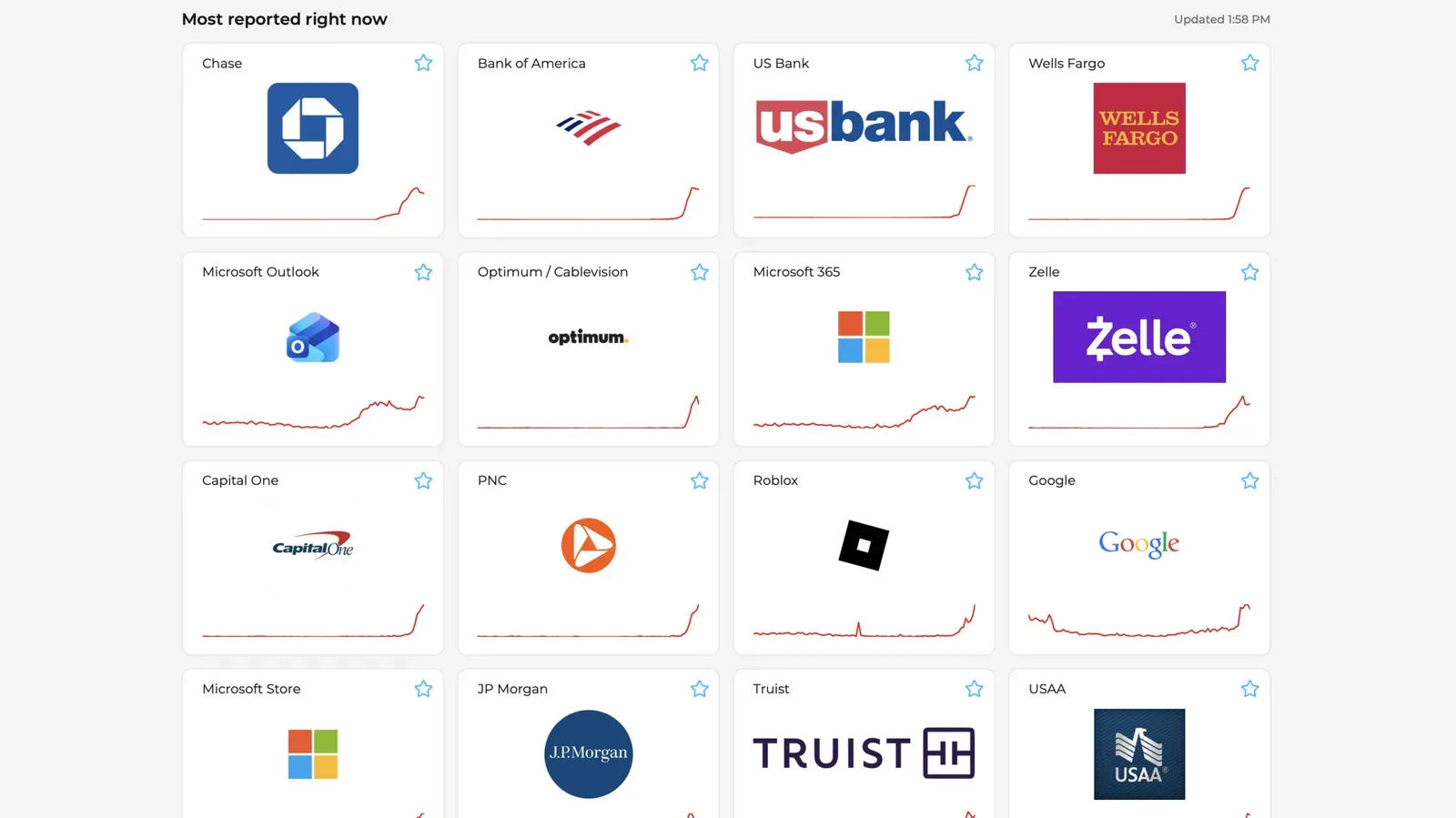
Customers of several major US banks and financial-services platforms reported difficulty accessing accounts and completing digital transactions on November 16, as reports of outages and degraded service rose through the day.
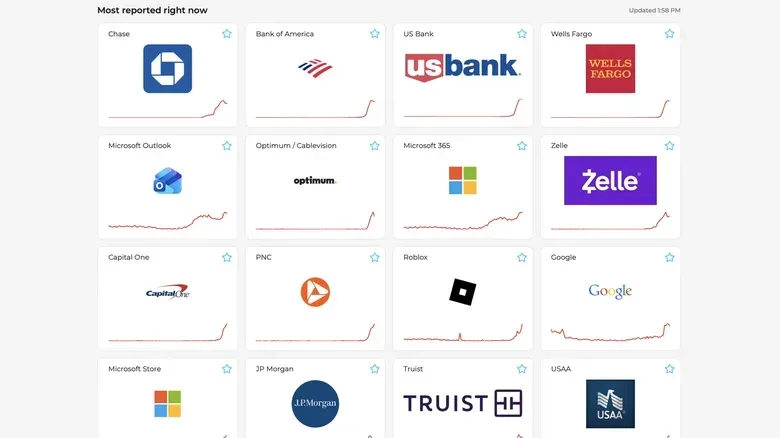
Chase, Bank of America, US Bank and Wells Fargo were among the most-reported services by mid-afternoon, while Zelle, Capitol One, PNC, JPMorgan and Truist also showed elevated reports of unavailability. The timing was not uniform: reports for some institutions began climbing at roughly 10AM ET, while others saw sharper increases later in the afternoon.
The available statements point to an operational disruption rather than a confirmed security incident. A Chase representative said customers could encounter slower transaction processing because of a technical issue and said it was not a cybersecurity problem. US Bank also indicated that some clients could see delays when sending or receiving Zelle payments.
What customers may be experiencing
An online-banking issue does not necessarily mean every customer or every function is offline. A service can be available for some actions while other actions are delayed, fail to load or take longer than expected to finish.
For more context, explore LeBron James Exquisite Rookie Patch Auto Leads a $4.68M Week in Sports Card Sales.
In this case, the two specifically described effects were slower transactions at Chase and possible Zelle payment delays for US Bank clients. Public user reports also indicated problems spanning account access and broader service availability at multiple organizations. That distinction matters: a delayed payment and an inaccessible account page are both disruptive, but they can arise in different parts of a bank’s digital operation.
For customers, the immediate practical concern is status rather than speculation. A transaction that appears to hang or remain pending should not automatically be submitted again. Repeating a payment can create confusion if the original request later completes. Likewise, a recipient waiting on a Zelle transfer may need to allow time for the payment status to update before treating it as a failed transfer.
Technical issue versus cybersecurity incident
The wording from Chase is significant because large-scale banking disruptions can prompt understandable concern about compromised accounts or criminal activity. A technical issue generally refers to a problem involving the systems used to operate a service: software, infrastructure, integrations, authentication flows or transaction processing. It does not, by itself, identify the precise component that failed.
A cybersecurity incident, by contrast, concerns an event that threatens the confidentiality, integrity or availability of systems or data through a security-related cause. Chase said the problem was not a cybersecurity issue. That statement should not be stretched beyond what it says: it describes the nature of the reported disruption, not a detailed explanation of root cause, repair timing or the scope of every affected customer action.
There is also no supplied indication that the various institutions were all affected by one confirmed shared failure. Multiple banks appearing in outage-reporting data at around the same time can be important, but it is not proof that they use the same affected system or that a single event caused every report. The institutions began seeing report spikes at different times, and the information available does not establish a common cause.
Why payment delays can feel like an outage
Digital banking depends on more than a customer being able to sign in. A payment must be accepted, processed and reflected in the relevant records. If any part of that sequence is slow, customers may see a pending transaction, a delayed notification or an apparent failure even when an eventual completion remains possible.
Zelle is a particularly visible example because it is used for sending and receiving money between people. A delay can affect both sides of the payment: the sender may be unsure whether funds left their account, while the recipient may be waiting for money that has not appeared. US Bank’s warning specifically covered both sending and receiving through Zelle.
That does not mean every delay has the same explanation, nor does it establish how long any individual payment will take. It does show why communications from affected institutions are useful during a disruption. Customers need to know whether they are seeing a login problem, an inability to initiate a payment, a delay in processing or a temporary issue displaying information.
What is known—and what remains unclear
Several points are established by the reports and bank statements: customers reported service trouble across a group of banks and payment services; the volume of reports increased over the course of November 16; Chase cited a technical issue behind slower transactions; and US Bank warned of potential Zelle delays. Chase also said its issue was not cybersecurity-related.
Much remains unconfirmed. There is no supplied technical diagnosis, no confirmed shared origin across the affected companies, no stated restoration schedule and no complete list of features that may have been affected at each institution. Outage-reporting spikes are a signal of customer trouble, not a replacement for a detailed incident report from each company.
It is also worth separating a statement from one institution from claims about the entire group. Chase’s characterization of its issue should not be read as a technical finding for Bank of America, Wells Fargo, PNC, Truist, JPMorgan, Capitol One, Zelle or any other service showing increased reports.
A busy period for high-profile service disruptions
The banking interruptions arrived after other prominent technical problems earlier in the month. Several Microsoft services experienced an outage on November 12. The following day, a problem involving air-traffic-control equipment led the US Federal Administration Authority to issue a nationwide ground stop for flights.
Those events do not establish a connection to the banking disruptions. They do, however, illustrate a broader reality of digitally managed services: issues in systems that normally operate quietly can become immediately consequential when they affect communication, transportation, payments or access to essential account information.
For now, the most responsible reading is a narrow one. Customers at multiple financial institutions reported access and payment difficulties, while the limited comments from Chase and US Bank describe technical delays rather than a cyberattack. Until further details are provided, the cause, relationship between the reported disruptions and full effect on banking functions remain uncertain.