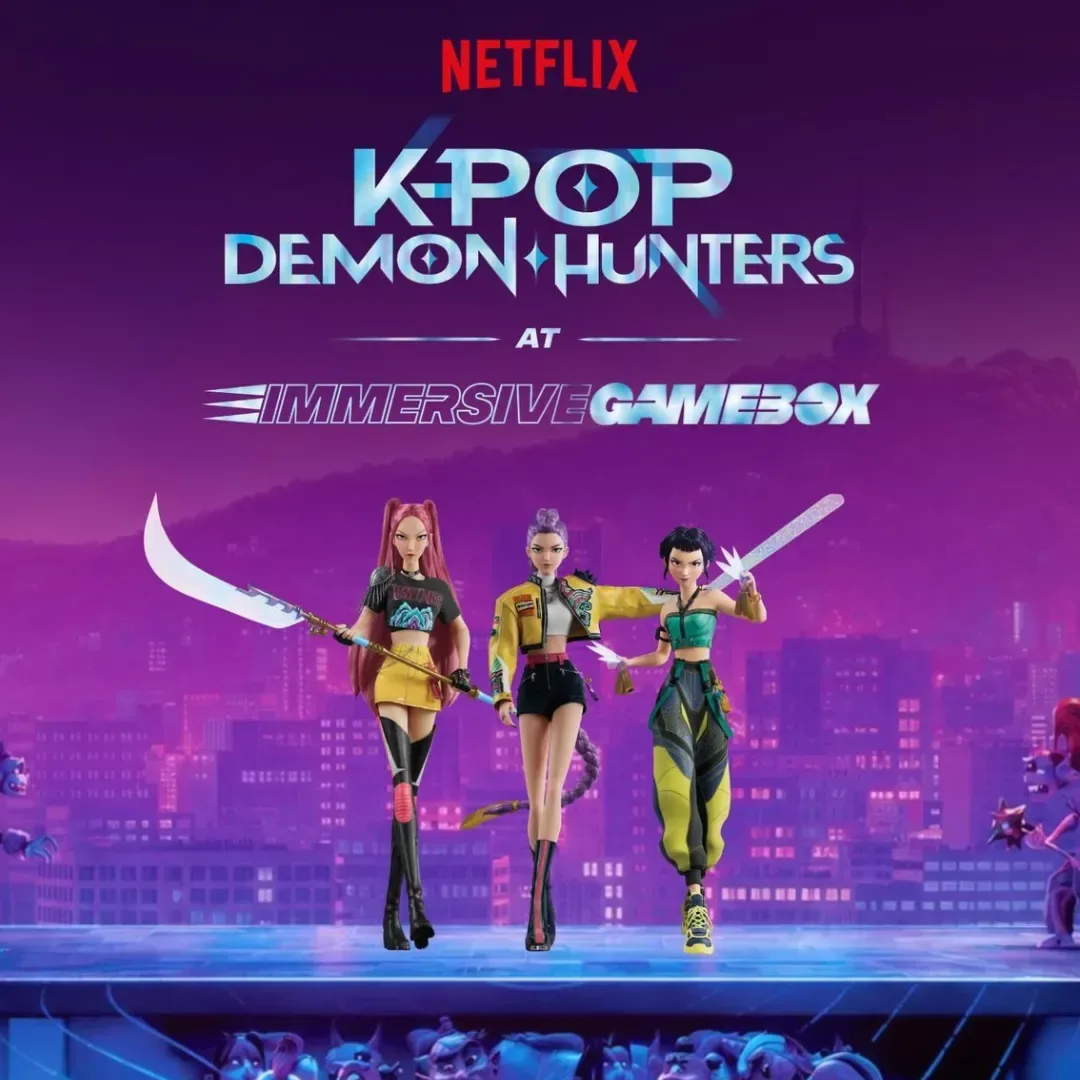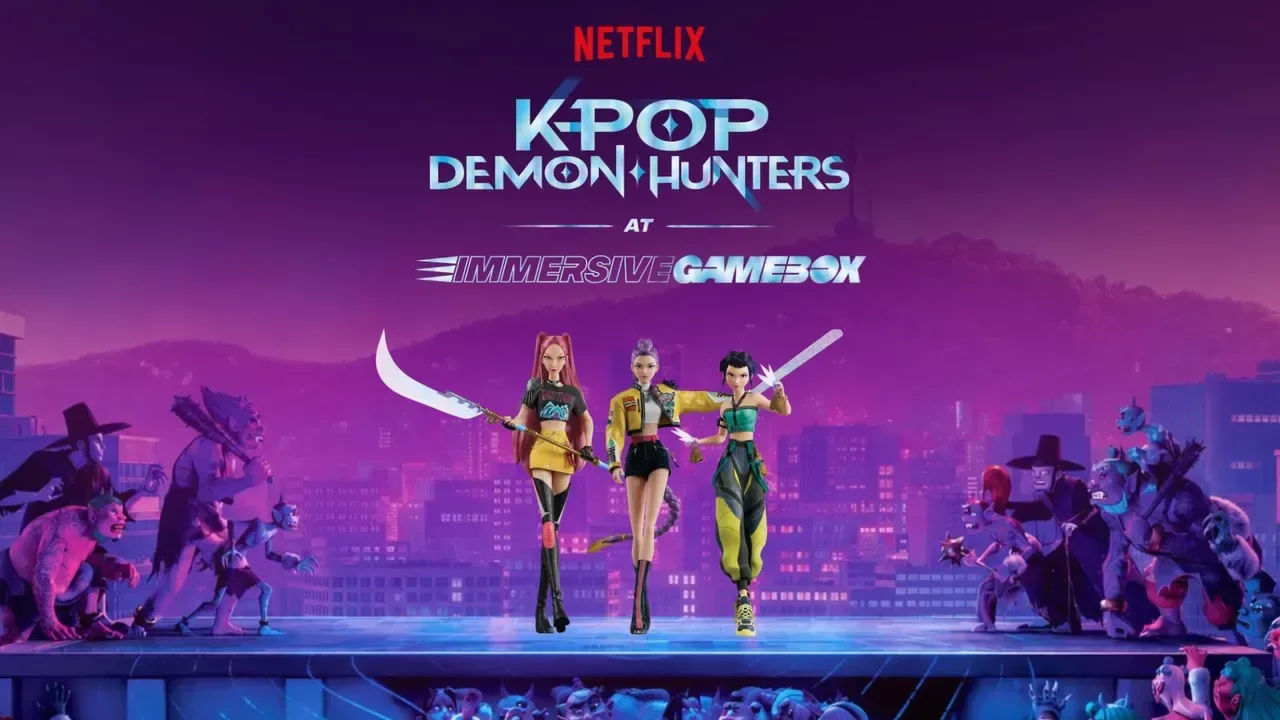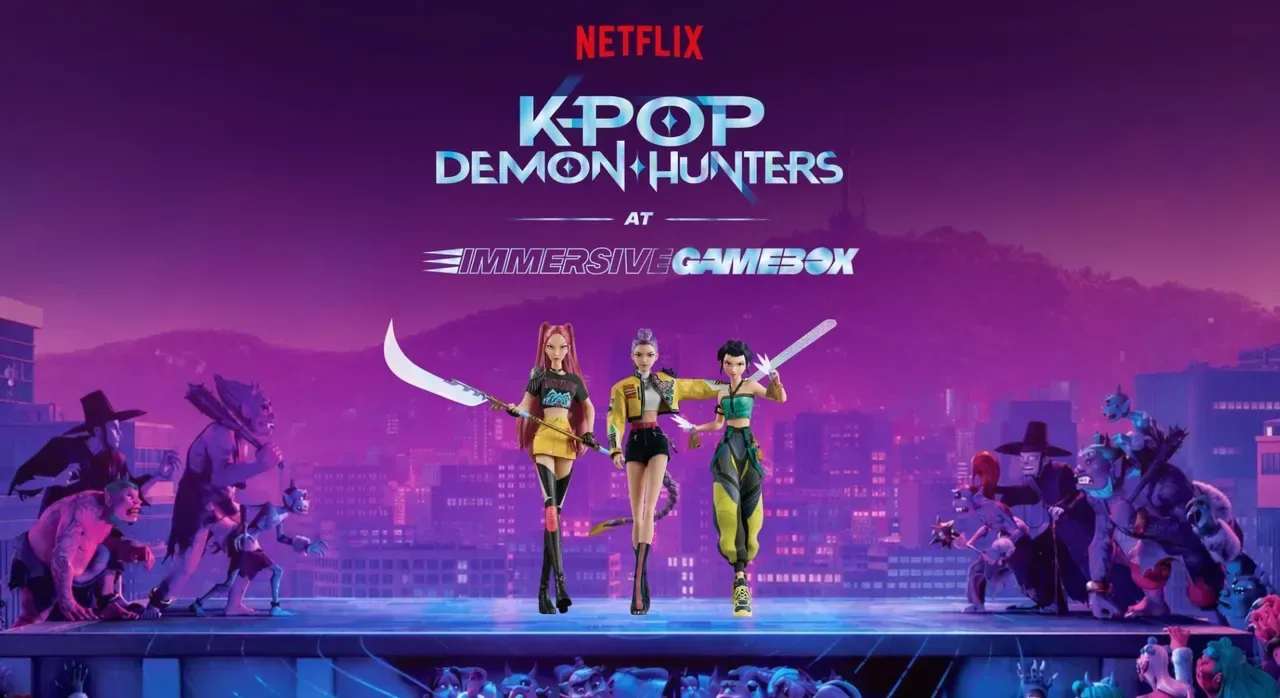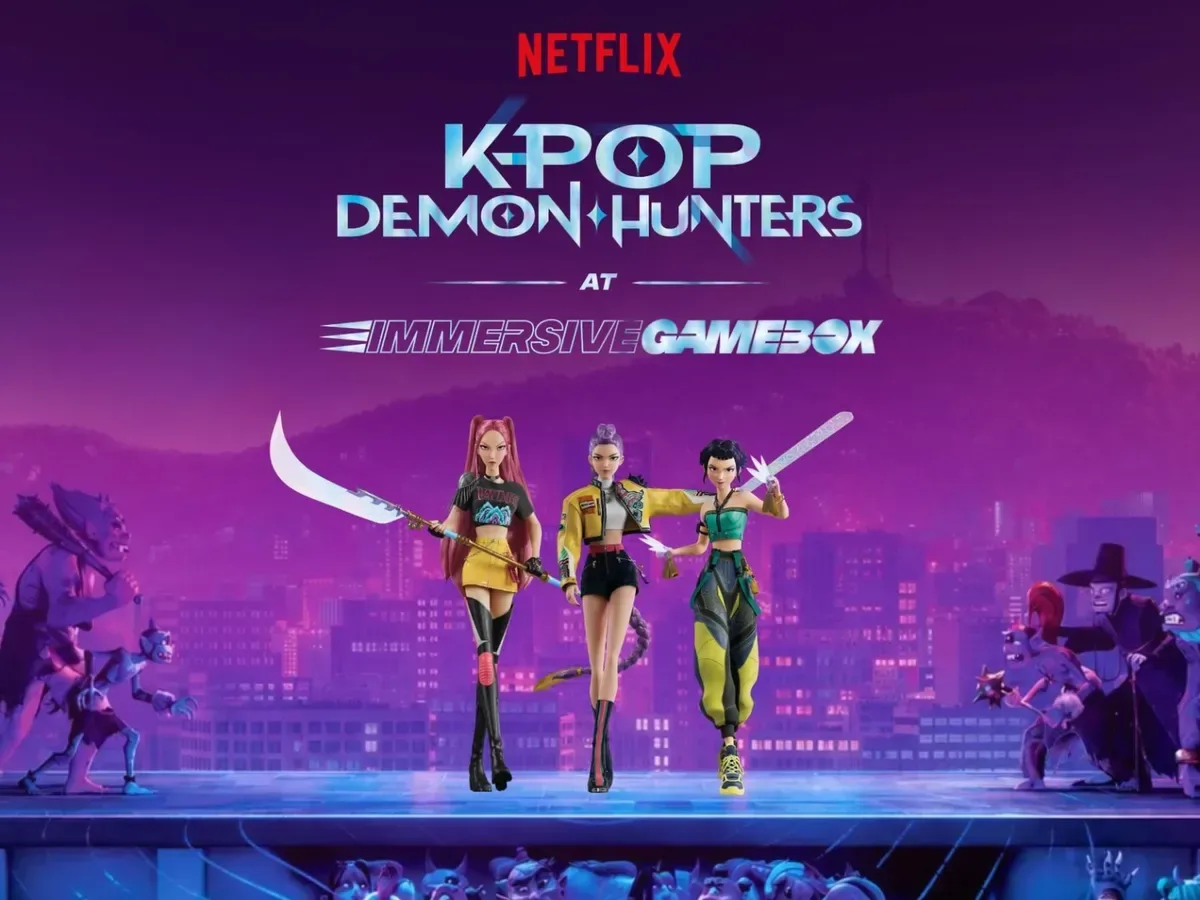
KPop Demon Hunters is heading into another kind of play space. Immersive Gamebox and Netflix are preparing an interactive experience based on the animated hit, scheduled to arrive at select U.S. locations in January 2027. Rather than adapting the property into a conventional home-console or PC game, the attraction is built for groups standing together in a dedicated venue and tackling a shared sequence of activities.
The central pitch is physical, social play. Groups will move, react and cooperate through interactive games that use 3D motion tracking, projection mapping, touch-sensitive walls and spatial audio. Participants will wear lightweight motion-tracking headsets rather than heavy virtual-reality goggles, an important distinction for anyone expecting a fully enclosed VR experience.
Players will begin by making a “Superfan” avatar in the visual style of the film. From there, HUNTR/X guides the group on a mission to protect the Honmoon. The experience is expected to incorporate recognizable characters, locations and moments from the movie, while asking the group to complete minigames and other collaborative activities along the way.
What the Gamebox format means
Immersive Gamebox’s approach sits somewhere between a location-based game room and an interactive screen experience. Its listed technology is designed to track players’ movement in a shared physical area, then combine that input with projected visuals, wall interaction and directionally placed sound. In practical terms, the format emphasizes seeing and responding to other people in the room instead of isolating each player behind a large headset.
For more context, explore Slayyyter Cancels Remaining U.K. and European Tour Dates Over Laryngitis and Vocal Cord Tears.
3D motion tracking refers to technology that follows movement in a three-dimensional space, allowing a game to react when a participant changes position or makes a gesture. Projection mapping is the use of projected imagery aligned to physical surfaces, helping a room or wall become part of the scene. Spatial audio places sound so that it can appear to come from particular directions or areas, rather than simply playing as a flat soundtrack.
Those elements do not establish precisely what every KPop Demon Hunters challenge will require. No individual minigames, performance systems or difficulty options have been detailed. But the confirmed emphasis on moving, reacting and working together suggests that the core experience is intended to make group coordination part of the activity rather than merely putting several people alongside one another.
That makes the scale of the booking especially relevant. The KPop Demon Hunters experience is designed for two to six players and is estimated to run for 60 minutes. A smaller party can still participate, while a full six-person room will need to share the available space and communicate around the same objectives. Families and friend groups considering it should view that player range as a design parameter, not as a promise that every participant receives an entirely separate story path.
Related coverage includes KPop Demon Hunters Interactive Gamebox Experience Set for January 2027.
A visit to the Honmoon, not a sequel preview
The game’s narrative focus is the original Honmoon storyline. HUNTR/X and the effort to protect the Honmoon provide the framework for the activity, placing this attraction alongside another upcoming in-person KPop Demon Hunters offering without presenting it as a new chapter in the franchise.
Netflix is also set to host KPop Demon Hunters: The Immersive Experience at two Netflix House locations in November. That production is described as using 3D technology, live actors, multiple sets, and themed food and drinks. The shared story basis may make the two events sound interchangeable, but the available details point to distinct formats. Gamebox is framing its version around cooperative interactive games and room-scale technology; the Netflix House event includes performers, sets and hospitality elements.
For fans deciding between them, the clearest distinction is participation style. The Gamebox outing is the one explicitly structured around a two-to-six-player team completing game activities. The Netflix House version is described through its live actors and physical sets. Both return visitors to the original film’s Honmoon narrative, so neither should be treated as confirmation of sequel material.
Tickets, locations and what has not been announced
Tickets are expected to become available in December. A Priority Waitlist is already open and is intended to provide 24 hours of access before the general sale. The announcement identifies the rollout only as taking place across select U.S. locations; it does not name the participating venues in the details currently available. It also does not provide ticket pricing.
That leaves a few sensible expectations to keep in check. The 60-minute estimate describes the designed run time, but prospective visitors should not assume it includes or excludes arrival procedures, avatar setup time, venue check-in or other logistics unless the booking information later spells those out. Likewise, “select U.S. locations” means availability may vary by city rather than representing a system-wide launch at every venue.
- Launch window: January 2027
- Venue scope: Select U.S. locations
- Group size: Two to six players
- Estimated duration: 60 minutes
- Ticket timing: Expected in December, with 24-hour early access for the Priority Waitlist
- Story setup: Create a Superfan avatar and join HUNTR/X in protecting the Honmoon
Why this is a notable fit for the property
The attraction’s premise places music, movement and collective fan energy at the center of the transition from animation to an in-person game. That is a natural match for a property whose identity includes K-pop performance alongside supernatural action, but it is also a meaningful design constraint: the experience needs to work for players with different levels of familiarity and comfort with physically active group games.
Immersive Gamebox has experience with Netflix-licensed concepts, including Squid Game and Floor Is Lava. The company launched in London before opening its first U.S. location in 2020, and it now says it hosts more than 29 experiences across 35 venues. Its prior work indicates that KPop Demon Hunters is entering an established location-based platform rather than requiring a one-off purpose-built installation.
For the broader KPop Demon Hunters audience, the timing also extends the property’s presence during a gap before its next film. Reports have suggested that a sequel may not arrive until at least 2029, while Netflix has agreed to give KPop Demon Hunters 2 a full theatrical release. The Gamebox project is not a substitute for that follow-up, and no new sequel plot details are attached to it. It is, instead, another way to revisit the existing world with friends—one where the screen, room and players’ own movement are all meant to contribute to the action.