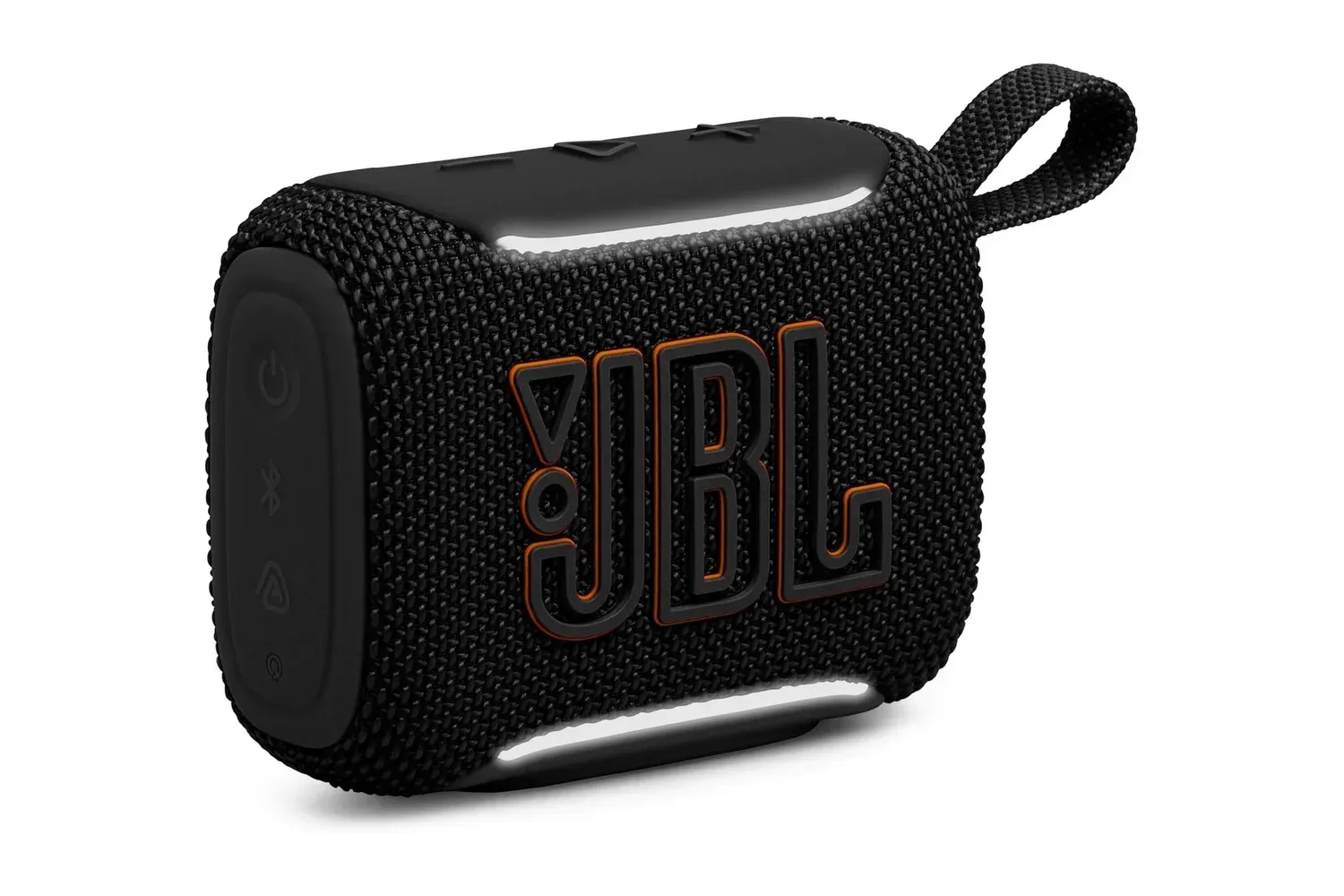
The JBL Go 5 portable Bluetooth speaker is listed at $40, reduced from $55—a $15 difference, or 27%. The small speaker combines travel-friendly hardware with a notably broad feature list: IP68 protection against water and dust, a claimed eight hours of playback with up to two additional hours through Playtime Boost, USB-C audio, multipoint Bluetooth, and compatibility with JBL’s AirTouch and Auracast linking systems.
For people assembling a compact desk, travel or handheld-gaming setup, the headline is not simply the lower price. It is the attempt to make a palm-sized speaker useful in more than one situation. The Go 5 weighs about 230 grams, has a built-in carrying loop, and uses a 45mm driver rated at 4.8W. Those specifications set realistic expectations: this is a highly portable single-speaker solution, not a replacement for a dedicated pair of bookshelf speakers or a large party speaker. Its appeal is flexibility and convenience.
A compact speaker designed to be carried, not parked
The Go 5 is small enough for a pocket, bag or backpack side pocket, and its integrated loop can be used to hang it from a strap or hook. That design has practical value beyond outdoor use. A speaker that can move easily between a desk, kitchen, hotel room and picnic table is more likely to get used than one that must remain connected to a permanent setup.
Its ambient edge lighting adds a visual element, with themes adjustable in the JBL Portable app. It also provides indicators for power, pairing and low battery. Lighting is not an audio upgrade, of course, but straightforward status cues can be handy on a compact device where there is little room for large displays or controls.
The speaker’s single 45mm driver produces 4.8W. In plain terms, the driver is the component that converts an electrical signal into sound, while wattage here describes an aspect of its output rather than a full guarantee of perceived loudness or sound quality. Room size, placement, the mix of the music or game audio, and distortion at higher volume all affect what a listener hears. The stated aim is clear vocals and unexpectedly substantial bass for the speaker’s size, but the physical limits of a tiny enclosure still matter.
Water and dust protection explained
The Go 5 carries an IP68 rating. “IP” refers to ingress protection: the first digit concerns resistance to solid particles such as dust, and the second concerns water protection. In this case, the 6 indicates protection against dust, while the 8 denotes that the speaker is rated to withstand full submersion. JBL also describes the Go 5 as drop-proof.
That combination makes sense for a portable speaker intended for poolside listening, beaches, showers, camping and casual outdoor use. It also reduces the anxiety around everyday mishaps: sand in a bag, rain during a walk, a spilled drink at a desk, or a fall from a picnic table. It does not turn a small wireless speaker into an invulnerable object, and care around charging ports and damage is still sensible. But the rating is a meaningful distinction for buyers who want audio gear they can take outside without treating it delicately.
Battery claims and the Playtime Boost trade-off
JBL rates the Go 5 for up to eight hours of battery life. The company’s Playtime Boost setting can add as much as two more hours by reducing bass. That is an important compromise to understand rather than just an extra number on a product page.
Bass demands energy and asks more of a small driver. By dialing it back, a speaker can prioritize runtime. For podcasts, voice chat, background music or a long work session, that trade may be entirely reasonable. For bass-heavy music, action games or a setting where fuller low-end impact matters, listeners may prefer the standard sound profile and accept the shorter claimed runtime.
“Up to” figures are estimates rather than a promise that every listening pattern will deliver the same result. Volume level, EQ changes, lighting use and the nature of the audio can all affect battery consumption. Still, the option gives owners a way to favor endurance when access to a charger is limited.
USB-C is for charging—and, with compatible devices, wired audio
One of the Go 5’s more useful features is its USB-C port. It can charge from the same type of cable commonly used for phones and many modern devices. More unusually for an ultra-compact Bluetooth speaker, the port can also receive lossless audio from a compatible smartphone or laptop over USB-C.
Lossless audio refers to audio delivered without discarding data through the compression associated with a typical Bluetooth transmission. That does not automatically mean every recording will sound dramatically different, nor does it erase the acoustic constraints of a compact speaker. It does mean a wired USB-C connection can avoid Bluetooth’s wireless compression stage when the connected device is compatible.
For handheld players and people building compact tech kits, a wired option can be especially appealing where low fuss matters. USB-C audio potentially lets the Go 5 serve as a small external speaker without relying on a wireless pairing process. Compatibility remains the key qualifier: the phone or laptop must support the relevant USB-C audio connection.
It is also worth separating USB-C audio from Bluetooth audio. The former is a physical cable connection; the latter sends audio wirelessly. The speaker supports both, giving users the choice between cable convenience at a desk and wireless freedom away from it. Readers following handheld-device software developments may also be interested in NitroDeck’s planned Android update for dual-screen handhelds, another example of how compact hardware setups increasingly depend on flexible accessories and interfaces.
Bluetooth 6.0, LC3 and two-device connections
The Go 5 lists Bluetooth 6.0 with LC3 support. Bluetooth is the short-range wireless connection used by phones, computers and other compatible devices to send audio to the speaker. LC3 is an audio codec, or method for encoding and decoding audio data, intended to support efficient wireless audio transmission.
In everyday use, the practical promise is reliable, efficient connectivity rather than a specification users need to manage constantly. Actual results will depend on the paired device and environment. Walls, distance and crowded wireless spaces can affect any Bluetooth connection, so the presence of a newer Bluetooth standard should not be read as a guarantee that every setup behaves identically.
The speaker also supports multipoint Bluetooth, allowing simultaneous connections with two devices. That is useful for a person moving between a laptop and phone. For example, someone could listen from a computer, then take a call or switch to phone audio without treating the speaker as tied permanently to one source. The value is convenience: fewer repeated disconnect-and-reconnect steps during ordinary use.
From one small speaker to a larger system
The Go 5 offers two paths for expansion. Two Go 5 units can be connected through AirTouch for true left-and-right stereo. Stereo matters because audio mixes often distribute elements between channels; separate left and right speakers can provide a wider, more directional presentation than one mono speaker can create.
It also supports Auracast, allowing the Go 5 to be linked with multiple compatible JBL speakers so they play the same audio. This is different from a two-speaker stereo arrangement. The stated purpose is to scale a setup for a larger space or gathering, potentially keeping the compact Go 5 in use alongside larger compatible speakers later. Linked speakers can be controlled through the JBL Portable app.
The distinction matters for purchase decisions. Someone who only needs private desk audio may never use either feature. Someone who begins with one small portable speaker but expects to add compatible products over time could see more value in staying inside an ecosystem that supports both stereo pairing and broader synchronized playback.
EQ controls and firmware updates
The JBL Portable app includes a seven-band equalizer, usually shortened to EQ. An EQ lets a listener adjust selected ranges of sound rather than accepting one fixed tuning. The most useful application is not necessarily chasing maximum bass or treble; it is adapting playback to the material and the environment. Speech may benefit from a focus on clarity, while music listeners may want a different balance.
The app is also the route for firmware updates. Firmware is the low-level software that runs the device itself. JBL says updates can add enhancements and capabilities over time. That creates the possibility of improvements after purchase, but it should be treated as potential rather than a defined list of future features. Buyers should judge the Go 5 based on what is already specified, with updates as an additional benefit.
Who the $40 listing makes the most sense for
At the listed $40 price, the Go 5 looks most compelling for buyers who prioritize portability, ruggedness and connection options over sheer room-filling scale. The IP68 rating, carrying loop and roughly 230-gram weight fit the needs of people who want a speaker for a bag, pool area, trip or small work space. USB-C charging helps reduce cable clutter, while USB-C audio adds a notable wired-use alternative where compatible.
Its strongest feature set is arguably the combination of small-device practicality and a route to grow: use one speaker by itself, pair two for stereo, or connect it with compatible JBL hardware for synchronized playback. Conversely, anyone whose priority is the widest stereo image from a single purchase, especially deep bass, should remember that this remains a compact single-driver speaker. Its design is about bringing sound along, not defeating the physical limits of its size.
The $15 reduction from $55 gives that balance more weight. The Go 5 is not merely presented as an inexpensive wireless speaker; it is a portable, water- and dust-protected speaker with app EQ, multipoint support, configurable lighting, USB-C wired audio and ecosystem pairing options. For the right small-space or travel use case, that is a substantial set of capabilities at the listed price.
Shop the products
Check current price, model and availability at the retailer.