The modern phone plan is trying very hard to become a tiny entertainment mall. Rather than competing only on coverage, data allowances and hotspot caps, major wireless providers are attaching streaming subscriptions and digital-service discounts to qualifying plans. The result is a potentially useful change for people who already pay for several services—but not every “included” perk is equal, and the phone plan remains the larger purchase.
T-Mobile, Verizon, Cricket Wireless and Metro by T-Mobile each take a noticeably different approach. Some include an ad-supported streaming membership at no separate charge on specific plans. Others sell discounted service bundles as add-ons. One option folds a full Amazon Prime membership into a prepaid plan. And T-Mobile’s T-Mix system points toward an even more flexible model, with a changing set of selectable perks that includes Xbox Game Pass alongside video, food delivery and airline-reward options.
For players, the important distinction is simple: a bundled entertainment benefit can be genuinely handy when it matches services already in use, but it should not be confused with a universal discount on every subscription—or with a reason to overlook the underlying wireless plan. A Netflix benefit does not make a plan automatically better for someone whose priority is Game Pass, and a Game Pass option does not tell us by itself which tier or terms apply.
T-Mobile ties its top plans to Netflix, Hulu and discounted Apple TV
T-Mobile’s Experience lineup places the most substantial video package on its higher-cost option. Experience Beyond 2.0 begins at $100 per month for one line with AutoPay, before taxes and fees. It includes Netflix Standard with ads and Hulu With Ads without an additional subscription charge. Apple TV can be added for $3 per month.
The included Netflix tier is ad-supported, meaning viewers get Netflix’s library of original and licensed programming with advertising. Hulu’s included tier is also ad-supported and includes Hulu originals, a broad movie and TV catalog, and next-day programming from ABC and FX. Those labels matter: “Netflix included” is not enough information on its own to establish the precise version of Netflix a customer receives.
Experience Beyond 2.0 also includes unlimited talk, text and 5G data, plus 250GB of high-speed mobile hotspot data. Mobile hotspot data is the data allowance used when a phone shares its cellular connection with another device, such as a laptop, handheld or tablet. For a gaming household, that capacity may be more consequential than a streaming perk during travel or an internet outage—although performance, signal quality and individual use cases are not established by a data figure alone.
The less expensive Experience More 2.0 starts at $85 per month for one line with AutoPay. It retains Netflix Standard with ads and the $3-per-month Apple TV offer, but does not include Hulu. That creates a clear fork: the $15 difference in stated starting price is tied, among other things, to the added Hulu benefit and the higher hotspot allowance on Experience Beyond 2.0.
T-Mobile Tuesdays is another part of the carrier’s entertainment pitch, offering recurring promotions involving movie tickets, dining and other entertainment. Those promotions should be viewed as rotating extras rather than a fixed, guaranteed streaming entitlement. Some legacy plans may also retain their own streaming benefits, so an existing customer should identify their exact plan before assuming a newly advertised bundle is the only available route.
T-Mix is the more game-relevant wrinkle
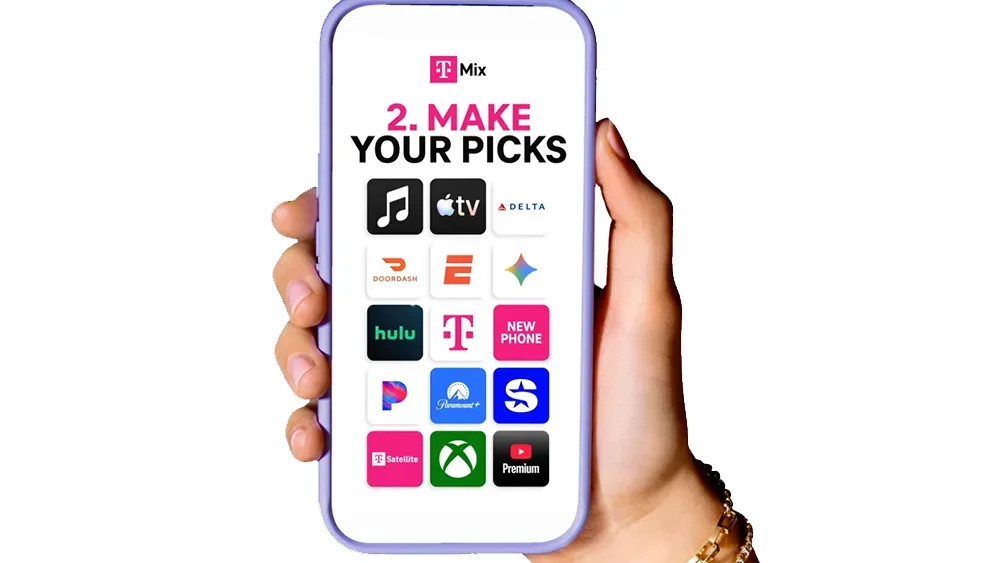
T-Mobile’s newer T-Mix service uses “Picks” to let subscribers assemble a curated selection of benefits. The available menu spans Netflix, Hulu, Apple TV and Paramount+, but also Xbox Game Pass, DoorDash and Delta SkyMiles. Picks can be changed every three months without changing the wireless plan.
That quarterly switching window is the interesting part for anyone who manages subscriptions around what they are actually playing or watching. It suggests a customer could shift a Pick at intervals rather than permanently locking their plan into one entertainment preference. Still, the supplied details do not specify T-Mix pricing, eligibility, which version of Xbox Game Pass is offered, or how many Picks a given customer receives. Those are essential details to verify directly before factoring the service into a budget.
In other words, the useful headline is flexibility—not a claim that every T-Mobile subscriber gets Game Pass free. The service makes Game Pass part of the carrier’s wider perks conversation, but the precise value depends on plan terms that are not detailed here.
Verizon makes streaming perks paid add-ons
Verizon’s structure is less about bundling services into the base price and more about allowing eligible unlimited-plan customers to select discounted entertainment packages. Its eligible plans include the myPlan lineup and the newer Simplicity plan.
The available options described here are:
- Disney+, Hulu and ESPN+ for $12 per month, using ad-supported versions.
- Netflix and HBO Max for $13 per month, also ad-supported.
- Apple One for $15 per month, combining Apple TV, Apple Music, Apple Arcade and iCloud+ storage.
The charges are on top of the wireless plan. That does not make them unhelpful; it simply makes the accounting clearer. Verizon customers are buying a discounted package rather than receiving a no-additional-charge subscription as part of the listed base plan.
Apple One is the most immediately gaming-adjacent choice in this list because it includes Apple Arcade, Apple’s game subscription service. It also combines music, video and cloud storage, so its appeal is broader than games. But a customer who only wants Apple Arcade should avoid mentally assigning the full package’s value to the games alone. The bundle is most relevant when several included services fit the same household.
The Disney, Hulu and ESPN+ option is built around franchises, television and sports programming. The Netflix and HBO Max bundle combines two major video catalogs. HBO Max’s game-adjacent appeal is clear for viewers following adaptations such as The Last of Us; readers looking for more on one upcoming HBO Max title can also see the details on HBO Max’s forthcoming dinosaur drama, The End of Oak Street.
Cricket’s case is simpler: HBO Max is included on its Supreme plan
Cricket Wireless offers HBO Max Basic with Ads with its Supreme Unlimited plan. The plan starts at $55 per month with AutoPay for one line, taxes included, and its stated package includes unlimited talk, text and data, 50GB of mobile hotspot data, and 150GB of cloud storage.
HBO Max Basic with Ads is the advertising-supported version of the service. Its catalog includes HBO series, original programming, Warner Bros. films and a changing selection of Hollywood releases. It is a more focused proposition than Verizon’s choose-your-perk system or T-Mobile’s higher-tier cluster of services: people who specifically value HBO Max may find it straightforward, while those after Netflix, Disney+ or a game library would need to look elsewhere.
That clarity can be valuable. A bundled subscription has practical value only if it replaces a subscription someone would otherwise maintain. If HBO Max is already a regular part of a household’s viewing, inclusion on a $55 prepaid plan is relevant. If it is not, the presence of the logo should not overpower the basics: monthly plan cost, tax treatment, hotspot capacity and network suitability for the individual customer.
Metro adds Amazon Prime, not merely Prime Video
Metro by T-Mobile includes a full Amazon Prime membership on its $60-per-month unlimited plan with AutoPay. The first month is listed at $65. Prime Video is part of Prime, but the value proposition goes beyond shows and films by incorporating Amazon’s shipping and other membership benefits.
For viewing, the membership covers Prime Video’s originals and its growing live-sports programming. The wireless plan also lists unlimited premium 5G data, 25GB of mobile hotspot data, HD video streaming and 100GB of Google One storage. Eligible Metro customers can additionally access T-Mobile Tuesdays offers.
This is a notably different bundle from the HBO Max, Netflix or Disney options because Prime is not solely a video subscription. A person who frequently uses Prime shipping and watches Prime Video may see the perk as more practical than a single-purpose video service. Someone who does neither should not assume that the broad Prime label automatically adds meaningful value.
How to read these deals without letting the logos drive the decision
There are a few durable checks consumers can make using the terms presented with the plans.
- Start with the phone plan, then assess the perk. The stated starting prices range from Cricket’s $55 with AutoPay to T-Mobile Experience Beyond’s $100 with AutoPay before taxes and fees. A streaming inclusion is only one component of a wireless bill.
- Identify the exact service tier. Netflix Standard with ads, Hulu With Ads and HBO Max Basic with Ads are defined tiers, not generic all-access labels. Advertising is part of the trade-off in several bundles.
- Separate included benefits from discounted add-ons. T-Mobile’s specified Netflix and Hulu benefits on Experience Beyond are included at no additional subscription charge; Verizon’s listed perks carry extra monthly charges.
- Check what the perk actually replaces. A household that already has Prime may care more about Metro’s inclusion than one that only watches a show there occasionally. The same logic applies to HBO Max, Apple services, Netflix and Hulu.
- Read plan conditions literally. AutoPay, one-line starting prices, taxes and fees, and first-month pricing can all affect the final monthly picture. T-Mobile’s $100 Experience Beyond figure is before taxes and fees, while Cricket’s $55 Supreme figure states that taxes are included.
- For gaming benefits, verify the missing specifics. T-Mix names Xbox Game Pass, but its available information here does not define the included Game Pass tier, price or eligibility. Treat that as a prompt for further confirmation, not as a complete offer description.
The broader shift is that a wireless plan can now function as a subscription-management decision. T-Mobile prioritizes bundled video on expensive plans and introduces switchable Picks through T-Mix. Verizon sells a menu of discounted media packages. Cricket pairs prepaid service with HBO Max, while Metro uses Amazon Prime’s wider retail-and-video footprint. The best match will be the one that aligns with subscriptions already used, without making the actual phone service an afterthought.