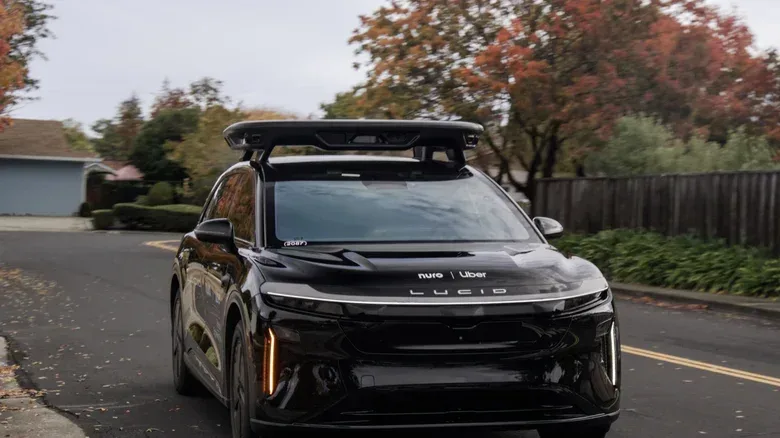
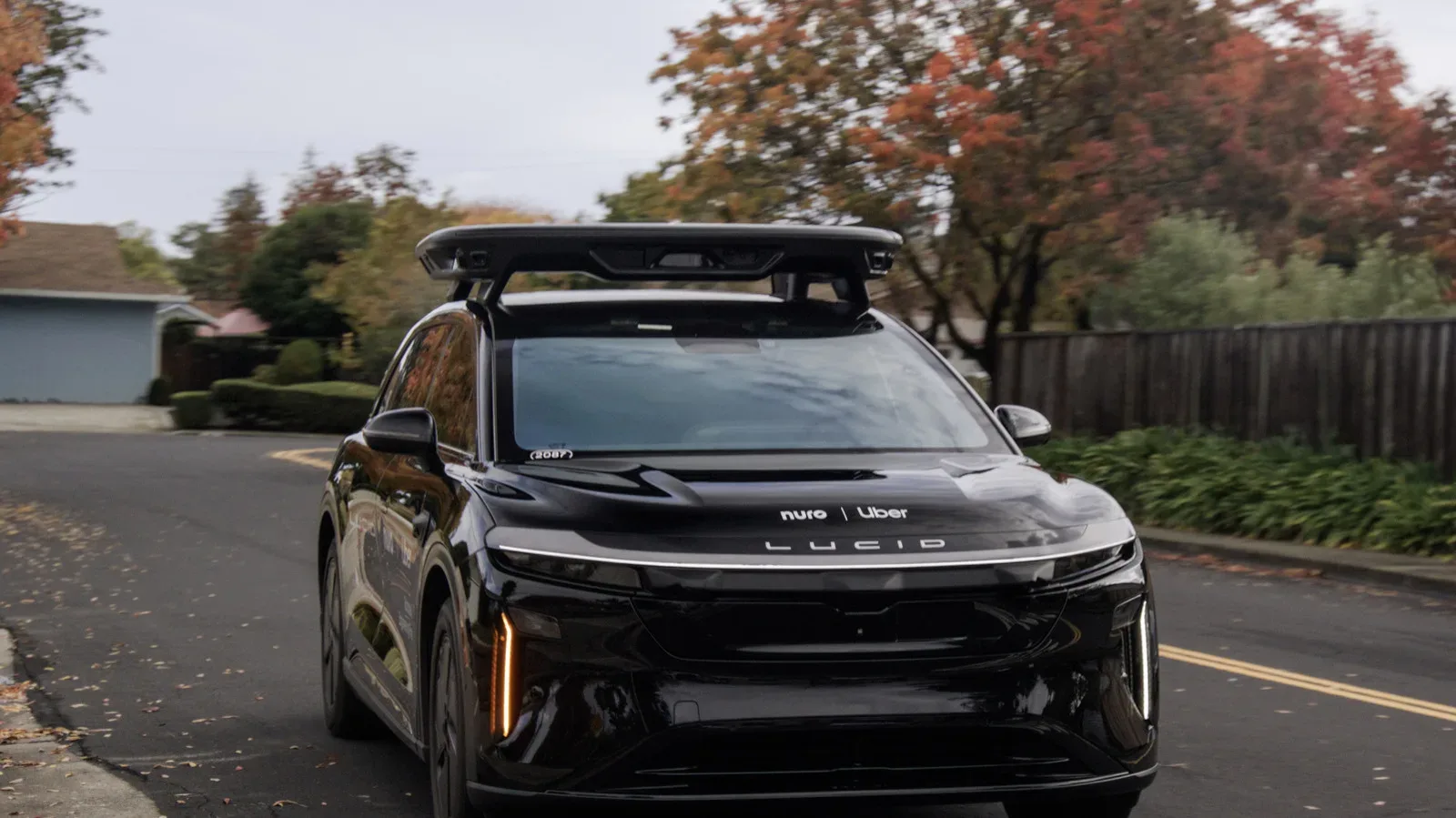
Uber, Lucid and autonomous-driving developer Nuro have begun testing robotaxis with no driver behind the wheel on public roads in the San Francisco Bay Area. The test vehicles are modified Lucid Gravity SUVs, and the partners intend to make rides available to the public through the Uber app in the first quarter of 2027.
It is a meaningful change in the program’s status: the fleet had previously been tested with a human driver in the vehicle. Now the companies are operating under a California DMV Driverless Testing Permit, obtained in May, that allows their vehicles to test on public roads without an onboard driver.
The initial driverless testing area covers Palo Alto, Mountain View, Los Altos and Sunnyvale. The companies plan to broaden operations to additional Bay Area cities in 2027. Before the public launch, employees are also expected to begin taking rides in the autonomous vehicles.
What is actually being tested?
A driverless-testing permit is not the same thing as a public robotaxi launch. This phase puts the vehicles into real public-road environments without a driver seated at the controls, but it does not mean members of the public can summon one yet.
That distinction matters. The current work is testing the complete operating setup: the vehicle, the autonomous-driving system, the sensors that feed it information, and the processes that support the ride. Employee rides are the next stated step, while a passenger-facing service remains planned for early 2027.
For people in the initial testing cities, the immediate practical change may simply be seeing a Lucid Gravity operating without a driver. Public availability, coverage area, ride volume and timing within the first quarter of 2027 have not been specified.
The three-company robotaxi stack
The project divides responsibilities among three companies rather than presenting a single firm as the entire service operator.
- Lucid manufactures the underlying vehicle. The robotaxi is based on the Lucid Gravity, modified for autonomous operation.
- Nuro supplies the Nuro Driver, described as an end-to-end autonomous-driving system.
- Uber plans to put the service in its ride-hailing network, where riders will request trips through the Uber app. It will also design the in-cabin experience and provide rider controls and support.
In plain language, Lucid supplies the car, Nuro supplies the system intended to drive it, and Uber supplies the customer-facing ride service. That separation is important because a robotaxi trip has more moving parts than the driving task alone. A rider still needs a way to request the vehicle, identify it, access controls during a trip and get help if something goes wrong or simply feels unclear.
Uber’s role in cabin design and rider support is therefore more than cosmetic. A vehicle can be technically able to complete a route, yet still need an understandable passenger experience: a clear way to begin or end a ride, practical controls and support pathways. Specific features of that interface have not been detailed.
How the vehicles perceive the road
The modified Gravity robotaxis use high-resolution cameras, lidar sensors and radar. These are different categories of sensors, each providing a different kind of input for an automated driving system.
Cameras
Cameras capture visual information about the vehicle’s surroundings. In broad terms, that can help a driving system interpret lanes, road signs, traffic signals and the behavior of other road users. The supplied details identify the cameras as high-resolution, but do not outline their range, placement or individual capabilities.
Lidar
Lidar, short for light detection and ranging, uses light-based measurements to map distances and the surrounding environment. It is commonly discussed in autonomous-vehicle systems because it can contribute depth and spatial information rather than only a flat visual image.
Radar
Radar uses radio waves to detect objects and their movement. Together, cameras, lidar and radar form a sensor suite: multiple sources of environmental data that can be used by the vehicle’s driving system.
Nuro’s system is characterized as end-to-end. In this context, that means the Nuro Driver is presented as a complete autonomous-driving system rather than a single component installed in the vehicle. The announcement does not provide technical details about its software architecture, operational limits or how it makes particular driving decisions, so it would be premature to infer more from the term than that.
For a useful everyday comparison, think less of one magical “self-driving” button and more of a full game party with distinct roles. The sensors are the party’s information-gathering tools, the autonomous-driving system processes that information and directs the car, while the ride-hailing platform handles the player-facing menu and assistance layer. The analogy stops there, of course: on public streets, clear limits and careful operation matter far more than a flashy tech-tree description.
From supervised driving to no-driver testing
The broader Uber-Lucid-Nuro robotaxi program was announced in July 2025. Testing with a driver behind the wheel began in December of the following year, before the companies received the California driverless-testing permission in May and entered the newly announced phase.
That progression highlights why “driverless” is a specific status worth using carefully. A vehicle can be autonomous in the sense that it uses an automated driving system while still carrying a person in the driver’s seat during testing. The new Bay Area work removes that onboard driver from the test setup.
It does not, by itself, answer every question a future passenger may have. The partners have not said how many vehicles will run in the initial driverless-testing rollout, what exact public service territory will be used at launch, or how quickly the service will expand beyond the early Bay Area area.
A 100-vehicle fleet, with a much bigger stated commitment
Lucid has said the robotaxi fleet already totals 100 vehicles. It is not clear whether all 100 will be used in the first stage of driverless public-road testing.
Uber has also committed to purchasing 35,000 Lucid-Nuro robotaxis and has stated that it intends to expand their availability internationally. That commitment signals a much larger ambition than the initial Bay Area operation, but it should not be confused with a disclosed global rollout schedule. The confirmed near-term public target is a Bay Area launch in the first quarter of 2027.
The gap between a current fleet figure and a larger purchase commitment is worth noting. The 100 vehicles describe the fleet Lucid says already exists; 35,000 describes Uber’s stated purchasing commitment. Neither figure reveals how many cars will be available to passengers on day one, nor does it establish when particular markets outside the Bay Area might receive service.
What Bay Area riders should watch for next
The milestones described so far form a fairly clear sequence:
- Driverless public-road testing begins in Palo Alto, Mountain View, Los Altos and Sunnyvale.
- Employees begin riding in the autonomous vehicles.
- Testing expands to more Bay Area cities in 2027.
- The companies target a public Bay Area service launch in the first quarter of 2027, accessed via the Uber app.
There is still plenty that has not been announced, including passenger pricing, the precise launch footprint, the fleet count at public launch and details of the cabin controls. Those omissions do not undermine the significance of the testing step; they simply define the difference between a road-test announcement and a complete consumer-service rollout.
The near-term takeaway is straightforward: Uber, Lucid and Nuro have moved their joint robotaxi effort from supervised testing into a driverless public-road phase. If the planned milestones hold, Bay Area passengers will be able to request the service in early 2027. Until then, the project remains in testing, with employee trips positioned as the next bridge between no-driver road operation and public rides.
Like any connected service, the experience around the vehicle will matter alongside the vehicle itself. For a related look at how connectivity can shape consumer tech reliability, see this guide to diagnosing recurring Wi-Fi dropouts.