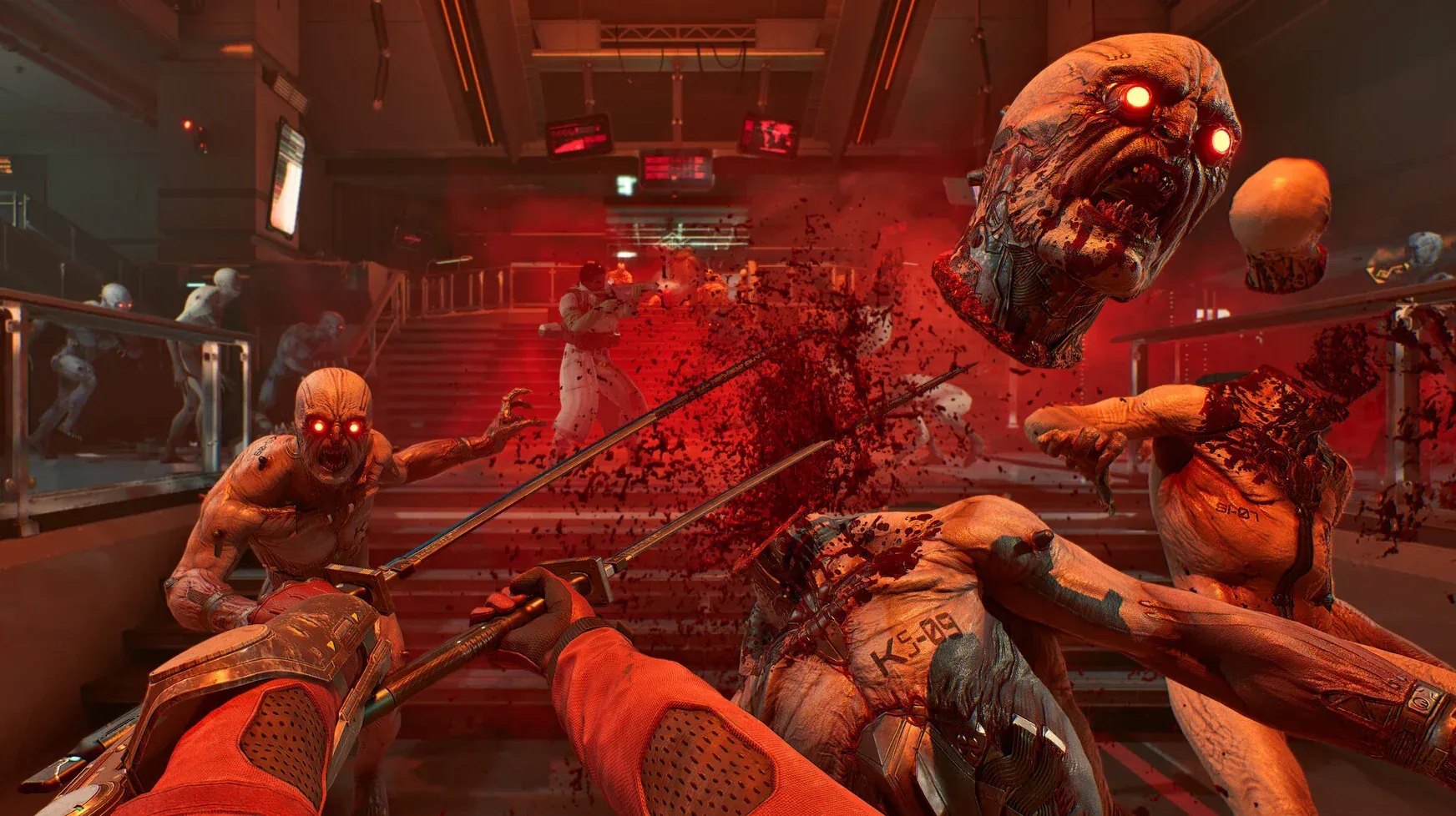
Tripwire Interactive has announced a new round of layoffs affecting 36 developers, adding further uncertainty for the studio behind Killing Floor 3, Killing Floor 2, and Maneater. The cuts follow restructuring earlier this year, while the studio says it remains at work on Maneater 2, continued support and development for Killing Floor 3, and publishing through its Tripwire Presents label.
The immediate human impact is the clearest part of the news: 36 people are losing their jobs. The broader argument around why the company is downsizing is considerably less clear. Steam player and review figures shared in response to the layoffs point to a sharp gap between the recent performance of Killing Floor 3 and the long-running popularity of 2016’s Killing Floor 2. But Tripwire cofounder and former CEO John Gibson has publicly rejected the idea that those numbers explain the situation on their own.
Instead, Gibson has argued that the company’s problems trace back to his departure in 2021. He characterized his removal as the work of “woke leftists,” said the studio was subsequently forced to be sold, and argued that Tripwire lost a key creative leader. It is a striking and highly personal explanation for layoffs that occurred years after he stepped down—and it should be treated as Gibson’s interpretation rather than an established account of a company’s business performance.
What Tripwire has confirmed
Tripwire said the team remains focused on internal projects, naming active development of Maneater 2, ongoing work on Killing Floor 3, and its publishing work. It also said it intends to continue supporting its games and community.
That statement establishes what is continuing, but it does not give a detailed financial explanation for the layoffs. There is no supplied evidence tying the 36 cuts to one game, one review score, a specific sales result, a particular ownership decision, or a single management change. That distinction matters because layoffs are often discussed as if one visible metric can conclusively explain everything. Public player counts and user-review percentages can reveal part of the commercial and community picture; they do not disclose a studio’s budgets, contractual obligations, publishing commitments, payroll structure, or internal planning.
Tripwire is currently part of Embracer Group. Its corporate path has shifted substantially since Gibson’s exit: cofounder Alan Wilson initially succeeded him as CEO; Tripwire was later acquired by Embracer and placed under Saber Interactive; Saber was subsequently sold off while Tripwire remained within Embracer. Matthew LoPilato, previously the company’s CFO, is now CEO, while Wilson remains at Tripwire as a vice president.
That sequence means the studio has experienced leadership and ownership changes alongside the challenges facing its latest shooter. It does not, however, prove that any one transition caused the present layoffs.
The Steam comparison behind the debate
One widely shared comparison came from gaming consultant Iain Garner, who contrasted the two Killing Floor games’ recent Steam results. Garner said Killing Floor 2 averaged roughly 6,000 daily players on Steam last month, compared with approximately 460 for Killing Floor 3. He also cited an 88% positive user-review rating for the older game and a 44% positive rating for the newer one.
Those are unfavorable comparisons for Killing Floor 3. In plain terms, average daily players is a measure of ongoing activity, not necessarily the total number of people who bought a game. It can be useful for assessing whether an online-focused title is holding a stable active community. A much lower figure than its predecessor may make matchmaking, word-of-mouth, and confidence in future support more difficult.
Positive review percentage, meanwhile, reflects the share of Steam user reviews marked positively. It is a measure of sentiment among users who choose to review, rather than a complete quality verdict or a direct sales report. Still, an 88% versus 44% split is a meaningful indication that the two games have generated very different levels of enthusiasm on that platform.
The comparison has obvious practical relevance because the Killing Floor series depends on repeat engagement. A co-op shooter benefits when players can reliably find others, when updates bring people back, and when the community believes the game will improve over time. The supplied figures cannot establish why players responded differently to the two games, but they do describe the scale of the reception problem being debated.
They also describe only Steam. No evidence here provides player totals or review data for other platforms, nor does it provide sales, revenue, development costs, or retention information. A careful reading is therefore narrower: the available Steam data suggests Killing Floor 3 is performing far below Killing Floor 2 in recent player activity and user-review sentiment. It does not settle every question about Tripwire’s finances or the precise rationale for its layoffs.
Gibson’s argument and the events he is referring to
Gibson co-founded Tripwire with Alan Wilson in 2005. His current posts frame the company’s recent difficulties as the consequence of his exit, arguing that the team behind Killing Floor 3 largely overlaps with the team that made Killing Floor 2 but lacks its former leader. He compared his departure to Apple removing Steve Jobs, while also acknowledging that mistakes could have been made after he left and that he was not the studio’s only talented employee.
The background is specific. In 2021, Gibson publicly praised a Texas abortion ban that had been upheld by the Supreme Court before the later overturning of Roe v. Wade. He described himself as a pro-life game developer and said he wanted to put his position on the record.
Tripwire’s development partners publicly distanced themselves from that statement. The company did as well, saying Gibson’s comments were his own, did not represent Tripwire, and conflicted with the values of the team, partners, and much of its community. Gibson stepped down as CEO within days.
In subsequent posts following the new layoffs, Gibson has said that only he—not the broader “old guard”—was pushed out. He also claimed that the company’s culture was damaged by the change and expressed regret that employees were caught in the fallout.
Why a single-cause explanation falls short
Gibson’s posts offer a leadership-centered theory: remove a founder and creative force, and a formerly successful machine breaks down. It is not impossible for a major leadership departure to affect a developer. Founders can carry institutional knowledge, long relationships, creative direction, and a particular way of organizing a team. A change at the top can alter all of those things.
But the available record does not demonstrate the broader claim that his exit is the reason for Killing Floor 3’s Steam reception or the layoffs. The supplied information contains evidence of weak recent Steam engagement and sentiment, an earlier restructuring, ownership changes, and 36 new job cuts. It contains Gibson’s stated view of those events. It does not include internal documents, financial data, or statements from current management assigning causation to his departure.
It is also important not to flatten a studio into one person. Game development is collaborative by nature: programmers, artists, designers, producers, quality-assurance staff, community teams, publishing personnel, and many others contribute to an outcome. Gibson himself has acknowledged the talent of the team he led. Presenting the performance of a large studio, a live game, and a company under changing ownership as the work of one indispensable individual is a rhetorical argument, not a conclusion established by the known facts.
For players, the more useful immediate question is what comes next for the games still under Tripwire’s care. The company says Killing Floor 3 remains in development and that it will continue supporting its catalog. That commitment matters particularly for a multiplayer game whose community is watching player activity and reviews closely. Yet layoffs can put pressure on any team’s capacity, making the eventual cadence and scope of updates a key practical measure to watch.
For the people losing their jobs, though, the argument on social media does not change the result. The public dispute over blame may continue, but the confirmed development is a new round of cuts at a studio that says it is still trying to move forward with multiple projects. Readers following broader games-business upheaval may also want to see how another studio restructuring unfolded in the changes surrounding Haven Studios and Fairgames.