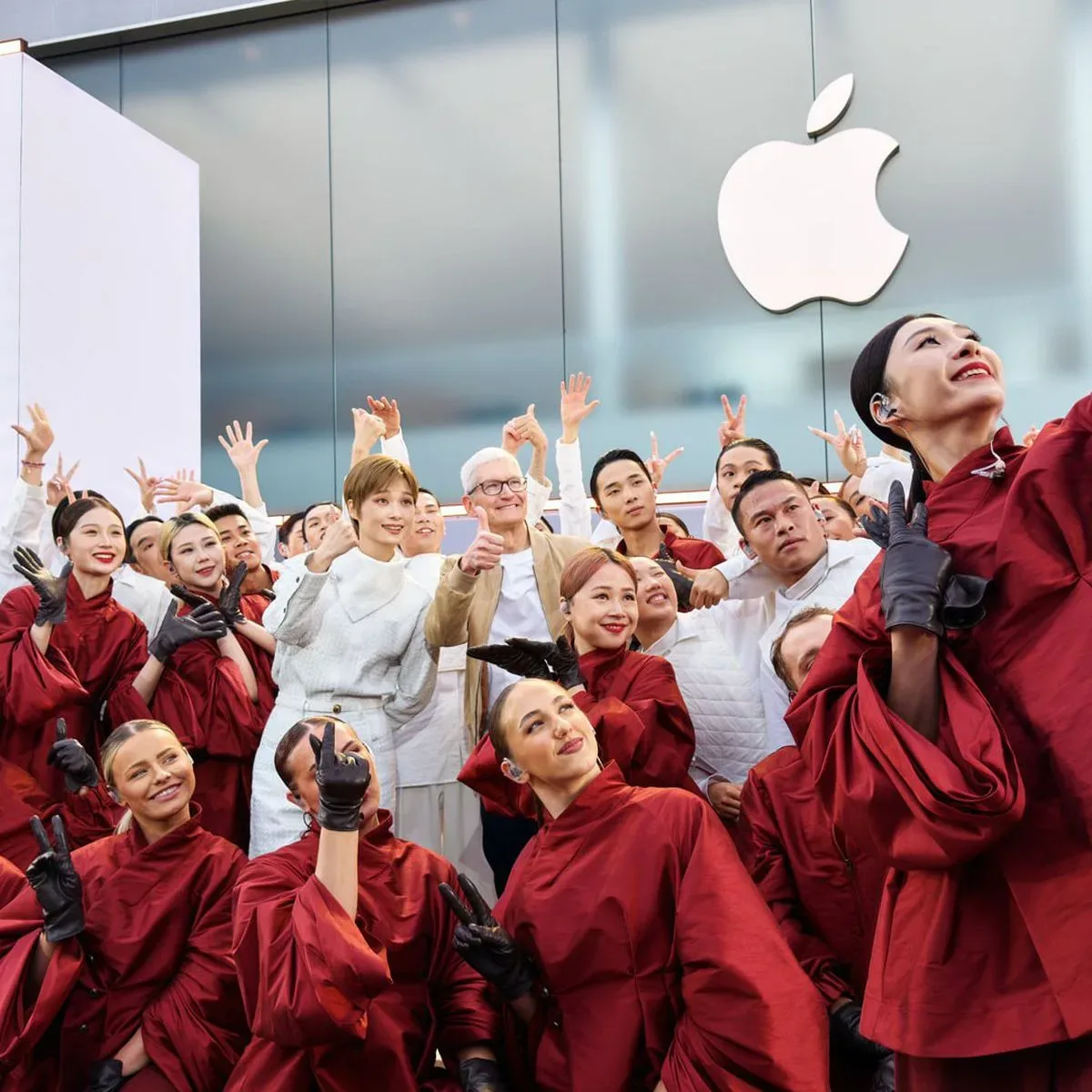
Apple executive chairman Tim Cook is making his third visit to China in 2026, with the latest trip putting Guangdong at the center of a discussion about the company’s manufacturing footprint, retail reach and future local development work. The timing is consequential: the visit follows the launch of the iPhone 18 Pro and iPhone 18 Pro Max by several weeks, and early sales indicators point to a strong start for Apple’s newest premium handsets in China.
Cook’s Guangdong meetings are reported to have focused on growing both manufacturing and sales operations. On October 11, he reportedly met Guangdong governor Meng Fanli, discussing the province’s role in Apple’s wider China business and prospects for additional activity. Cook expressed interest in doing more locally through smart manufacturing and expanded sales channels, while Meng said Guangdong would support further growth, including research and development.
That is a compact set of talking points, but each part matters. Apple’s relationship with China is not just about selling finished devices in a huge consumer market. It also depends on a deep network of suppliers and partners, particularly in regions such as Guangdong. A visit that combines policy-level meetings, supplier-region discussions and a public-facing retail stop highlights how closely those pieces fit together.
A new role, with government relationships explicitly in scope
This is Cook’s first China trip since taking the role of Apple executive chairman on September 1. John Ternus became Apple CEO at that point. Apple has said that Cook’s responsibilities in the chairman position include relationships with government policymakers, giving the Guangdong meeting particular relevance beyond a standard corporate visit.
Corporate titles can sound abstract, so it is worth separating what is known from what should not be assumed. The reported discussions concern possible expansion in manufacturing, sales channels and research and development; they do not establish a specific new facility, product plan, investment amount or timetable. Likewise, a provincial offer of support is meaningful as an indication of intent, but it is not the same thing as a completed agreement.
Still, Cook’s presence itself signals that the relationship is a senior-level priority. Meetings with policymakers can address the practical conditions surrounding a company’s operations: how it works with regional suppliers, how it reaches customers, and where it may place additional technical or development activity. Those are interlocking issues for any global hardware firm, especially one whose devices are assembled through extensive supply chains and then sold through a mix of physical stores and other channels.
What “smart manufacturing” means in this context
The phrase smart manufacturing generally describes the use of connected systems, data and automation to improve industrial production. In this case, the reported interest in smart manufacturing should be read as a direction of travel rather than a published list of factory technologies. No specific system or factory project was identified.
For Apple customers, manufacturing discussions can feel far removed from the phone in their hand. In reality, production operations affect whether a company can build complex devices consistently and at scale. That does not mean this trip guarantees changes to supply, device quality or future model availability. It does mean Apple and Guangdong are discussing the operational foundations that sit behind those outcomes.
The research-and-development component is similarly significant, though undefined. Research and development, often shortened to R&D, covers work to create, test and improve products or the processes used to make them. The reported support for R&D expansion does not reveal what Apple might develop, where any work would occur, or when it could begin. It does establish that the conversation was not limited to existing manufacturing and sales activity.
Guangzhou appearances give the trip a consumer-facing side
The visit has also included public moments in Guangzhou. Cook watched a creator use an iPhone 18 Pro to record martial-arts footage, an appearance that naturally spotlights the new handset’s camera as a tool for motion-heavy video. Cook also wrote on Weibo, “Great to be back in China!” Customers later reported that he visited an Apple Store in Guangzhou on Sunday.
The martial-arts filming demonstration is a straightforward but effective example of the kind of scenario phone-camera marketing often emphasizes: moving subjects, fast action and a creator shooting outside a traditional production environment. It does not, on its own, provide technical measurements or establish a broader camera comparison. What it does show is Apple placing the iPhone 18 Pro within a practical creative setting during a trip otherwise dominated by business and policy discussions.
That overlap is important for the games-adjacent technology audience, too. Flagship smartphones are not only communication devices; they are cameras, media machines and platforms used for games, social video and livestreamed content. Nothing in the visit amounts to a gaming announcement, and there is no evidence here of new Apple game partnerships or China-specific game initiatives. But stronger manufacturing and sales operations can matter indirectly for the hardware ecosystem in which mobile games, creators and accessory makers operate.
For players, the immediate takeaway is therefore modest: no new game has been announced, no service change has been confirmed, and no Apple hardware specifications have changed because of these meetings. The near-term relevance is commercial rather than feature-based. Apple is working to reinforce the supply, distribution and institutional relationships around the devices people use for mobile gaming and content creation.
Early iPhone 18 Pro figures add context to the timing
Cook’s return comes soon after the iPhone 18 Pro and iPhone 18 Pro Max began selling. Counterpoint Research placed Apple first in China’s smartphone sales ranking for September 14 through September 20. Separately, the first three days of sales for the new Pro models in China were reported to be 12% higher than the number of units their predecessors sold across their entire first week of availability a year earlier.
The comparison needs to be read precisely. It concerns the new Pro phones in China, and it compares three days of this launch with a full first week for the prior generation. It is a measure of an early launch window, not a full-year demand forecast and not a complete picture of Apple’s entire iPhone lineup. Even so, it offers a notable indication that the newest premium models started strongly in the market.
Early ranking data and an early launch-sales comparison answer different questions. A sales ranking for a defined period indicates where a company sits against smartphone competitors during that window. The 12% figure compares the pace of new Pro-model sales against the preceding Pro generation’s launch performance. Neither figure tells us why customers bought devices, which exact model configuration they chose, or whether momentum will persist.
For Apple, the combination of encouraging early performance and a high-level China visit makes strategic sense. A stronger-than-previous initial reception for the Pro range provides a favorable backdrop for discussions around further sales channels. At the same time, the company’s continued engagement with Guangdong underscores that demand alone is not the whole story; hardware sales depend on the manufacturing and partner networks that make product launches possible.
This is Cook’s third China trip this year
Cook has already visited China twice in 2026. In March, he traveled to Chengdu and Beijing as Apple marked its 50th anniversary, and he addressed the China Development Forum. In May, he was among business leaders accompanying President Donald Trump for talks with Chinese President Xi Jinping.
Those visits provide useful context for the October trip. The March visit connected Apple’s anniversary moment with an economic-policy forum. The May visit placed Cook among business leaders during high-level U.S.-China talks. The latest stop is more closely tied to Guangdong’s industrial and commercial role, with reported discussion of local manufacturing, sales channels and R&D.
It would be a mistake to collapse those three trips into one simple narrative or infer commitments that have not been announced. Yet their frequency illustrates the value Apple places on direct engagement in China during a year of leadership change and a major iPhone launch. As executive chairman, Cook’s policymaker relationships are part of the job, and the Guangdong meetings show that responsibility being exercised in a region central to Apple’s partner network.
What to watch next—and what remains unknown
The clearest confirmed picture is one of continued engagement: Cook is visiting China again, has held reported talks with Guangdong’s governor, and has appeared publicly in Guangzhou as the iPhone 18 Pro range begins its market life. The bigger questions are still open.
- Manufacturing: The talks raised the possibility of more local work through smart manufacturing, but no named project, site or schedule has been detailed.
- Sales: Apple is interested in additional sales channels, though the form of those channels has not been specified.
- R&D: Guangdong has indicated support for expansion, but there is no public description of an R&D program or the products it could influence.
- iPhone demand: Initial Pro sales have been strong by the cited comparison, but longer-term performance cannot be determined from the first days of availability.
- Gaming implications: The visit does not introduce a new Apple gaming policy, service or game launch. Any impact on mobile gaming remains indirect.
Apple’s latest China visit is best understood as a business and relationship-building trip with several layers: provincial government engagement, supply-chain relevance, possible future development work, retail visibility and a timely iPhone 18 Pro showcase. Its most concrete consumer signal is the early performance of the new Pro phones. Its most consequential longer-term signals may emerge only if the broad discussions around manufacturing, sales and R&D develop into specifics.
For more Apple hardware context, see our coverage of the Apple Watch SE 3 GPS price listings.