For an industry pitch built on polish, speed and a future without awkward human limitations, a sudden 20-second switch into Cantonese during an English-language interview is about as unhelpful a demo as it gets.
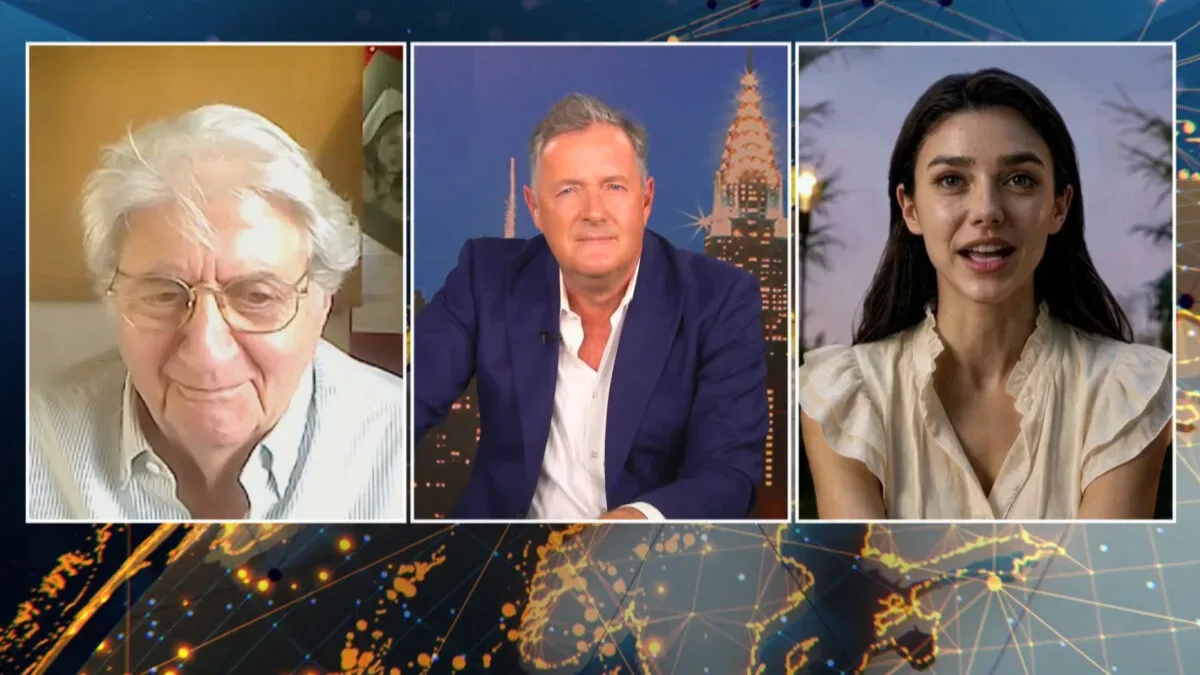
A clip of AI-created performer Tilly Norwood, appearing alongside actor Tom Conti in an interview with Piers Morgan, has circulated after a question about whether her co-stars were also computer generated appeared to derail the exchange. Norwood seemed unable to process the question, paused, and then began speaking Cantonese. Conti responded that he had not understood the answer and asked whether Morgan had.
It is a small, strange moment rather than proof of what every AI system can or cannot do. But it is revealing because it occurred in precisely the setting synthetic performers are supposed to master: a tightly framed public-facing conversation, where the product is not merely a rendered face but the impression of comprehension, personality and presence.
A performer is more than a convincing image
Norwood has been promoted by AI firm Particle6 as an artificial movie star for roughly a year. The company is using a press tour to draw attention to Misaligned, its first film, which follows an AI performer trying to win acceptance from humans.
That framing puts an unusual amount of weight on a basic question: what does it mean to call an AI character an actor, let alone a movie star? A digital character can be visually sophisticated while still relying on a system that struggles with conversational context. Likewise, a fluent sentence does not necessarily demonstrate that the system has correctly interpreted an unexpected question.
The distinction matters. In ordinary usage, an actor’s work includes responding to direction, maintaining a coherent character, understanding partners and adapting to the emotional or practical rhythm of a scene. A promotional interview is a similarly unforgiving test. The participant has to handle interruptions, ambiguity and questions that were not neatly anticipated in a prewritten script.
Norwood’s pause and language shift made that gap conspicuous. Viewers did not need specialist knowledge of machine learning to recognize a breakdown in the social contract of an interview: one person asks something, the other person addresses it. When that exchange fails, an uncanny visual presentation becomes more noticeable, not less.
Particle6 calls the detour a display of language ability
Particle6 chief executive Eline van der Velden characterized the Cantonese turn as Norwood showing language skills, suggesting that the character may have wanted to demonstrate them because previous interviews had been conducted in English. Van der Velden also described Norwood as autonomous.
That explanation highlights one of the central communication problems around AI performers. Autonomous can mean very different things depending on the system and the production process. In a broad technical sense, it may indicate that software can generate an output without a human selecting every word in real time. It does not, by itself, explain how the output was prompted, constrained, monitored, edited or approved, nor does it establish human-like understanding or independent intent.
Those details are especially important when an AI character is presented as a public personality. A synthetic performer may be assembled from several layers: an image or animation system for the face and movement, a voice system for speech, and a language model or other software to generate responses. If one part handles a question poorly, the audience experiences the total result as the character failing, regardless of which technical layer produced the issue.
That is not a standard human performer is normally asked to clear. Audiences may judge an actor’s performance, but they do not usually have to wonder whether a sudden non sequitur came from a dialogue model, an animation workflow, a translation process or a decision made off-camera. With an AI personality, the machinery is part of the performance whether its backers want it to be or not.
The real hurdle is trust, not just photorealism
Companies pursuing AI entertainment often emphasize the prospect of creating material quickly and reducing dependence on human creative labor. Yet the Norwood clip suggests why a technically functional output is not the same as a persuasive piece of entertainment.
Visual quality can be judged in a single frame. Believability has to survive time. It depends on consistency from one response to the next, understandable speech, appropriate reactions and a sense that a character is engaged with the person in front of them. In that sense, a live interview is closer to a stress test than a glossy promotional render.
There is also a difference between a short-form clip and sustained storytelling. A brief social post can succeed on novelty alone: a striking image, an unexpected voice or the simple curiosity of seeing software imitate a familiar format. A film, series or recurring public figure asks for something more durable. The audience needs a reason to keep watching after the novelty has worn off.
Misaligned is therefore a notable choice of subject for Particle6’s first film. Its premise—an AI performer seeking acceptance among humans—mirrors the wider reception challenge facing projects built around synthetic talent. The public discussion is not only about whether the imagery is technically possible. It is also about whether people want this kind of performer to occupy roles historically held by artists and crews, and whether the result gives audiences something that conventional production does not.
Why labour concerns sit behind the awkward clip
The reaction to AI performers cannot be separated from concerns about work in film and television. Industry groups are continuing to seek protections for actors and crew as studios explore ways to cut human labor. That background changes how an apparently silly interview malfunction is received.
If a synthetic character were presented simply as a visual-effects experiment, audiences might treat the failures as part of the experiment. When the surrounding pitch includes replacement, efficiency or a route around human creators, glitches can carry a different meaning. They become evidence, fair or not, in a larger argument over whether the technology is ready, desirable and being deployed responsibly.
That does not mean every use of AI in entertainment is identical. The term covers many possible tools and workflows, and the supplied information does not establish how any particular production is made. But the distinction between assisting a human production and marketing a synthetic personality as a replacement performer is substantial. The latter asks audiences to form a relationship with the system’s output as though it were a star.
That is a high bar. People do not only watch performers for technical competence. They bring interest in craft, biography, chemistry and the sense that a person made choices within a role. A company can manufacture a face and a voice, but it still has to persuade viewers that following that character is rewarding rather than merely novel.
What the moment does—and does not—show
It would be a mistake to treat one viral clip as a comprehensive verdict on AI-generated media. It does not prove that no artificial character can sustain a conversation, nor does it explain the complete technical setup behind Norwood’s appearance. The available account does not establish whether the exchange was live, how responses were generated, or what human oversight was involved.
What it does show is the risk of presenting a system as a celebrity before it can reliably meet the ordinary expectations that come with celebrity. The more a project leans on words such as “actress,” “star” and “autonomous,” the more viewers will judge it by the standards attached to those labels rather than by the looser standards of a tech demo.
That is why the Cantonese detour landed so sharply. The issue was not simply that Norwood spoke another language. It was that the language shift appeared disconnected from the question being asked, at the exact moment the character was expected to demonstrate conversational awareness.
For anyone following the wider AI push, including debates around AI features in consumer software, the underlying lesson is familiar: a polished interface can hide a complicated system, but it cannot automatically create confidence. AI products are increasingly judged on the gap between the promise and the experience.
Particle6 may see Norwood’s unexpected multilingual response as a showcase. Many viewers will see it as a reminder that an AI performer is not judged solely on whether it can generate output. It is judged on whether that output feels meaningful when another person asks a straightforward question. At least in this clip, the human actor’s baffled response supplied the clearest line reading.