Home-theater upgrades have a habit of beginning with a simple wish—make the dialogue easier to hear, give an action scene some weight, stop relying on a television’s tiny built-in speakers—and ending in a spreadsheet full of separate speakers, cables, mounts, and add-ons. That is why a soundbar package that includes its subwoofer deserves close attention, particularly when it is discounted.
Sony’s BRAVIA Theater Bar 5 has been listed at $278, a reduction from its $350 list price. That works out to 21% off, and the key detail is that the price covers more than the bar itself. The package is a 3.1-channel system with a wireless subwoofer included, rather than a soundbar that asks buyers to budget separately for the lower-frequency component later.
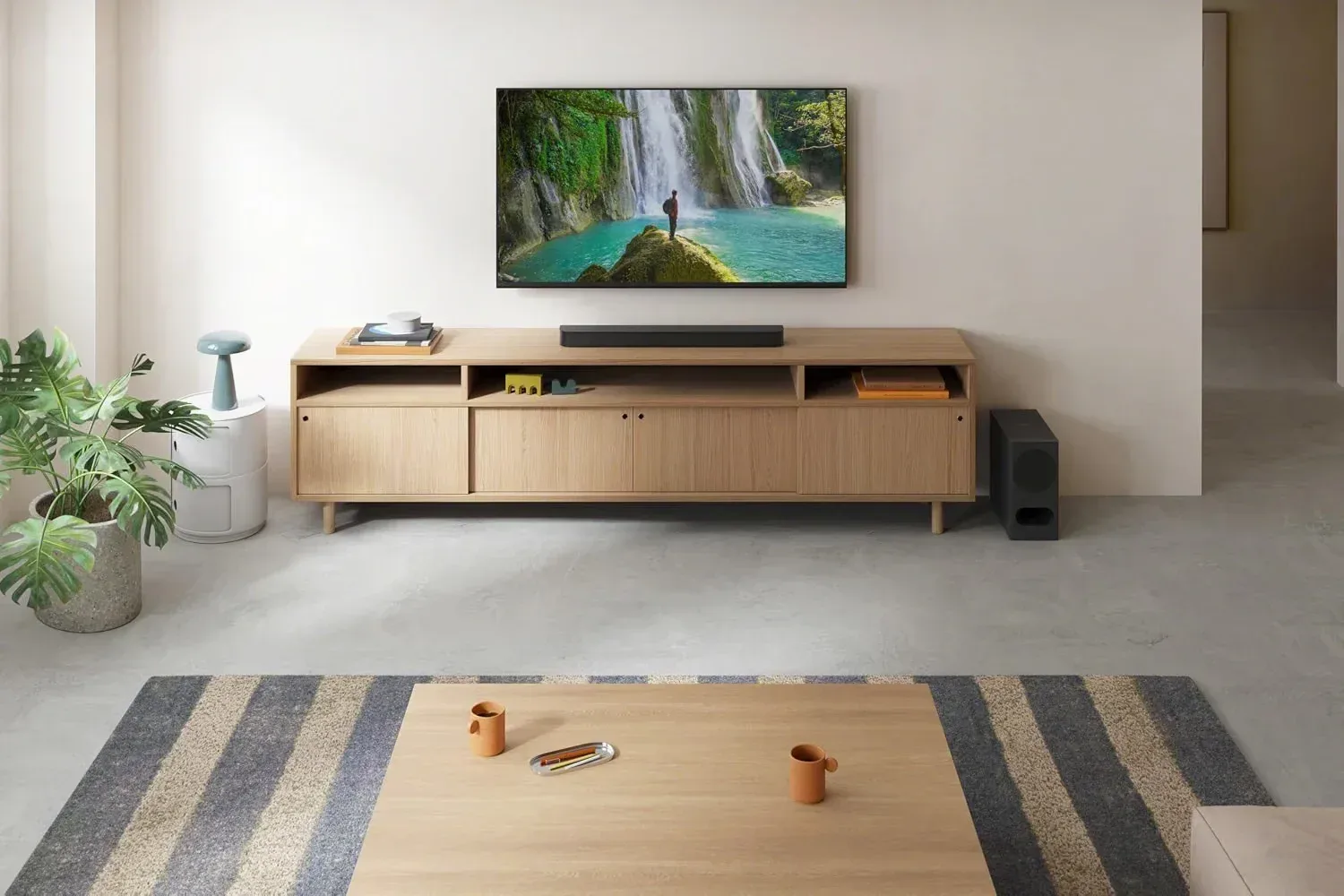
For players building a more convincing setup around a PlayStation console, or anyone alternating among films, shows, and music, the appeal is easy to understand. The Theater Bar 5 is positioned around practical home-theater priorities: a dedicated channel for voices, a separate box for bass, virtualized surround and height processing, and Bluetooth playback when the TV is not part of the plan.
It is not a full room-filling speaker array with physical rear channels or ceiling-mounted hardware. But its feature list aims to cover several reasons people consider a larger system in the first place, while keeping the core package in a much simpler form.
A real center channel matters for dialogue-heavy games and movies
The “3.1” designation is important. In this configuration, the left and right channels handle the broad stereo presentation, the .1 refers to the subwoofer, and the third front channel is a physical center speaker. That center channel is intended to anchor dialogue and other audio elements that are meant to come from the middle of the screen.
Many less elaborate soundbars use their left and right drivers, plus digital processing, to create an impression of centered speech. That can be perfectly workable, but a dedicated center channel has a direct purpose: it gives dialogue a specific place in the system’s layout. For a game with mission briefings, a cinematic RPG with long conversations, or a movie where plot details arrive in a whisper over a busy soundtrack, that distinction is relevant.
It also reflects a basic frustration with TV sound. Modern televisions can be remarkably thin, leaving limited space for the larger speaker enclosures that help voices sound substantial. A separate soundbar changes where that sound comes from and gives the system more room to separate vocal content from music and effects.
There is no promise that any hardware feature will solve every dialogue issue in every room. Volume balance can depend on a mix, a listener’s seating position, a room’s reflective surfaces, and personal hearing needs. Still, a physical center channel is a meaningful specification for someone whose first criterion is not simply “louder,” but “clearer.”
The included wireless subwoofer is part of the value equation
The wireless subwoofer uses a 160mm speaker unit. Its role is to handle bass that a relatively compact soundbar cannot reproduce with the same physical presence. Explosions and engines are the obvious examples, but low-frequency sound also informs the impact of a game soundtrack, the tension of a horror sequence, and the rumble beneath a big-screen action set piece.
“Wireless” here helps reduce one particular installation headache: the subwoofer does not need an audio cable run back to the bar. It still needs power, so it is not a cable-free magic trick. But the absence of a signal wire can make placement less awkward in a living room, especially when the ideal spot is not immediately beside the television stand.
This is also where the $278 price deserves to be considered as a package price rather than merely a soundbar sale. Shoppers comparing hardware should check whether a competing system includes its subwoofer in the box, because buying one separately can significantly change the total. A lower sticker price on a bar alone is not always a lower cost for a comparable bar-and-subwoofer setup.
That does not automatically make one system the right choice for every room. Those with very limited floor space may prefer an all-in-one bar, while enthusiasts seeking true surround separation may want physical rear speakers. The Theater Bar 5’s proposition is more straightforward: it brings a center channel and a separate bass component into one 3.1-channel bundle.
Atmos and DTS:X without extra height speakers
The BRAVIA Theater Bar 5 supports Dolby Atmos and DTS:X content through Sony’s Vertical Surround Engine. Rather than relying on up-firing drivers to bounce sound off a ceiling, the processing is designed to create a sense of vertical placement from the front of the room.
That is a useful distinction for shoppers parsing the increasingly crowded surround-sound vocabulary. The system is not described as including physical height speakers, side surrounds, or ceiling speakers. Its approach is signal processing: it attempts to place audio above the listening position without requiring those extra components.
How persuasive virtual height effects feel is not universal. Room shape, ceiling characteristics, seating, content, and individual preference can all affect the result. Some listeners will appreciate the additional spaciousness, while others may prefer to think of it as a subtle expansion rather than a substitute for a fully speaker-equipped Atmos installation. Either response is reasonable, and the specification should be evaluated with that expectation in mind.
Sony also includes S-Force Pro processing to make the stereo soundstage seem wider than the physical bar. For a setup where every speaker sits across the front wall, widening can help avoid the sensation that all music, ambience, and game effects are confined to the width of the television furniture.
For more on the console side of Sony’s wider ecosystem, readers can follow the ongoing industry story around Hideo Kojima’s Physint publishing plans. The Theater Bar 5 is a home-audio product rather than a PlayStation accessory, but the broad use case is familiar: games increasingly place as much emphasis on atmosphere, score, and positional cues as on the image itself.
BRAVIA owners get an additional dialogue tool
Setup and ongoing updates run through the BRAVIA Connect app once the Theater Bar 5 is connected to a network. The app is intended to guide placement and configuration, while also handling firmware updates. That approach may be convenient for people comfortable with app-based setup, although the included remote remains available for common controls.
That remote can adjust volume, bass level, and sound modes without requiring a phone. It is a small but useful inclusion: a sound system should not make a basic volume change feel like opening a settings menu in a live-service game.
Owners of compatible Sony BRAVIA TVs have an additional feature, Voice Zoom 3. When the TV and soundbar communicate through the BRAVIA connection, the AI-driven function is designed to further enhance dialogue clarity. It is specifically an added consideration for BRAVIA TV households, not a universal feature to assume across every television brand.
Bluetooth support gives the bar a second job beyond TV and console audio. Phones and tablets can stream music to it without the television being powered on. That is common functionality at this level, but it remains useful for a living-room device that may also serve as an everyday music speaker.
What to weigh before treating the discount as an automatic buy
The listed $278 figure is compelling chiefly because of the overall configuration. Buyers considering it should focus on whether its particular compromises fit their space. The package has a dedicated center channel and a wireless subwoofer, but it does not eliminate the value proposition of a true multi-speaker surround setup for people who specifically want physical sound behind or above their seating position.
Likewise, virtual surround processing is an attempt to create a larger field from the front of the room, not a claim that the bar has become a set of discrete speakers throughout the room. That difference matters when comparing products, and it is worth keeping expectations grounded.
Still, the BRAVIA Theater Bar 5’s current listing addresses a common upgrade path efficiently. At $278 versus a $350 list price, it combines a 3.1-channel bar, a physical center channel, a 160mm wireless subwoofer, Dolby Atmos and DTS:X processing, Bluetooth streaming, remote control, and app-guided setup in the same box. For someone seeking stronger dialogue and real bass without beginning a lengthy component-by-component home-theater project, that is the central reason the deal stands out.
Shop the products
Check current price, model and availability at the retailer.