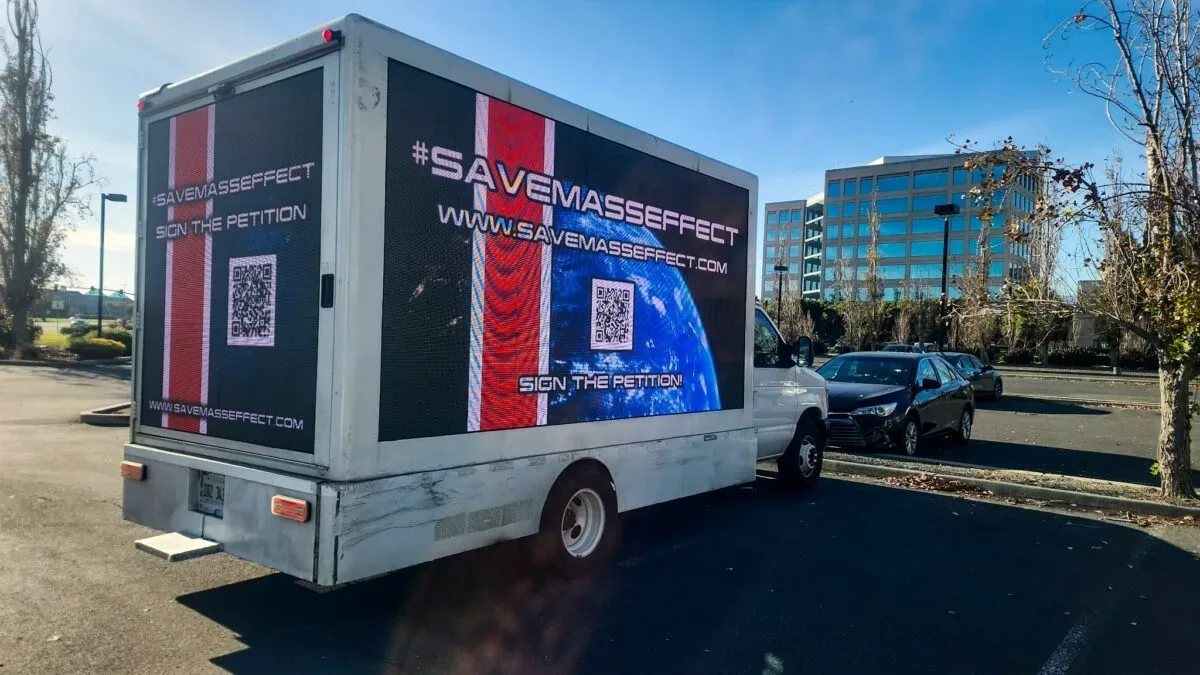
A mobile billboard truck carrying a #SaveMassEffect message is circling Electronic Arts’ Redwood City headquarters, turning a fan campaign into an unusually literal drive-by plea for the future of BioWare’s sci-fi role-playing series.
The vehicle was arranged by We Are Mass Effect organizers Ariel Aguilar and Mer with content creator Kala Elizabeth. Its scheduled route is intended to run for four hours, ending at 1 p.m. Pacific Time. Organizers said the driver would circle as close to the property as possible without trespassing, and they have asked local supporters to share photographs while explicitly telling people not to enter EA property.
That boundary is important. The action is designed as visible advocacy rather than a disruption of the workplace. A mobile billboard differs from a permanent sign chiefly in its movement: it can bring a message directly through the public streets surrounding a company campus, but it remains subject to ordinary access and property limits. In this case, the organizers’ stated instruction is clear—watch, document if nearby, and do not cross onto the headquarters grounds.
A campaign moving from screens to streets
The truck is the latest public-facing piece of a crowdfunding-backed #SaveMassEffect effort that began last month. The campaign has financed billboards near EA offices and around December’s Game Awards, seeking to demonstrate that players still want the Mass Effect series to continue after BioWare closed on October 21.
One earlier billboard appeared in Times Square. The Redwood City vehicle applies a different kind of pressure: instead of asking passersby in a broad entertainment district to notice the message, it makes the campaign visible in the immediate area around the publisher that controls the franchise. It is a symbolic move, not evidence of a change in EA’s plans. Still, symbols are precisely what these efforts are built to create—an unmistakable, shareable record that a group of fans is organized enough to raise money and put its concern in public view.
There is a practical media logic to this as well. A truck can be photographed repeatedly as it travels, allowing people who cannot attend to see the action online. Organizers’ request for pictures suggests the physical route and the digital conversation are meant to work together. The sign gets attention in person; photos let supporters extend that attention beyond Redwood City.
Why the timing matters
The campaign arrives one day before November 7, known to fans as N7 Day. BioWare had previously marked the date as an annual celebration of Mass Effect. That calendar placement adds an emotional charge to the billboard action: a day traditionally associated with a community celebration is now approaching amid uncertainty over the studio and a cancelled project, Mass Effect: Universe.
Recent attention around the date has also highlighted that licensing agreements for new Mass Effect merchandise had apparently been arranged before BioWare shut down. The existence of merchandise plans does not establish what will happen to the games themselves, nor does it promise a revival. But it helps explain why fans have been especially alert in the days before N7 Day. For a community looking for signs of continuity, remnants of planned activity can feel like reminders of what might have been announced or teased under different circumstances.
Related coverage includes Save Mass Effect Campaign Sends Mobile Billboard Around EA Headquarters Ahead of N7 Day.
The phrase “cancelled” carries a specific meaning here. It refers to the reported end of Mass Effect: Universe, not an assurance that every possible future use of Mass Effect is impossible. The truck campaign is asking for continuation, but neither the vehicle nor the previous billboards signal that EA has agreed to sell the property, restart work, or form a replacement development team. Keeping that distinction in view matters when fan energy is running high.
What the supporters are asking for—and what makes it difficult
The wider push has not stopped at advertising. Canadian fans have signed an e-petition asking the House of Commons to examine whether BioWare developers could receive funding that would allow them to purchase the studio and its intellectual property from EA.
“Intellectual property,” often shortened to IP, means the legal rights attached to a creative work: its name, characters, settings and other protected elements. In this situation, a proposal involving the Mass Effect IP would necessarily depend on EA’s cooperation. Public funding, a petition, fan interest and a willingness by developers to regroup would not, by themselves, transfer ownership of a publisher-controlled franchise.
That does not make the petition or billboard meaningless. They are methods of demonstrating public support, concentrating attention and articulating a preferred outcome. They are not mechanisms that compel a private owner to sell. The distinction is the central tension behind the whole campaign: supporters can make a sustained case for preserving the people and series they care about, but the decisions needed to create a new studio or move franchise rights remain far outside a fan group’s direct control.
In other words, the campaign has a cultural target and a business target. Culturally, it asks people to remember Mass Effect as a series worth continuing. Commercially, it aims that sentiment at EA, whose participation would be required for the ownership scenario supporters have raised. A mobile billboard cannot resolve either question. What it can do is make the request impossible to mistake for passive online nostalgia.
The careful line between advocacy and escalation
The organizers’ anti-trespassing reminder is more than a routine disclaimer. It establishes the kind of campaign they are trying to run. A visible public demonstration can invite participation without asking participants to interfere with staff, access restricted spaces or create a confrontation. That approach makes the message easier to separate from conduct that could harm the cause it is trying to advance.
For anyone who happens to be nearby, the stated request is limited: photographs can help document the truck, while EA property remains off-limits. For everyone else, the immediate event will likely be experienced through those shared images and the discussion around N7 Day rather than from the streets outside the headquarters.
The campaign’s future-facing argument is simple even if the path to achieving it is not. Supporters want Mass Effect to survive BioWare’s closure, and they are using crowdfunding, outdoor advertising and political outreach to make that desire visible. The legal and corporate obstacles are substantial, particularly where ownership of the series is concerned. But the Redwood City truck shows that the #SaveMassEffect movement is continuing to seek public attention rather than waiting quietly for a decision it cannot make itself.
Mass Effect’s situation also sits within a broader conversation about keeping games and game histories accessible when corporate plans change. EA’s recent return of older titles to PC storefronts illustrates the behind-the-scenes work preservation can require, as explored in EA’s rediscovered classics vault story. Preservation and making a new Mass Effect are different goals, of course, but both depend on decisions made by rights holders and the companies capable of supporting the work.
For now, the most concrete development is the truck itself: a four-hour circuit near EA headquarters, deliberately kept on public ground, arriving just before a date that has long held meaning for Mass Effect fans. It is a protest with wheels, a promotional surface turned into a plea, and a conspicuous reminder that a cancelled project has not ended the community’s wish to see the galaxy return.