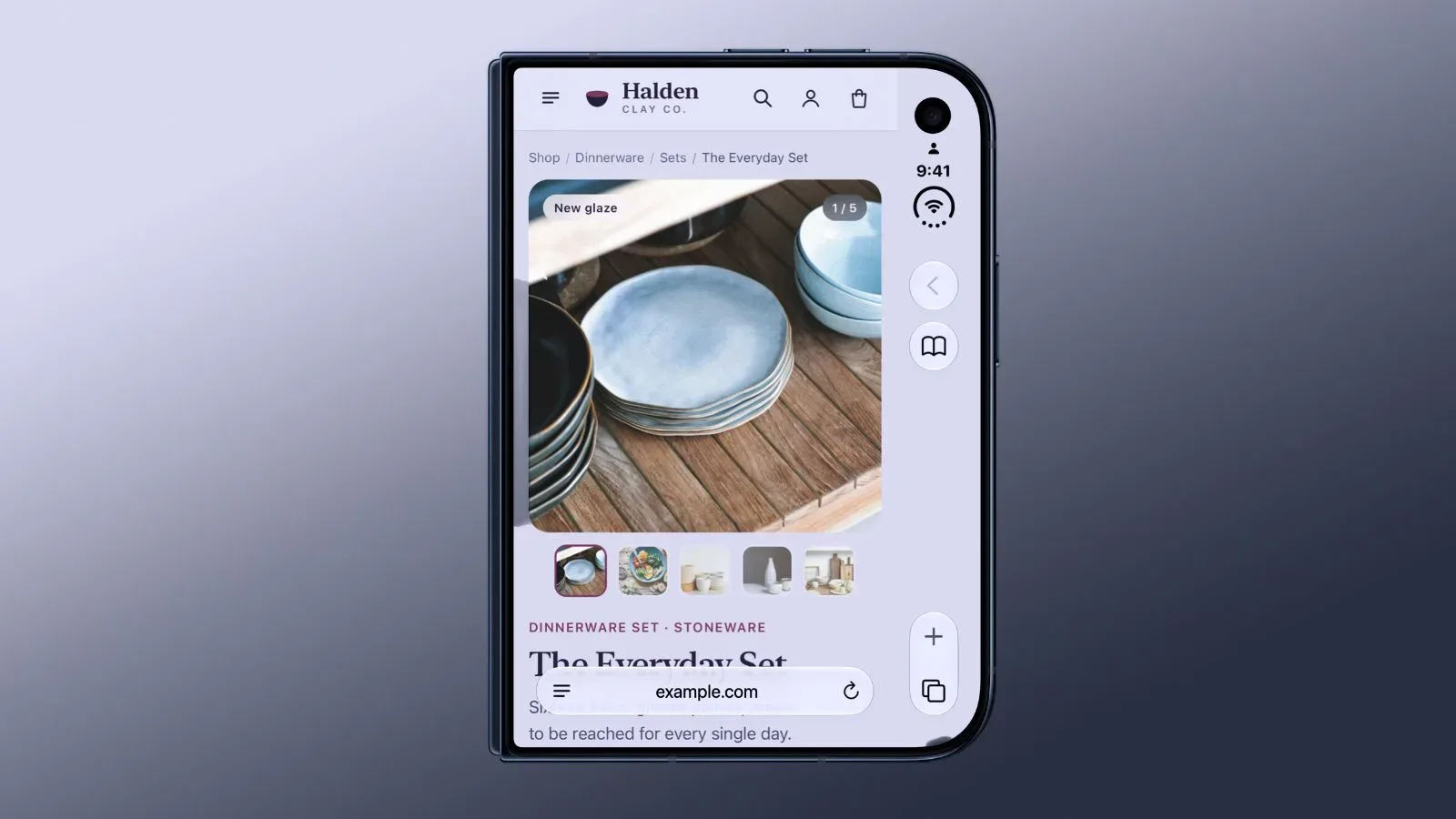
Samsung has turned a reported iPhone Duo display problem into the centerpiece of a new Canadian advertising campaign, using the familiar bright vertical line seen in affected inner screens as the visual punchline. The ads position the Galaxy Z Fold8 not simply as another folding phone, but as the choice from a company arguing it has spent longer solving the realities of the category.
Three images posted to Samsung Canada’s Instagram account carry variations on the same theme: folding is established territory for Samsung, and consumers unhappy with the iPhone Duo should move to the Galaxy Z Fold8. One image says Samsung has known folding for “a thing or eight,” a clear reference to the company’s eighth-generation Fold model. The campaign uses a sharp white line placed at the apparent trouble spot on the iPhone Duo’s inner panel, leaving little ambiguity about the issue it is invoking.
The ad arrives after some iPhone Duo customers reported hinge-related problems followed by cracks in the internal screen. In the reported cases, the affected area appears consistent: a break at the fold region accompanied by a bright line on the OLED display. Apple has acknowledged that an issue affects the inner display on a small number of iPhone Duo units and has directed people experiencing display trouble to AppleCare for a replacement.
That admission gives Samsung a narrow but potent opening. Foldables ask buyers to spend flagship-level money on a device whose most distinctive component is also its most unfamiliar one: a large display designed to bend repeatedly. A rival does not need to prove that every competing device will fail for a campaign like this to land. It only needs a visible, memorable failure mode and a claim to longer experience with the form factor.
What Samsung’s campaign is actually arguing
Samsung’s message is not a technical diagnosis of the iPhone Duo issue. The ads do not establish why the affected screens cracked, how widespread the problem is, or whether the Galaxy Z Fold8 is immune to comparable failures. Instead, they make a marketing argument about category maturity.
Samsung released its first Galaxy foldable smartphone in September 2019. The Galaxy Z Fold8, its eighth-generation Fold model, arrived three months before the iPhone Duo. That chronology is central to the campaign: Samsung is presenting years of iteration as an advantage customers should value when choosing a device that must open and close around a hinge.
A Samsung spokesperson characterized the work as a playful campaign built around the growing foldable rivalry and the importance of experience in the category. The tone is cheeky, but the underlying pitch is serious. In conventional slab phones, an ad can tout cameras, battery life, performance, or software features. In foldables, confidence in the hinge and flexible display is itself part of the product proposition.
Samsung’s “thing or eight” line works because it converts the model number into a claim of accumulated experience. It tells potential buyers that the company has seen more versions of the format, has had more time to learn, and has reached a later stage of refinement. That remains advertising, rather than an independently demonstrated reliability comparison, but it is a straightforward way to turn a rival’s reported defect into a reason to consider an alternative.
Why the bright line matters more than a vague durability claim
The campaign’s most effective visual is the bright line crossing the display at the area associated with the fold. It translates a hardware complaint into an instantly readable symbol. A consumer does not need to know the structure of a foldable panel or the details of a hinge mechanism to understand that a large bright stripe through a screen is not the intended experience.
OLED is the display technology named in reports of the affected iPhone Duo screens. In this context, the relevant point is simple: the bright line is visible on the inner panel itself, not merely a cosmetic mark on an exterior surface. The reports link the line with cracking around the hinge area, which is why Samsung can use the image to connect its own foldable history with a direct suggestion of reliability.
There is an important distinction between the confirmed information and the implication of the campaign. Apple says the issue concerns a small number of iPhone Duo units. Samsung’s ads are designed to make that problem feel representative of a first-generation rival product. Neither statement answers the broader question a prospective buyer may have: how likely is a particular iPhone Duo or Galaxy Z Fold8 to develop a display issue over time? The available information does not provide failure-rate data, a technical cause, or a device-by-device comparison.
That uncertainty does not make the campaign irrelevant. For expensive electronics, a small acknowledged defect can still shape perception, especially when it concerns the central feature a buyer is paying for. It does mean consumers should treat the campaign as competitive messaging rather than a substitute for a complete durability record.
Apple’s position: strong demand alongside a limited display issue
Apple’s response presents a different picture from Samsung’s ad copy. The company says early iPhone Duo users have responded very positively and says developers are rapidly updating apps to make use of the device’s form factor. At the same time, Apple has recognized the inner-display issue affecting a small number of units and says customers with a display problem should seek a replacement through AppleCare.
Those two points matter together. A foldable’s value is not limited to its ability to physically open. The larger internal canvas needs software that knows what to do with it. Apple’s statement indicates that app updates are part of the early iPhone Duo story, while the hardware concern is being handled as an issue requiring replacement support. For more perspective on how software support factors into the device’s appeal, see this look at the iPhone Duo’s everyday case as apps catch up.
Demand also complicates the narrative that Samsung is trying to create. Online iPhone Duo orders are backordered until January, although Apple has had intermittent in-store availability. A backorder is not evidence that every aspect of a product is problem-free, nor does it quantify the size of the display issue. It does show that the reports have not prevented substantial interest in Apple’s first foldable.
Samsung, meanwhile, appears to have Galaxy Z Fold8 supply available, with multiple colors and capacities listed for delivery on November 3. Availability is a practical advantage for shoppers who want a foldable immediately, particularly when the competing model is not readily available for online order. It is also an area where a consumer’s choice may be shaped by timing rather than by long-term preference between platforms.
Price sharpens the rivalry
The two devices sit close enough in price that Samsung’s attack is aimed at the same premium buyer rather than a different budget tier. The iPhone Duo starts at $1,999 with 256GB of storage. The Galaxy Z Fold8 is priced at $1,899 for the same capacity, a $100 difference.
At this level, buyers are unlikely to regard a foldable as a casual upgrade. The purchase combines a phone, a large-screen device, and a new physical design that comes with different expectations around carrying, opening, closing, and using apps across two screen states. The $100 gap is meaningful, but Samsung’s campaign is trying to make trust in the hardware the more consequential difference.
For someone considering either device, the immediate practical questions are less dramatic than the ads. Is the preferred model available when it is needed? Is the buyer comfortable with the respective platform and the apps they rely on? If considering iPhone Duo, are they aware that Apple has acknowledged a limited inner-display issue and that the stated remedy is an AppleCare replacement? If considering Galaxy Z Fold8, does Samsung’s longer foldable lineage align with the buyer’s priorities, rather than merely its marketing?
These are not questions the campaign can answer on its own. But it has successfully placed them at the center of the conversation. In a market where the defining hardware feature bends at a hinge, the image of a line across the screen carries unusual weight.
A rivalry moving from novelty to proof
Samsung’s move signals an increasingly direct phase of foldable competition. The company is no longer only asking consumers to try a futuristic-looking device; it is asking them to judge which manufacturer has earned trust through repetition. Apple, for its part, is entering that contest with reportedly strong early demand, developer interest in the new form factor, and an acknowledged issue on a small number of devices that gives its rival an obvious point of attack.
The Galaxy Z Fold8 campaign is memorable precisely because it concentrates a complicated issue into one visual: a bright line where a display is supposed to fold. But prospective buyers should separate the joke from the available evidence. Samsung has a longer history in foldables and a slightly lower listed price for matching 256GB capacity. Apple says its issue affects a small number of iPhone Duo units and advises affected owners to use AppleCare for replacement. Beyond that, the campaign’s certainty is marketing; the durability comparison remains a question the supplied facts do not settle.