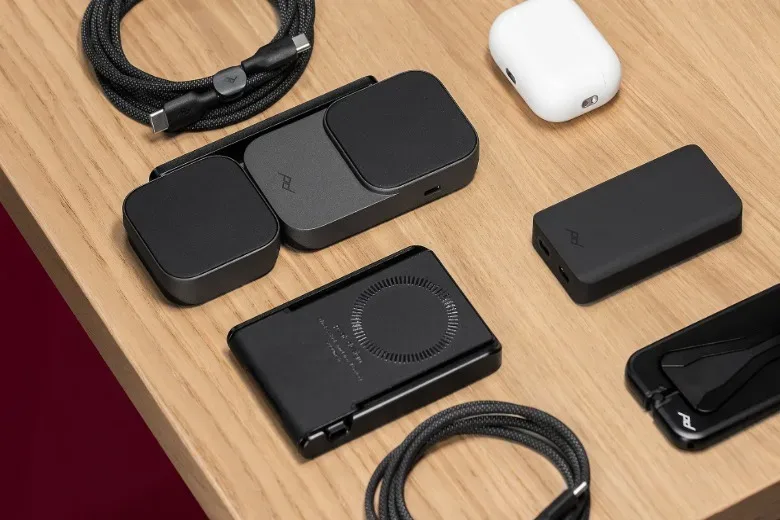
Peak Design is taking a familiar premium-design approach into a new category: charging accessories. The company’s first group of power products includes a wireless travel battery, a folding two-device wireless charging station, a thin dual-port wall charger and USB-C cables. They are designed around portability, compact storage and a coordinated ecosystem rather than a race to the lowest possible price.
For gamers and frequent travelers, that focus is easy to understand. A phone, handheld, laptop, watch and earbuds can turn even a short trip into a cable-management problem. Peak Design’s lineup does not eliminate the need to check a device’s power requirements, but it does put several useful travel-oriented formats on the table: a phone battery with a built-in stand, a flat-folding charger, a slim 65W adapter and cables offered at power levels suitable for handhelds and some laptops.
The new range is available to order through Peak Design and select retailers, with global availability expected in mid-November. As with the company’s bags and tripods, the emphasis appears to be hard-wearing materials and purposeful physical design—and the listed prices place these products above many basic charging alternatives.
A travel battery that doubles as a phone stand
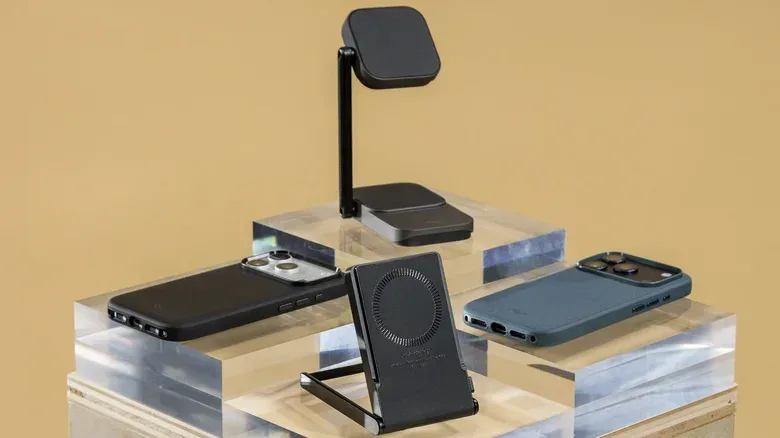
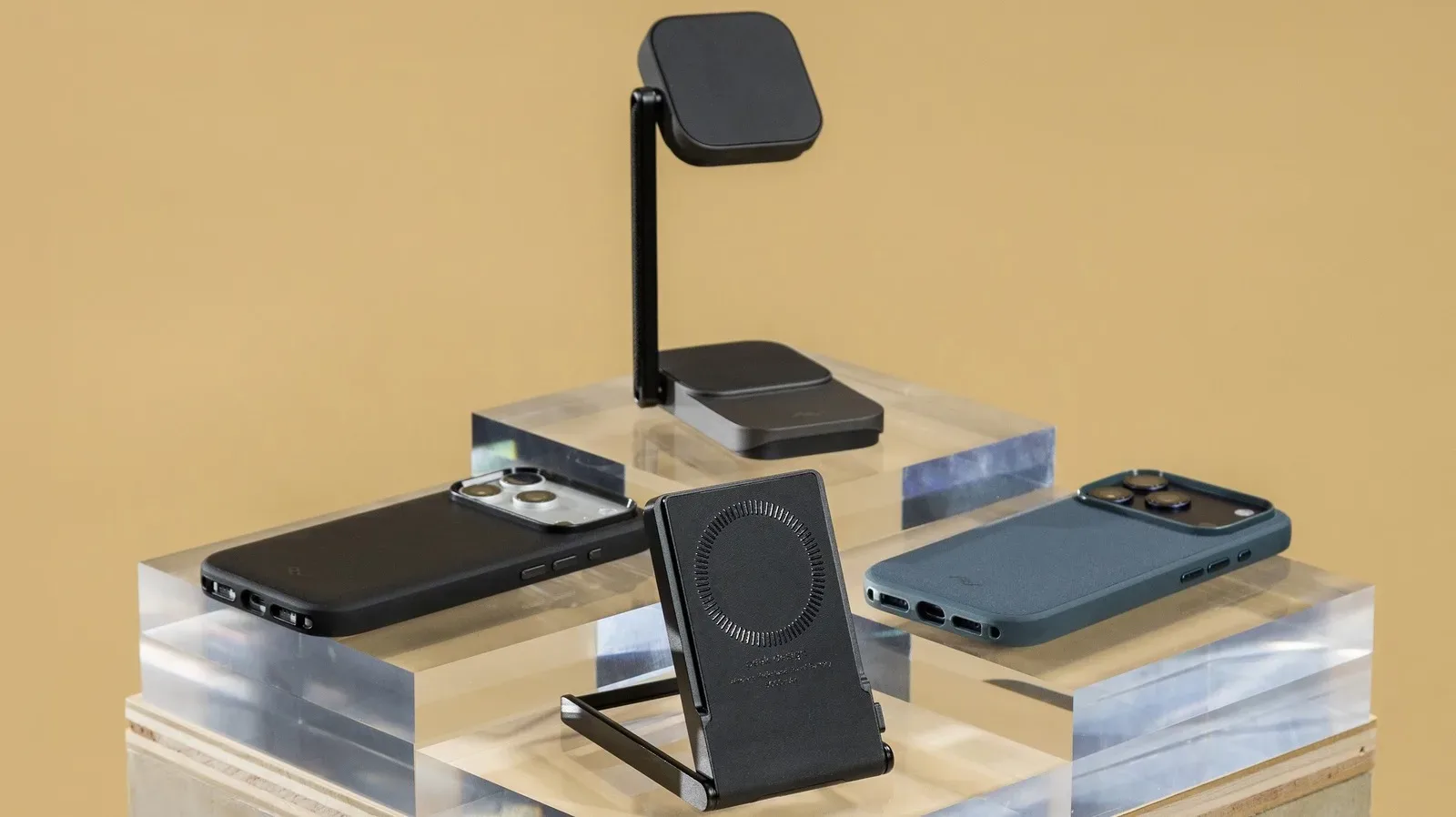
The $100 Kickstand Travel Battery is the most distinct item in the group. It combines a 5,000mAh battery with a magnetic wireless charging surface and integrated kickstand in a body Peak Design lists at 10.5mm thick. The stand can hold a compatible phone in either portrait or landscape orientation.
That orientation flexibility matters more than it may initially sound. Portrait is the conventional position for messages, maps and a quick social scroll, while landscape makes more sense for video, a mobile game or following a guide at a desk. The battery requires MagSafe or PixelSnap compatibility for this mounting approach, so prospective buyers should confirm that their phone or case works with the magnetic system before treating the stand as a guaranteed feature.
Peak Design says the battery delivers up to 15W of wireless charging when it is running on its own stored power. When plugged in, it provides up to 5W. Those are two different use cases, and they should not be conflated: the product’s highest stated wireless output is the 15W battery-powered figure, not the plugged-in figure.
The company also calls it the first wireless charger certified for Qi2.3. Qi is a wireless charging standard. In this case, the newer 2.3 designation should not be read as a new top-speed tier. The notable increase to 25W arrived with Qi2.2; Qi2.3 is described as a more behind-the-scenes refinement. Certification can still be meaningful as a compatibility and standards marker, but it does not mean this particular travel battery suddenly charges at 25W.
The folding station is the fastest wireless option here
Peak Design’s $100 2-in-1 wireless charging station has two Qi2.2 pads, each rated for up to 25W. This makes it the lineup’s higher-output wireless option on paper. It also has a 5V USB-C port intended for small additional devices, such as a smartwatch.
The station is built from die-cast aluminum and zinc, and it folds flat for storage. Fold-flat construction is especially practical for someone who otherwise carries separate charging pucks, a stand and a small wall adapter. The key benefit is not simply that the accessory can recharge two devices; it is that it can be packed as a single, more orderly piece of kit with a comparatively small footprint.
There is an important practical distinction between a stated maximum and the speed every device will receive in every setup. “Up to 25W” signals a ceiling. Real-world charging behavior depends on the receiving phone, its wireless charging support and the broader charging arrangement. Buyers should therefore regard the 25W number as a capability to match against their own hardware, rather than a promise that any phone placed on either pad will charge at that rate.
For a player who uses a phone as a companion device while gaming, the utility is straightforward: one pad can support the phone and the other a second compatible device, while the USB-C port may cover a smaller accessory. The product is not presented as a handheld-console dock or as a replacement for a device-specific power supply. Its appeal is consolidated bedside, desk or travel charging.
What GaN means for the Dual Slim Charger
The $65 Dual Slim Charger moves away from wireless charging entirely. It has two USB-C ports and provides up to 65W, using GaN, short for gallium nitride. In charging products, GaN is the technology associated here with enabling a compact charger design.
Peak Design has chosen a different shape from the familiar small charging cube. The adapter is half an inch thick and has fold-flat prongs, favoring a flatter profile that may suit a pocket in a bag, a tech pouch or the outer compartment of a backpack. Shape is not a trivial consideration with travel chargers: a compact cube can still protrude in an awkward way, while a thinner adapter can sit more neatly against other packed gear.
The 65W total output is the important specification. “Dual” describes the port count, but it should not automatically be interpreted as 65W available to each connected device at the same time. Anyone intending to power more than one item should consider the charger as a 65W-class shared-power accessory and make sure their laptop, handheld or other device is appropriately supported.
For context, USB-C is a connector format rather than a universal guarantee of identical charging behavior. Cable capability, charger output and the device’s own accepted power all matter. Readers looking to untangle that terminology can also see why USB-C’s name does not itself define charging or connectivity.
UltraStrand cables cover compact and high-power needs
Peak Design is also introducing UltraStrand USB-C cables. The company says they are designed for kink resistance and durability, and each includes an integrated clip for keeping excess cable under control. That clip is a modest feature, but it addresses an everyday annoyance: loose cables repeatedly tangling with chargers, handheld cases and other accessories inside a bag.
The range starts at $25 for a 60W version. A $40 model supports up to 240W. Lengths run from 15cm to 2 meters, giving buyers a choice between short links for tightly packed charging setups and longer cables for hotel outlets or desktop use.
The 240W option is positioned for laptops as well as devices including the Steam Deck and Switch 2. That stated ceiling does not mean every USB-C device needs, accepts or will draw 240W. It means the cable is rated to support substantially higher-power use cases than the 60W version when paired with compatible equipment. Selecting a cable should still begin with what the device and charger can use—not simply the largest number on the packaging.
The 15cm size has a particularly clear travel role. Shorter cables can reduce clutter when a battery is attached close to a device or when several items are charging from one compact station. A 2-meter cable is more useful when the outlet is inconveniently placed. Neither is universally better; the correct length is the one that avoids both unnecessary slack and an over-tight connection.
Premium positioning, with a lifetime guarantee
At $100 each for the travel battery and 2-in-1 station, $65 for the Dual Slim Charger, and $25 to $40 for cables, this is plainly not a budget-oriented launch. Peak Design is betting that material choices, slimmer shapes, folding construction, integrated cable control and travel-specific utility can justify the premium.
The company is offering a lifetime guarantee across the products, a commitment that fits its durability-focused pitch. It is nevertheless sensible to distinguish a guarantee from a technical specification: the guarantee speaks to the company’s support commitment, while compatibility, charging rates and physical fit still need to be evaluated product by product.
The strongest case for the lineup is a person who values a consistent, compact travel loadout and can make use of the particular designs. The Kickstand Travel Battery makes most sense for a MagSafe- or PixelSnap-compatible phone owner who wants a small stand as well as backup power. The folding station is better suited to users with multiple Qi2-compatible devices. The Dual Slim Charger is the more conventional, broadly useful choice for someone who needs a thin two-port USB-C adapter, while UltraStrand cables provide options for both low-clutter packing and higher-power connections.
Peak Design is entering a crowded field, but it is not trying to make anonymous charging essentials. The new accessories lean into the same proposition that built the company’s reputation in bags and tripods: everyday equipment can be thoughtfully engineered, made to travel well and priced as premium gear. Whether that equation works for an individual buyer will depend less on the novelty of charging itself and more on whether these specific shapes, magnetic mounting features and power ratings simplify the devices they already carry.