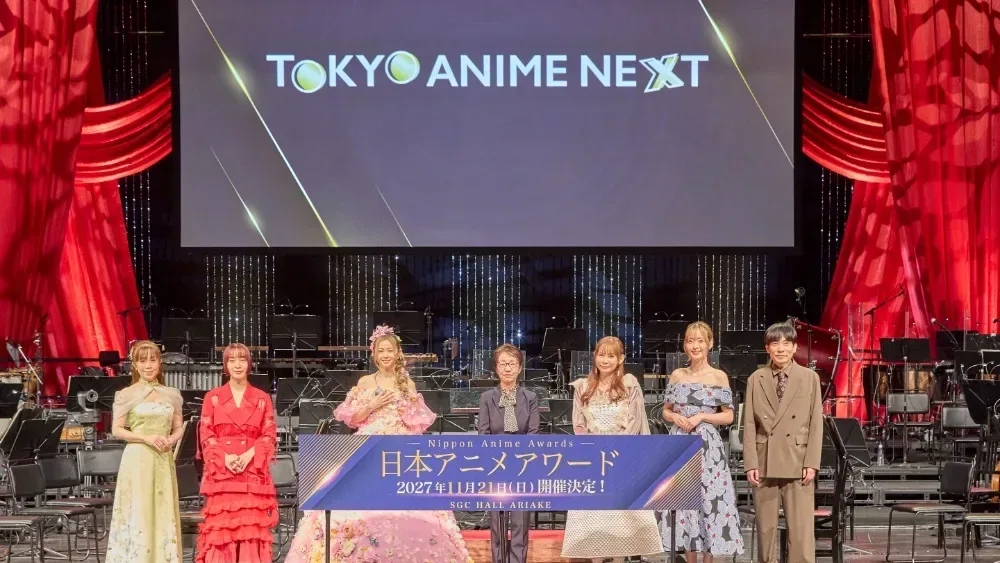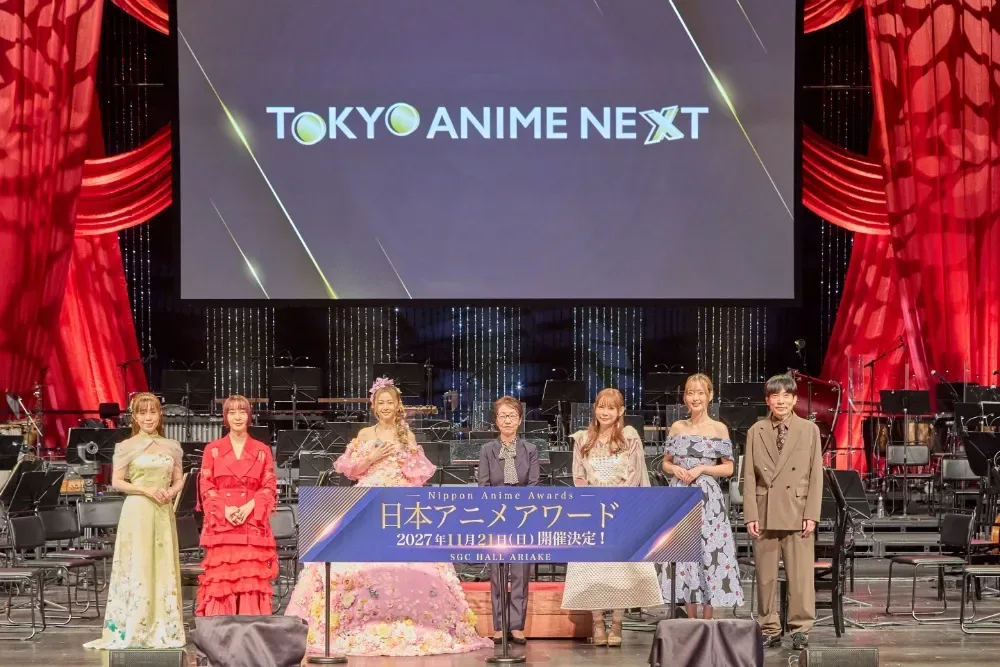
Japan’s newly named Nippon Anime Awards will hold its first ceremony on Nov. 21, 2027, at SGC Hall Ariake in Tokyo’s Ariake district. The prize is being established by the Association of Japanese Animations (AJA), with an ambition that reaches beyond a conventional trophy night: it is intended to recognize outstanding anime works and the people behind them, while also supporting business opportunities and young talent.
The name was revealed on Nov. 2 during Tokyo Anime Next, a four-day program of screenings, workshops and live presentations centered largely on Tokyo’s Ikebukuro area. AJA president Ishikawa Kazuko introduced the identity alongside the slogan “Moving Frames. Moving Hearts. Moving the World.” That phrasing places the awards’ focus squarely on animation as both an art form and an international industry.
What has been confirmed for the new awards
The core details are relatively clear. The first Nippon Anime Awards ceremony is scheduled for Nov. 21, 2027, at SGC Hall Ariake. The awards will celebrate notable anime titles and creators, with attention to viewers in Japan and abroad. AJA also says the ceremony will include initiatives conducted with the Tokyo Metropolitan Government to help create new animation-sector business and foster emerging talent.
That is an important distinction. An awards program normally refers to recognition: nominees, winners, prizes and a ceremony. The Nippon Anime Awards are also being framed as a platform for industry development. In practical terms, that could make the event relevant not only to audiences following a favorite series or film, but also to studios, creators and companies looking for professional connections. Specific categories, eligibility rules, judging procedures, nominees and award designs have not yet been detailed.
Those unanswered questions matter. Award categories reveal what an organization wants to spotlight, whether that is filmmaking craft, voice performance, music, technological work, individual creators or particular forms of animation. Eligibility rules likewise determine whether the program will primarily recognize theatrical films, television series, streaming work, short animation or another mix. For now, it is most accurate to view the Nippon Anime Awards as an announced project with a confirmed inaugural date rather than a fully published awards framework.
A public-private push around anime
The Tokyo Metropolitan Government’s involvement is a defining part of the plan. Governor Koike Yuriko said the government would continue to support anime and the people who bring it to life. Tokyo Anime Next itself was organized by AJA and co-organized by the metropolitan government, while Toshima City served as special sponsor and Sony Music Solutions handled the event secretariat.
Government support does not automatically explain precisely how the awards will operate, but it establishes an institutional connection around the initiative. The declared goals—new business for animation and development of young talent—suggest an agenda broader than a single annual stage show. The surrounding program already included formats suited to those aims: an industry symposium, public screenings, creator discussions, production classes and an activity that introduced children to frame-by-frame animation work.
For the wider entertainment landscape, it is another example of events being used as a meeting point between creative work, audience engagement and commercial development. Gaming shows increasingly use a similar structure, mixing consumer-facing presentations with business activity. Gamescom Asia x Thailand Game Show’s growing industry role in Bangkok illustrates why the business-facing side of a public event can be as meaningful as its headline attractions.
Related coverage includes Nippon Anime Awards Sets First Ceremony for November 2027.
Anime and games are distinct media with different production models, but they overlap in the people and businesses that follow them: artists, performers, publishers, music partners, license holders and global fan communities. The Nippon Anime Awards’ emphasis on international audiences therefore has implications beyond an acceptance speech. Its eventual programs could become a place where Japanese animation is presented simultaneously as culture, creative labor and export-facing industry.
Tokyo Anime Next offered an early picture of the approach
The announcement closed Tokyo Anime Next, which ran from Oct. 30 through Nov. 2. Its structure was notably wide-ranging. A symposium at the TIFFCOM market on Oct. 30 considered the purpose of the new awards, bringing the conversation into a professional market setting. TIFFCOM is a market environment connected with screen content, which made it an apt venue for discussing how a new anime award might serve creators and businesses in addition to fans.
Across the weekend, 14 works—primarily theatrical features—were screened at three cinemas in Ikebukuro. Four screenings included discussions with cast and crew. Events such as these can give audiences useful context for a finished production: the creative choices behind a work, the contributions of staff whose names may otherwise pass quickly in credits, and the different roles required to turn an idea into animation.
The program also hosted the world premiere of the first episode of Lona, a television series from screenwriter Nogi Akiko and Wit Studio. Its inclusion is a reminder that an awards initiative can be tied to current and future work as well as retrospective celebration. Still, a premiere screening should not be mistaken for evidence of a Nippon Anime Awards nomination system or a formal relationship between the title and the eventual awards; no such detail has been announced.
Production classes at Toshima Civic Center involved staff from Cosmic Princess Kaguya! and Mobile Suit Gundam Hathaway: The Sorcery of Nymph Circe. The program also featured a session about a Japan–Saudi Arabia co-produced animation created for Saudi Arabia’s 96th National Day. Together, those elements point to the variety of conversations surrounding modern animation: individual production practice, established franchises, international co-production and the uses of animation in cultural projects.
Why the children’s activity is more than a side note
Children at the event used studio light tables to trace frames from Chibi-Maruko-chan. A light table is a work surface illuminated from underneath, allowing an artist to see another sheet of paper through the page being drawn on. In traditional animation, it helps an animator maintain visual consistency from one drawing to the next.
Tracing frames is not the same as producing a finished sequence, but it is a direct way to show the underlying labor behind movement on screen. Animation often looks fluid because many individual drawings, poses or images have been organized into a progression. Presenting a hands-on activity around that process makes the work visible in a way that a screening alone cannot. It also fits the stated interest in developing young talent: curiosity about craft is a necessary first step, even if it is not itself professional training.
Music gave the launch event a familiar emotional language
The latter half of the roughly 90-minute main event was an Orchestra Premium Stage, pairing the Tokyo Philharmonic Orchestra with edited footage from three major anime properties. The selection emphasized a crucial part of anime’s global appeal: songs and score cues often become inseparable from viewers’ memories of a series.
For the Demon Slayer: Kimetsu no Yaiba segment, Nakagawa Nami performed “Kamado Tanjiro no Uta,” following an orchestral presentation of the score piece “Demon Slayer Corps.” Higuchi Ai performed “Akuma no Ko,” the closing theme for Attack on Titan: The Final Season Part 2, after the orchestra played “Ashes on the Fire.” The finale focused on Detective Conan, which is marking its 30th anniversary, with Kuraki Mai performing “Secret of My Heart” alongside the orchestra.
These were not awards performances in the sense of honoring announced winners. Instead, they functioned as a showcase of music’s role within animation fandom and its ability to bridge language and geography. An opening or closing theme is more than background music: it can define the mood of an episode, create anticipation, or give a production a recurring sonic identity. Score music works differently, generally supporting a scene’s emotion, tension or pace from inside the story itself. Putting both forms on a concert stage underlines how many contributors shape the impact of an anime title.
International reach is central to the stated mission
The program’s opening panel addressed anime’s international pull. It featured comedian Itakura Toshiyuki of Impulse, singer Nakagawa Shoko and Sally Amaki of 22/7. Amaki, who was raised in Los Angeles, described Nakagawa Shoko’s “Sorairo Days”—the opening theme for Gurren Lagann—as her gateway into anime music. She said she sang it during her voice-actor audition.
That anecdote neatly captures why an awards body may want to address overseas audiences without treating them as an afterthought. A song, series or character can be an entry point into a broader creative field. It can influence what a viewer watches, what language they explore, which performers they follow, or even what career they imagine pursuing. The Nippon Anime Awards’ chosen slogan is aspirational, but the event’s music and panel programming offered a concrete expression of that aspiration: animation travels through individual works and through the people who form lasting connections with them.
Ishikawa said the aim is to share anime’s appeal and potential with a wider global audience and build that future collectively. The operational test will come over the next year: the awards will need to explain how selections are made, which works and professionals are eligible, and how its business and talent programs will be organized. Transparency on those points will be essential if the new event is to become a trusted marker of achievement.
What to watch before November 2027
- Categories and eligibility: The eventual list will show the breadth of work the awards intend to recognize.
- Judging and selection: Details on voters, juries or nomination procedures will be central to understanding the awards’ authority.
- Talent initiatives: The partnership with the Tokyo Metropolitan Government has been announced, but the shape of programs for developing young creators remains to be defined.
- Business programming: Any markets, networking events or international outreach connected to the ceremony could clarify how the initiative plans to support the sector.
- Audience access: The ceremony venue and date are known, while attendance, broadcast or streaming information has not been specified.
For now, the Nippon Anime Awards has a name, a mission statement and a confirmed destination on Tokyo’s 2027 calendar. Its launch is backed by an industry body and linked to public-sector support, while Tokyo Anime Next has provided an early model of the mix it may seek to encourage: celebrated screen works, live music, production education, international conversation and space for the next generation of animation makers.