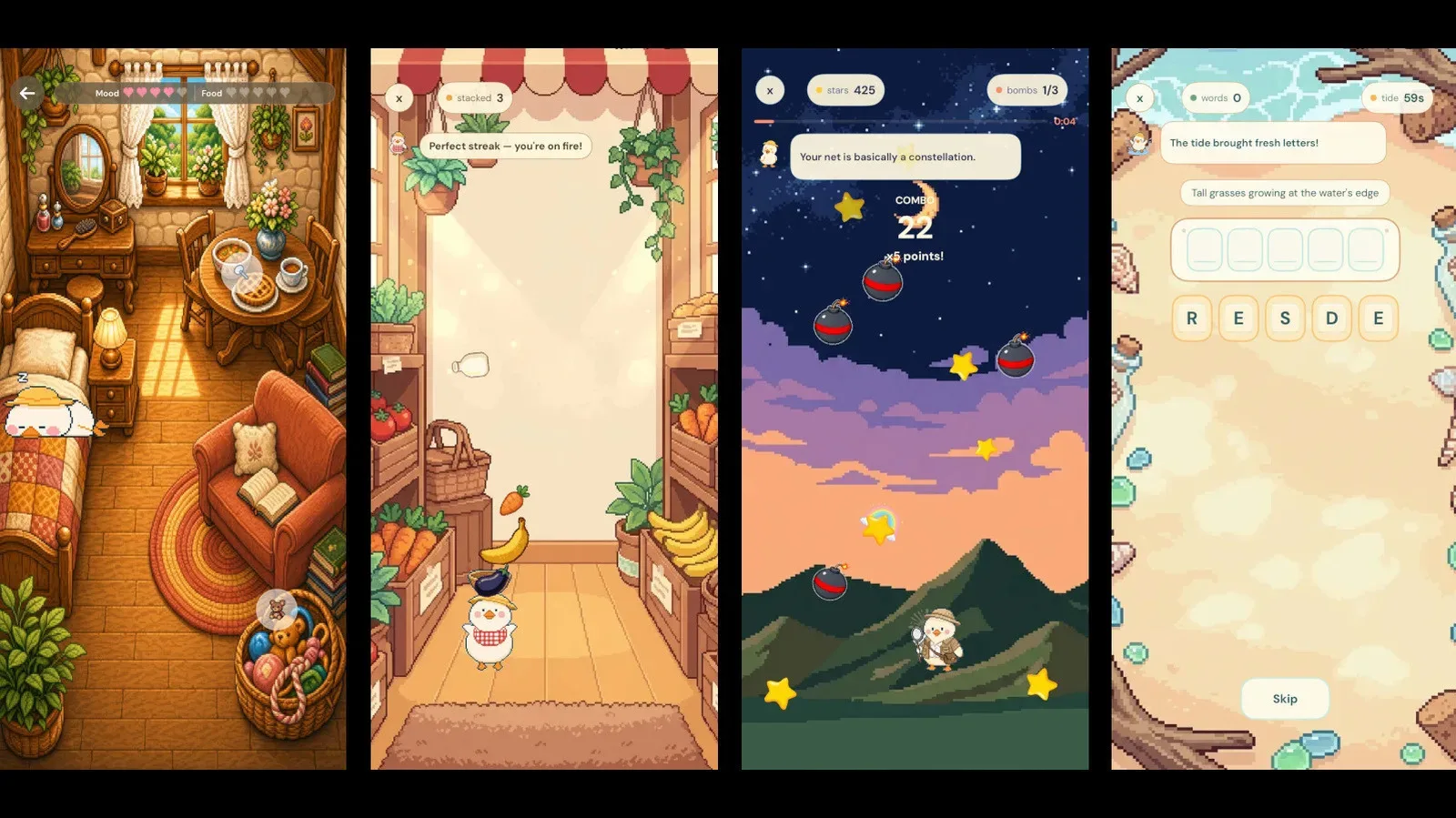
Meta has introduced Waddle World, a 16-bit virtual-pet app that combines the familiar rhythm of hatching, feeding and entertaining a digital creature with an AI-powered diary. The app is currently limited to the Philippines, where its store listings indicate it first appeared in late September.
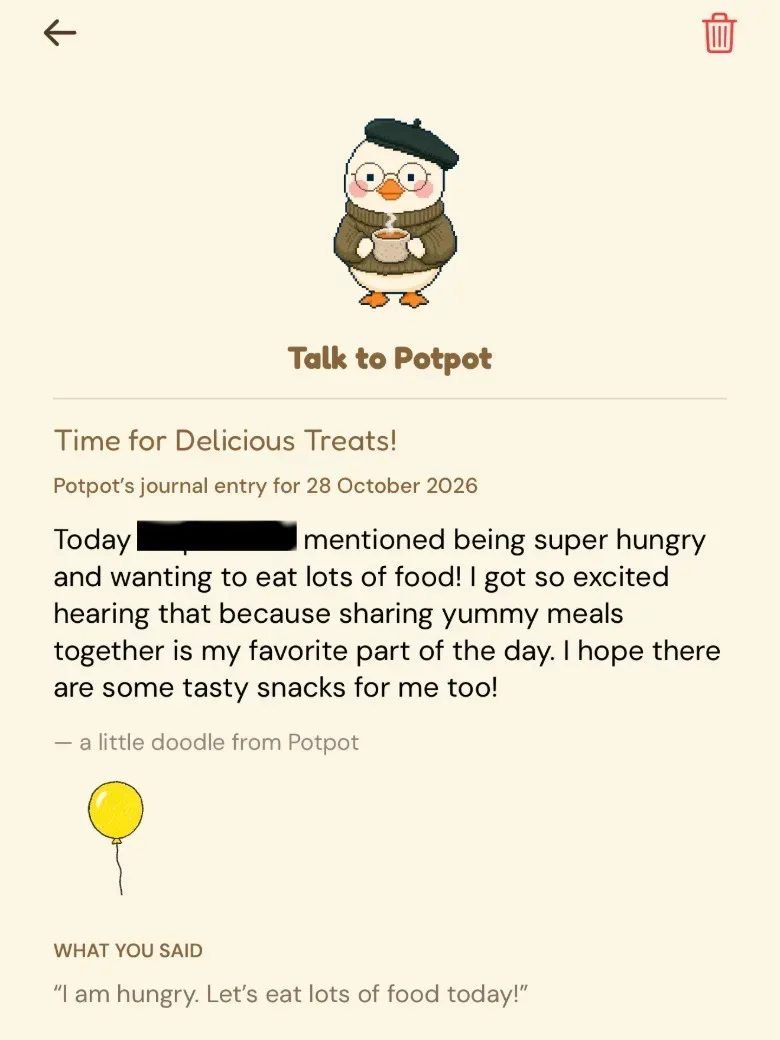
The basic pitch is immediately legible to anyone who has spent time keeping a pocket-sized creature alive: hatch an egg, look after the pet, play games, earn points, and spend those points on food and toys. Waddle World’s unusual element is that the pet is also meant to be a conversational journal partner. Players can type or dictate an entry, receive a response from the pet, and get a small illustrated doodle attached to that exchange.
That makes Waddle World less a traditional game with an AI feature bolted on than a lightweight journaling interface wearing the costume of a virtual pet. Meta itself describes it as a “daily journal disguised as a pet,” which is a notably direct explanation of the design. The cute creature, pixel-art presentation and care loop give the user a reason to return; the journal prompt supplies the material for the AI interaction.
A virtual pet built around daily check-ins
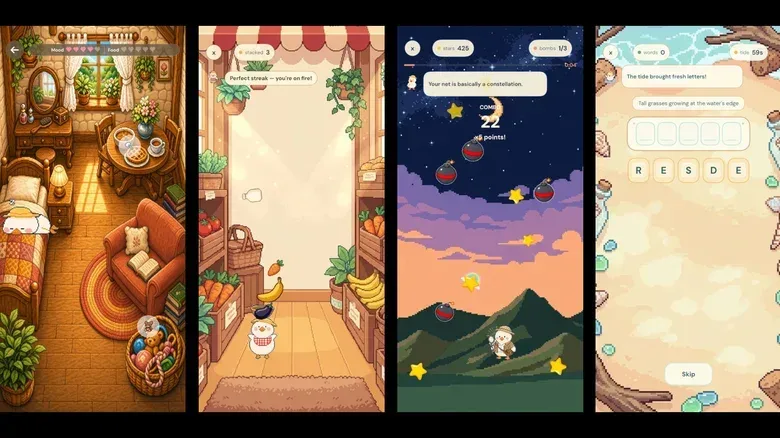
At its foundation, Waddle World uses the established virtual-pet formula. A player begins by hatching an egg, then is responsible for feeding and playing with the resulting pet to keep it happy. Food and toys are acquired with points earned through mini-games.
The activities described for the app are deliberately simple and arcade-like:
- One game involves stacking grocery items on the pet’s head.
- Another asks players to catch falling stars while avoiding bombs.
- A third is a word game built around arranging jumbled letters.
These mini-games are important even if they are not the headline feature. In a conventional virtual-pet design, small repeatable activities create a resource loop: play briefly, gain points, buy care items, then use those items on the pet. Waddle World appears to retain that loop rather than making every interaction a text chat. The result is a structure with two distinct reasons to open the app: upkeep for the pet and an opportunity to record something from the day.
The 16-bit visual approach also fits that purpose. It evokes a compact, approachable game rather than a productivity tool or a formal diary. Nothing in the available description establishes a broader progression system, a specific pet species, social functions, or how frequently players must attend to their pet, so those details remain unknown. What is clear is that the app puts its AI interactions inside a format whose rules are easy to understand at a glance.
What the AI changes
An AI-powered response in this context means software generates a reply to a player’s written or spoken journal entry rather than selecting from a fixed set of prewritten dialogue lines. Waddle World’s pet can chat with the user, reply after a diary entry and create a doodle to accompany that interaction.
That distinction matters. A traditional virtual pet may react to hunger, toys or a successful mini-game with scripted animations and phrases. Waddle World is designed to react to the user’s own words. A short entry about a difficult day, a holiday, a game session or a mundane errand gives the app material to answer. The character can therefore feel more personally responsive than a pet whose vocabulary is limited to a small dialogue pool.
There is also a speech-input option: users can dictate rather than write an entry. Dictation is simply speaking to create text for the journal flow, while the AI response remains the system’s generated answer. The availability of both input methods suggests the daily-journal idea is intended to be low-friction. A player can make the interaction more like a conventional diary entry or more like a brief voice note to a digital companion.
The doodles are a meaningful part of the presentation. A response rendered only as text would make Waddle World resemble a compact chatbot. A generated illustration gives each exchange an additional keepsake-like layer and keeps the pet at the center of the interaction. The source material does not specify the art-generation process, the degree to which each picture is customized, or whether entries can be exported or revisited outside the app. It is therefore safest to view the doodles as illustrated companions to conversations, not as a defined image-creation tool.
Why the journal framing is more than a cute gimmick
Calling the app a diary disguised as a pet explains its likely daily rhythm. Virtual-pet games have long used care tasks to establish habitual check-ins. Journaling apps, meanwhile, ask users to supply a thought, memory or observation. Waddle World brings those two patterns together: the pet supplies a friendly prompt and a reason to come back, while the journal entry supplies a personal prompt for the AI to answer.
That can make a blank-page habit feel less intimidating. “Write a journal entry” can sound like an assignment. “Tell your pet about your day” is a smaller, more playful request. The app’s framing may be particularly appealing to people who enjoy cozy, low-stakes games but do not normally use a dedicated journal.
It is also worth separating companionship design from a claim that an app is a human friend or a therapeutic service. The supplied details describe a chatty pet that answers entries and produces doodles. They do not describe professional mental-health support, moderation practices, safety tools, or any promise of emotional outcomes. Players should understand Waddle World as an entertainment and journaling product with AI-generated interactions, and reserve highly personal or sensitive material for contexts they judge appropriate.
That last point is practical rather than alarmist. A journal is often where people write candidly, and voice dictation can make disclosure feel especially casual. Before using any app as a diary, it is sensible to review the privacy information and account settings available in its own store listing or app experience, and to decide what kinds of details are comfortable to enter. The available information does not state Waddle World’s specific data handling practices, so no conclusion about them should be drawn from the cute visual style or the conversational premise.
A narrow launch leaves major questions open
For now, the most concrete limitation is regional: Waddle World is only available in the Philippines. Its Apple App Store and Google Play listings surfaced through links shared online, and those listings place the app’s initial availability in late September. There is no stated reason for the limited release and no confirmed timetable for an expansion to other territories.
A country-limited availability window can serve several purposes, but the evidence here does not identify Meta’s reason. It may be a test before a wider release, as suggested by the limited availability, but that remains a possibility rather than a confirmed rollout plan. Players outside the Philippines should not assume a launch date, platform expansion, or eventual global availability until Meta provides those details.
There are other unanswered practical questions as well. The current information does not establish whether the app has purchases, how point rewards are balanced, whether pets can be customized, what language support exists, how long journal history is retained, or whether the app will change materially following this initial release. The app’s public outline is enough to convey the concept, but not enough to promise a particular long-term game depth.
Part of a broader cute-companion direction
Waddle World does not arrive in isolation. Meta already allows users to create cute avatars and assign a personality to a Muse agent. The company also revealed the Muse Charm at its September Connect event: an egg-shaped physical device intended as an AI companion and built around a user’s Muse avatar.
The Muse Charm’s form is deliberately reminiscent of a small virtual-pet device. It is designed to function as a keychain, with Meta positioning it as a way to keep Muse close at hand. The stated ambition is not merely to put an avatar on a physical object, but to create a device with continual access to the user’s environment and experiences. Meta is aiming to release the Muse Charm in time for the December holiday period.
Waddle World and Muse Charm are separate products with different forms: one is a phone app with journaling and mini-games, while the other is a physical companion device centered on a Muse avatar. Still, both lean on the same broad idea: AI may be easier to invite into everyday routines when it has a small, expressive character and a playful object or game layer around it.
That is the strategic significance of the pixel pet. Waddle World turns prompts and responses—interactions that can otherwise feel technical or transactional—into care, play and a short daily ritual. The app’s pet does not replace the underlying AI system; it gives that system a face, a schedule and a reason to be opened between more obviously practical tasks.
The approach also creates an interesting tension. The more charming and responsive a character becomes, the easier it may be for users to treat it as a familiar presence rather than software. For a game, that is often the point: personality makes routine actions feel rewarding. For AI products, it means clear expectations about what the system does, what it remembers and how it handles a person’s words become especially valuable. Waddle World’s available description establishes the character-driven experience, but leaves many of those operational details unaddressed.
What players can reasonably expect right now
The available outline supports a straightforward expectation. Waddle World is a small-scale virtual-pet experience that asks players to care for a creature, earn in-game points via several mini-games, use those points on pet items, and communicate through written or dictated diary entries. In return, the pet can produce AI-generated replies and doodles.
It should not yet be treated as proof of a broad international launch, a full-featured life simulation, or a detailed statement of Meta’s future AI-companion plans. It is, at present, a Philippines-only app with a familiar handheld-pet sensibility and a distinctly modern conversational hook.
For readers following the wider push toward devices and apps that make technology feel more personable, it sits alongside other experiments in putting conversational systems into everyday objects and routines. The appeal of that direction is easy to see: a daily diary can be transformed into a tiny exchange with a pixel creature, and a chatbot answer can become a collectible-looking doodle. Whether that ritual has staying power will depend on the quality and consistency of those interactions, along with details Meta has not yet shared about where Waddle World goes next.
In the meantime, the app is a concise example of how old game language is being repurposed for AI: hatch an egg, tend to a pet, play a minute of something cheerful, then tell it what happened today. The technology may be new, but the invitation is unmistakably familiar.
For another look at how consumer tech is being shaped around more natural, everyday interactions, see Amazon Echo Time’s camera-free smart-alarm approach.