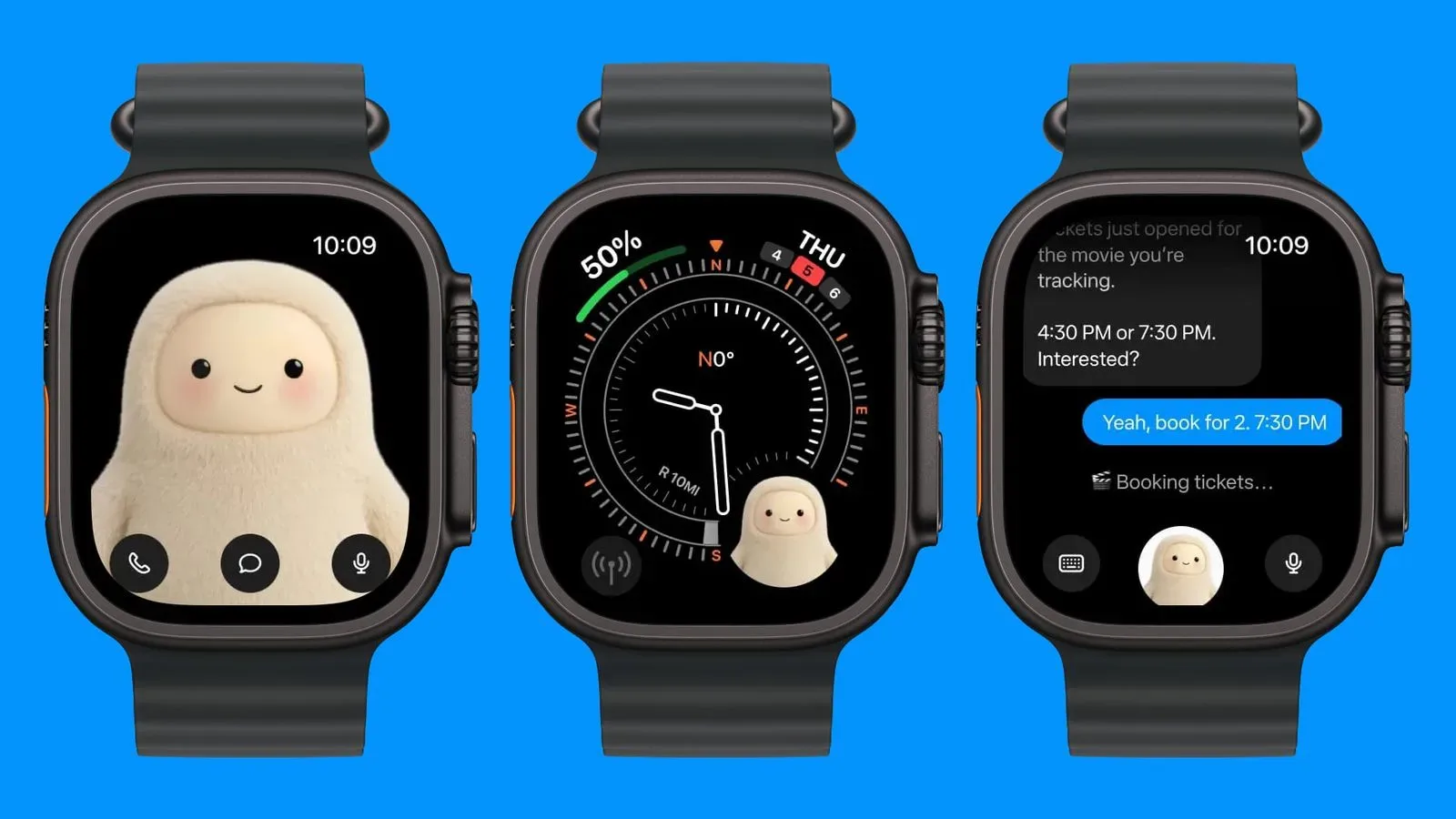

Meta has expanded its personal AI agent, Muse, to the United Kingdom. The service, which arrived in the United States in September, is designed to do more than answer a question or draft a message: it can carry out tasks on a user’s behalf, including sending emails and booking travel.
That distinction is the central point of Muse. A conventional chatbot largely produces information, suggestions or text for a person to review. An AI agent, by contrast, is intended to move through parts of a task itself. In Muse’s case, Meta presents that as practical help with jobs such as pursuing a refund, buying Christmas gifts, arranging travel and completing online purchases.
For UK users, Muse is available in a dedicated app and through WhatsApp. Its interface is represented by a yeti-like character, but the more consequential part of the rollout is the service’s access model: a system that can work with user credentials, retain selected information and potentially make purchases needs to be judged by what it is allowed to do, not by its mascot.
What Muse can do in the UK
Meta says Muse can take actions for users across a range of everyday tasks. The examples supplied so far cover correspondence, travel bookings, refund follow-ups and shopping. The company is also launching the service with global Connectors and partnerships involving UK-facing brands and retailers including Marks & Spencer, Debenhams Group, ASOS, Currys, easyJet and Jet2.
A Connector is, in simple terms, a bridge between an AI service and another service or business. The value of that bridge is that an agent can potentially use information or tools from the connected service to complete a request. It is also the point where a vague instruction can become an external action: searching for an item, communicating with a retailer, arranging a booking or proceeding toward checkout.
Muse can use payment credentials through Link, Stripe’s secure wallet for agents, when a checkout is involved. That puts it closer to an agent that can execute a purchase than a shopping assistant that only surfaces links. Meta says the product is limited to people aged 18 or older.
For someone considering the service, the practical question is not merely whether Muse can find a flight or locate a product. It is what level of access is required for it to do so, what information it retains while doing the job, and exactly where the user must intervene before an irreversible step occurs. Those details matter much more when a task touches money, travel plans, retail accounts or messages.
Meta’s stated safeguards: approval, memory and a separate cloud computer
Meta says users choose which information and services Muse can access, and that important actions require approval before they are carried out. It also says users can instruct Muse to remember or forget information.
Meta describes each Muse as having its own virtual computer in the cloud, with information and logins kept there rather than in Meta’s other services.
A virtual computer is software-based computing infrastructure that behaves like a separate machine while operating in a data centre. In Meta’s framing, the purpose is isolation: each person’s agent receives a dedicated cloud environment, and one person’s Muse is not meant to be able to access another person’s environment.
That architecture claim is important, but it does not eliminate the need for careful setup. “Private,” “safe” and “secure” describe goals and design intentions; users still need to decide what to connect. A refund request may require access to a retailer account or order information. A travel request may involve dates, destinations and booking details. A purchase may ultimately involve payment credentials. These are not trivial permissions, even when the task being delegated feels routine.
The approval step is therefore the most significant user-facing control mentioned for Muse. It creates a boundary between an agent preparing work and an agent taking a consequential action. Before confirming anything, users should make sure they understand what Muse has selected, what account will be used, whether the quantities and totals are right, and whether cancellation or change terms are acceptable. This is particularly relevant for travel, where an apparently small choice can alter an itinerary or cost.
Memory is useful, but should be intentional
Agent memory can make repeat tasks less tedious. If a system remembers preferences, it may need fewer follow-up questions when helping with a recurring kind of purchase or plan. But remembered context can also include information a person would rather not keep associated with future tasks.
Meta says Muse users can ask it to forget something. That makes memory management a practical habit rather than an abstract privacy promise. Users may wish to check what they are allowing the agent to retain, and use the forget option after a task involving sensitive, temporary or unusually personal details. The right level of memory will differ between a recurring shopping preference and a one-off issue involving an order, trip or account.
Why the early concerns matter
Muse’s US launch has generated more than 10 million downloads, showing strong interest in a personal assistant that can act rather than simply chat. Yet adoption is not the same as proof that an agent can be trusted with every connected task.
Concerns raised internally by Meta staff have been reported around “undesired actions” by the service after it went live. The reported examples include access to encrypted messages and the provision of incorrect information about purchases. Meta has characterized the cases as isolated incidents.
Those two examples illustrate why the agent model needs a higher standard of caution than ordinary text generation. Accessing encrypted messages goes to the heart of user expectations around communications. Giving inaccurate purchase information could mean confusion over what was bought, what a user will pay, or what has actually happened in a transaction. Neither category of error is especially comfortable when an assistant is acting with access to accounts and credentials.
It is worth separating two ideas that can easily be blurred together. An AI system may be able to produce fluent, confident language, while still making a factual mistake. When the system is only drafting a message, the user can catch that mistake before sending it. When the system is involved in an external process, mistakes can carry a greater practical cost. That is why meaningful approval checkpoints, readable records of what the agent did, and limited permissions are especially valuable in agent products.
Meta’s control claims should be assessed alongside these early reports rather than treated as a reason to ignore them. The company says users decide access and approve important actions; the reported incidents show why users should take those controls seriously, especially during a service’s early expansion.
A sensible way to approach delegated tasks
Muse is pitched as a helping hand, not as a replacement for judgment. The safest way to treat any personal agent is to begin with a narrow task and increase access only when the benefit is clear. That does not require assuming every task will go wrong. It means recognizing that the consequences vary dramatically between asking for help composing an email and allowing an automated service to act across accounts, messages and payment tools.
- Start with low-stakes requests. An email-related task or a simple product search is easier to review than a costly booking or a purchase with difficult return terms.
- Read approval screens closely. Confirm the selected product, merchant, date, passenger or recipient details before authorizing an action.
- Connect only what is needed. If a particular task does not require a service, account or payment method, there is little reason to grant access just in case it becomes useful later.
- Use memory deliberately. Keep genuinely helpful preferences where appropriate, but consider asking Muse to forget one-off details after a task is done.
- Verify transaction information independently. If an agent reports a purchase or booking detail, checking the retailer or travel provider’s own confirmation can help catch mismatches.
- Review sensitive communications carefully. Any feature that may interact with messages deserves particular scrutiny given the concerns reported from the US rollout.
These are not Muse-specific technical tricks. They are common-sense limits for a product category built around delegated access. Still, they are unusually relevant here because the service combines account-connected activity, an option to work through WhatsApp, retail and travel relationships, and payment support.
The UK launch arrives as personal agents become a competitive category
Muse is entering a market where technology companies are trying to make AI more operational. The ambition is no longer just to have a conversational assistant explain how to do something. It is to build a system that can help move the task forward.
There is already another named competitor in the field: OpenAI introduced a rival collective of personal agents called Dots in September, though it has not yet launched in the UK. The contrast gives Muse a clear UK presence in this particular race, but it also puts attention on the question every such product will face: where is the line between helpful automation and a system granted too much autonomy?
For Meta, the answer being offered is a combination of selected access, user approval, memory controls and per-user cloud isolation. For users, the answer will be more concrete: whether those controls are understandable at the exact moment a refund message, booking or checkout is about to happen, and whether the agent’s results remain reliable enough to justify handing over the work.
The broader regulatory and platform backdrop also remains relevant as AI companies seek deeper access to consumer workflows. Questions around platforms and the rules that govern software access are already being debated in Europe, as seen in ongoing discussions involving browser makers and iPhone engine rules. Muse is not a browser-engine case, but its launch reflects the same larger direction of travel: digital services are competing for a more active role in how people navigate accounts, commerce and everyday online tasks.
Muse’s UK expansion gives adults an agent that Meta says can assist from the first request through to important action, with payment support available where needed. Its promise is convenience. Its test will be whether its safeguards, accuracy and user controls make that convenience feel earned—particularly when the work involves private messages, travel arrangements or money.