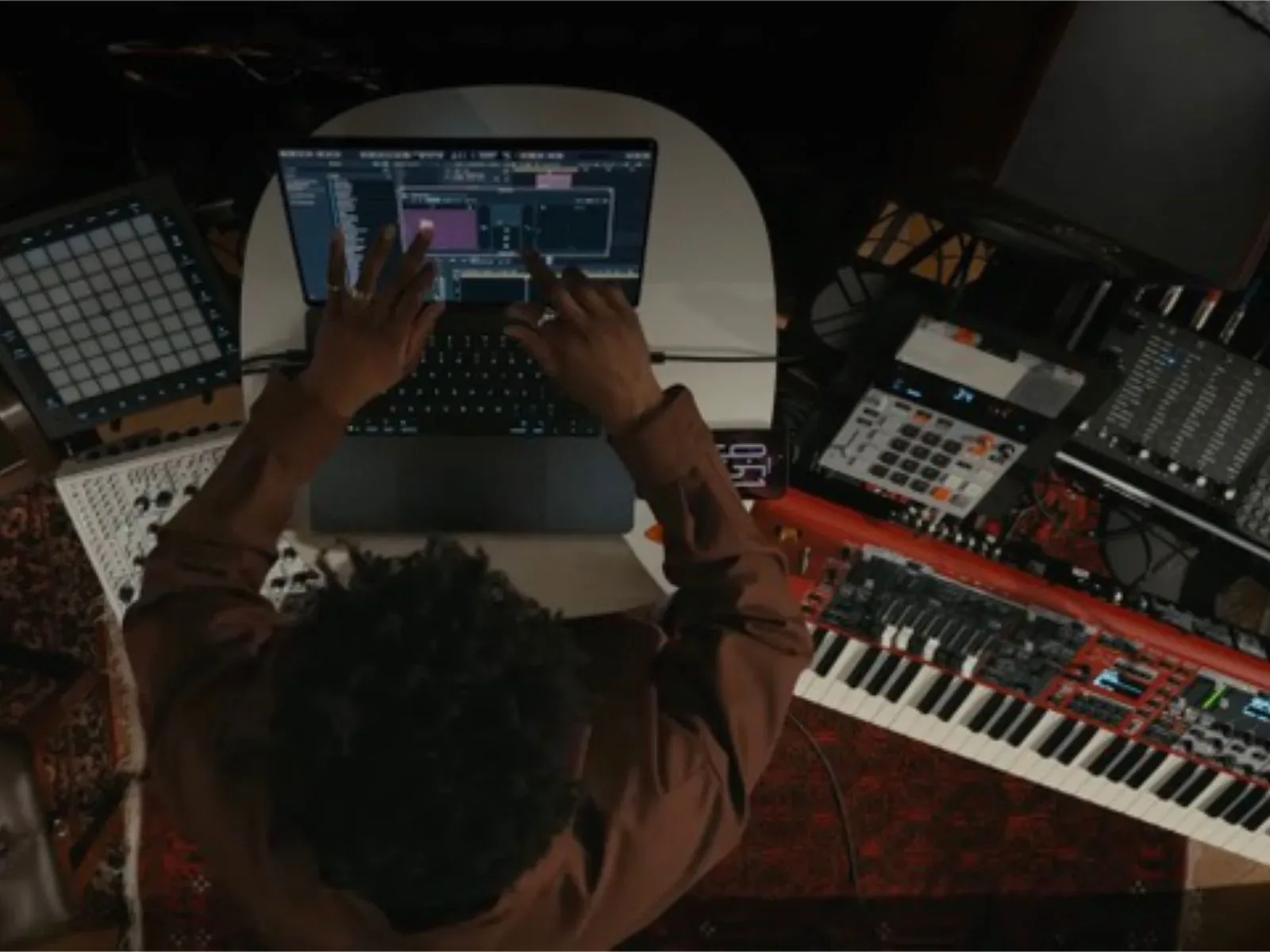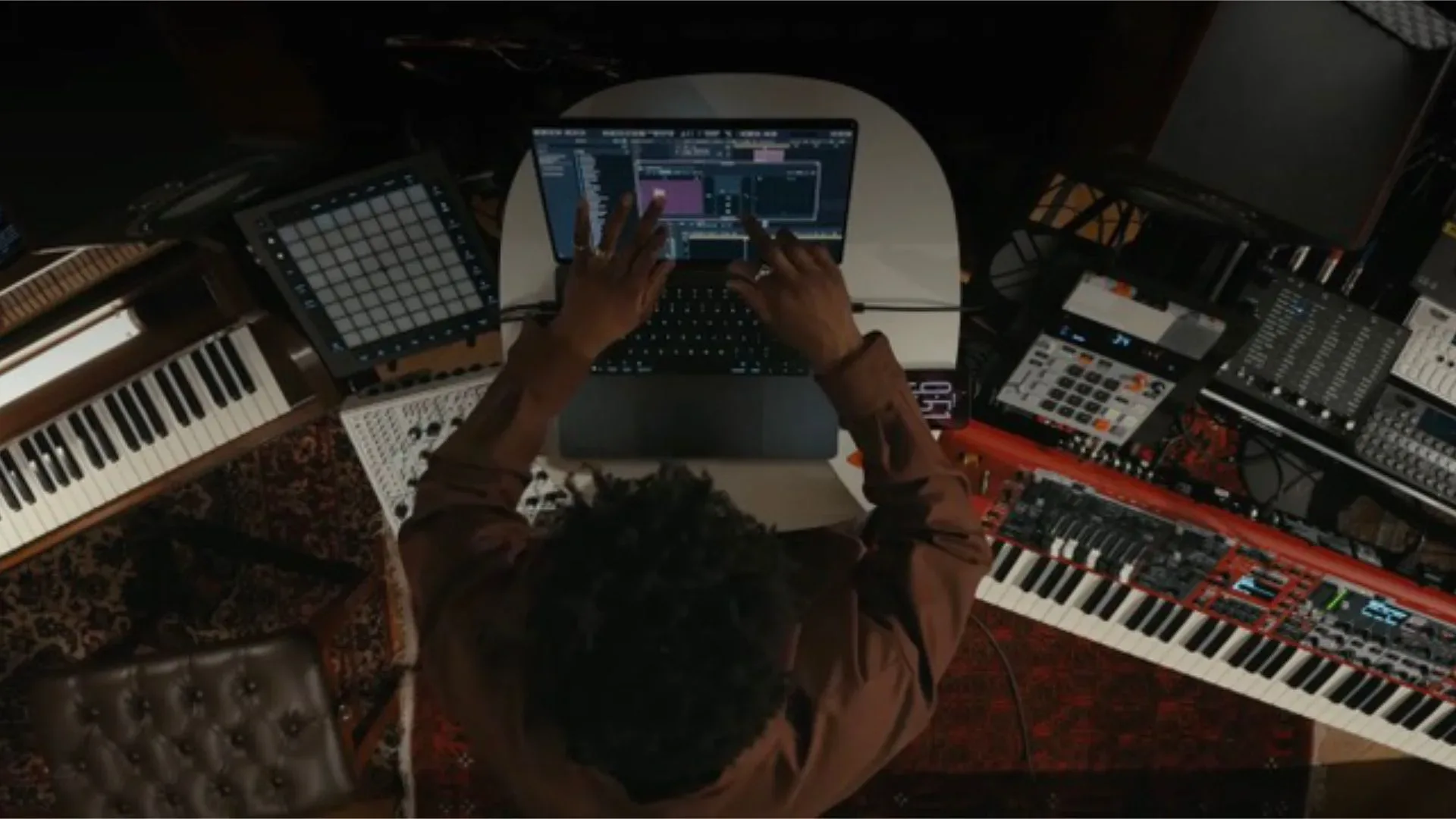
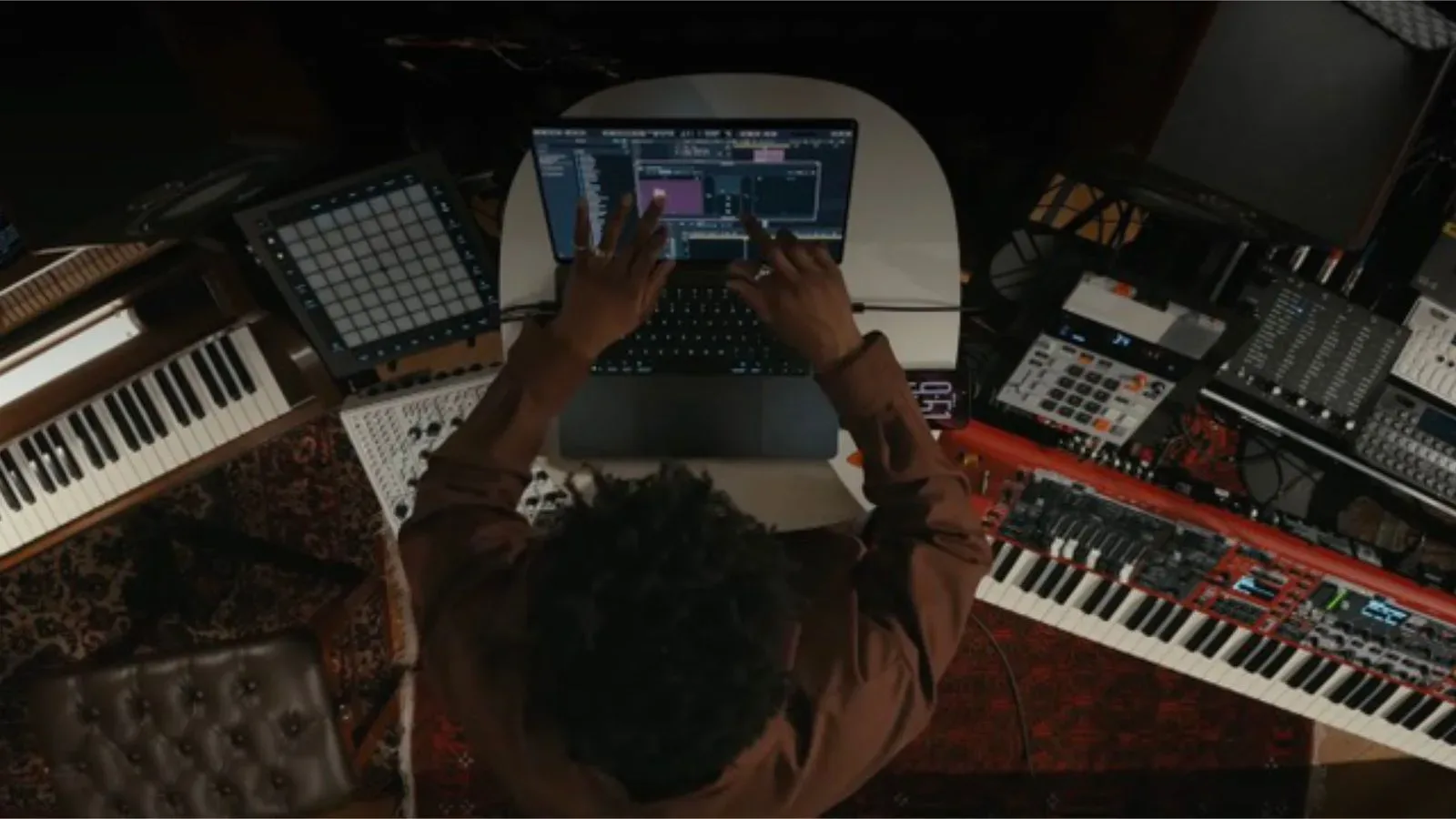
Apple has put a musician, rather than a benchmark chart, at the center of its latest touchscreen MacBook Pro demonstration. British singer, songwriter and producer Labrinth created a new song during an overnight livestream at the Apple Tower Theatre in downtown Los Angeles, using the new laptop alongside Logic Pro.
The session is a straightforward showcase for the touchscreen’s creative ambitions. In Logic Pro, the interface can present an onscreen keyboard, chord pads and drum pads. Those controls can be played directly on the display, including multiple notes at once. For a producer building ideas quickly, that means a laptop screen can double as a playable surface rather than only a place to view tracks, meters and plug-in windows.
Apple had teased the collaboration on TikTok beforehand with a white box bearing Labrinth’s name and a direction not to open it until November 4. The subsequent overnight event supplied the reveal: Labrinth making music with the newly introduced hardware and Apple’s production software.
Labrinth is a particularly logical fit for a demonstration focused on moving between composition and performance. His work spans solo tracks including Jealous and Earthquake, music for HBO’s Euphoria, and LSD, the group he forms with Sia and Diplo. That varied background does not tell us precisely how every part of the new song was made, but it makes the event’s focus clear: Apple wants the touchscreen MacBook Pro to be understood as a workstation for people who both arrange music and physically play musical ideas.
What the Logic Pro controls demonstrate
Touch is not one single feature in a music application. It can mean a number of distinct forms of input, and the controls shown in Logic Pro illustrate why that distinction matters.
- Onscreen keyboard: A keyboard layout displayed on the screen for entering pitched notes.
- Chord pads: Touch targets that trigger chords, allowing a user to work with harmonies without individually pressing each note.
- Drum pads: Pad-style controls for triggering percussion sounds and rhythmic parts.
All three are familiar concepts to musicians who use hardware controllers, but their appearance on the laptop itself changes the immediate setup. The user can move from selecting a sound or looking at an arrangement to tapping in a rhythm, chord or melody on the same device. The ability to trigger multiple notes simultaneously is especially relevant to chord performance: it allows the screen to be used for more than one-note-at-a-time entry.
That is an important practical boundary to understand. A touchscreen does not automatically replace every studio tool, and the livestream should not be read as proof that it will. The information shown establishes that Logic Pro offers touch-playable musical controls; it does not specify latency, sensitivity, editing workflows, peripheral support, or how the controls compare with dedicated keyboards and pad controllers. Producers considering the machine will still need to judge whether an integrated touch surface suits their own habits.
But the creative case is easy to see. A musician with a rough melodic, harmonic or rhythmic idea often needs a fast route from idea to recording. Directly playing a virtual control may be more immediate than reaching for another device, particularly in situations where carrying extra gear is undesirable. It could also help during writing sessions where a producer wants to sketch parts before committing to a more elaborate performance setup.
A premium MacBook Pro built around a new display approach
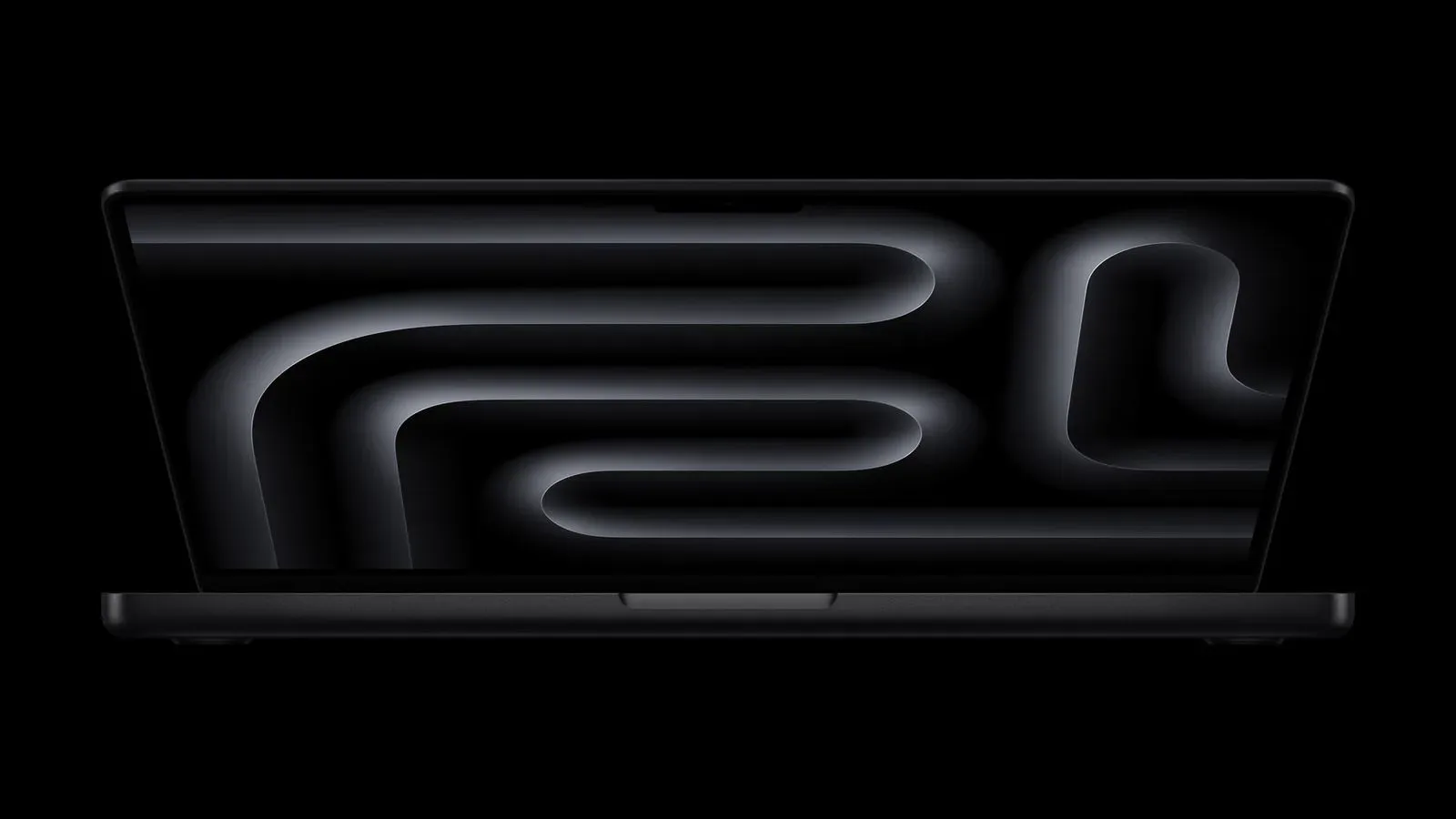
The new MacBook Pro is equipped with what Apple calls a PROLED XDR Display, described as a tandem OLED touchscreen. OLED is a display technology in which pixels emit their own light, rather than relying on a separate backlight. “Tandem” refers here to the display configuration Apple has identified; the supplied specifications do not detail the implementation beyond that name. The important point for this demonstration is that the panel is both an OLED display and a touch input surface.
The lineup is offered in 14-inch and 16-inch sizes, with a choice of M5 Pro or M5 Max chips. Apple is positioning the models firmly at the professional end of its laptop range: U.S. pricing starts at $2,899 for the 14-inch version and $3,399 for the 16-inch version. They launch Friday, November 6.
Those starting prices put the touchscreen MacBook Pro in a category where a buyer’s workflow matters more than novelty. Touch controls may be compelling for Logic Pro users, but an expensive production laptop is usually expected to perform several demanding roles: recording, arranging, editing, sound design and general project management. A buyer should therefore treat the touch layer as part of a broader package that includes the display, the selected M5 Pro or M5 Max chip, screen size and software needs—not as the sole reason to choose a configuration.
The choice between the 14-inch and 16-inch versions is similarly about working style as much as size. The source material confirms the two options but does not offer a feature-by-feature difference beyond their dimensions and starting prices. Creators who work with many tracks, virtual instruments and windows may value the larger visible workspace, while others may prioritize the smaller model’s footprint. Neither preference can be settled by a livestream alone.
Why the performance format matters
Apple demonstrated music production when it introduced the MacBook Pro last week, and the Labrinth session turns that initial software example into a public performance. This is a more useful format than simply presenting a list of touch capabilities because it frames the screen as an instrument-facing interface. Rather than asking viewers to imagine a chord pad or drum pad in use, it shows a musician working toward a new piece of music.
There is also a meaningful difference between making a creative feature visible and proving every professional claim around it. A livestream can demonstrate that a performer can interact with these controls while composing; it cannot on its own settle broader questions about a long recording session, a full album project, or someone’s personal preference for hardware instruments. Keeping that distinction in mind is valuable for anyone evaluating creative technology announcements.
Still, music production is a sensible showcase for direct interaction. Many software tasks involve selecting, moving and adjusting items visually. Musical controls add another layer: they invite a player to tap patterns, chords and notes in real time. The touchscreen can therefore serve two related roles within the same project—navigating the application and triggering sound—without requiring the user to swap to a separate controller for the latter.
For readers following Apple’s creator software, Logic Pro’s recent updates are also worth watching alongside this hardware shift. Logic Pro 13’s smarter sound search and iPad controls point to an ecosystem where finding sounds and interacting with musical tools are continuing areas of focus. The touchscreen MacBook Pro gives that direction a different form factor: direct input on the primary computer rather than on a separate tablet.
What prospective music creators should take from it
The Labrinth event offers a clear example of the machine’s intended appeal, but it is not a universal recommendation. The strongest audience is likely to be creators who already use Logic Pro or are interested in its built-in playable controls. For them, the combination of onscreen keyboard, chord pads and drum pads could reduce the friction between a passing idea and a first recording.
It may be less decisive for musicians whose setups already depend on preferred external keyboards, drum machines or controllers. Those users may see the touchscreen as an additional way to work rather than a replacement for established gear. Likewise, people choosing between the M5 Pro and M5 Max options should avoid assuming that a touch-focused demonstration alone answers a performance question; the material identifies the chip choices but does not provide task-specific comparisons.
What is certain is that Apple is using a working musician to make the case that a MacBook Pro can be more tactile in the studio. The overnight session places Logic Pro’s touch keyboard, chord pads and drum pads at the center of that pitch, while the 14-inch and 16-inch tandem OLED touchscreen models arrive on November 6. At starting prices of $2,899 and $3,399 in the U.S., respectively, it is a high-end proposition—but one aimed squarely at creators who want their main production computer to invite a little more hands-on play.