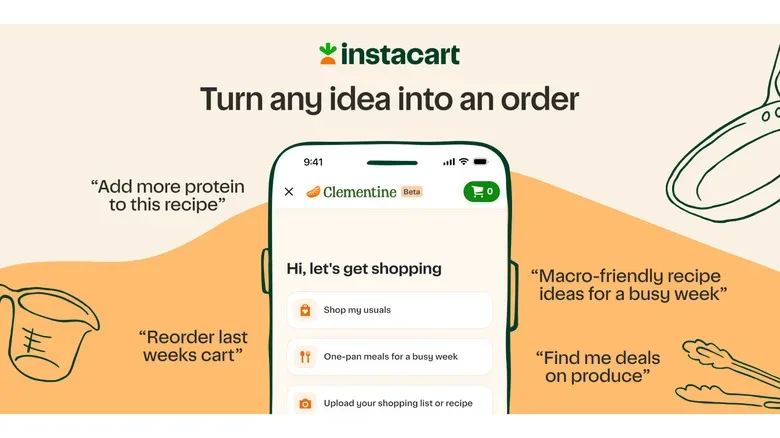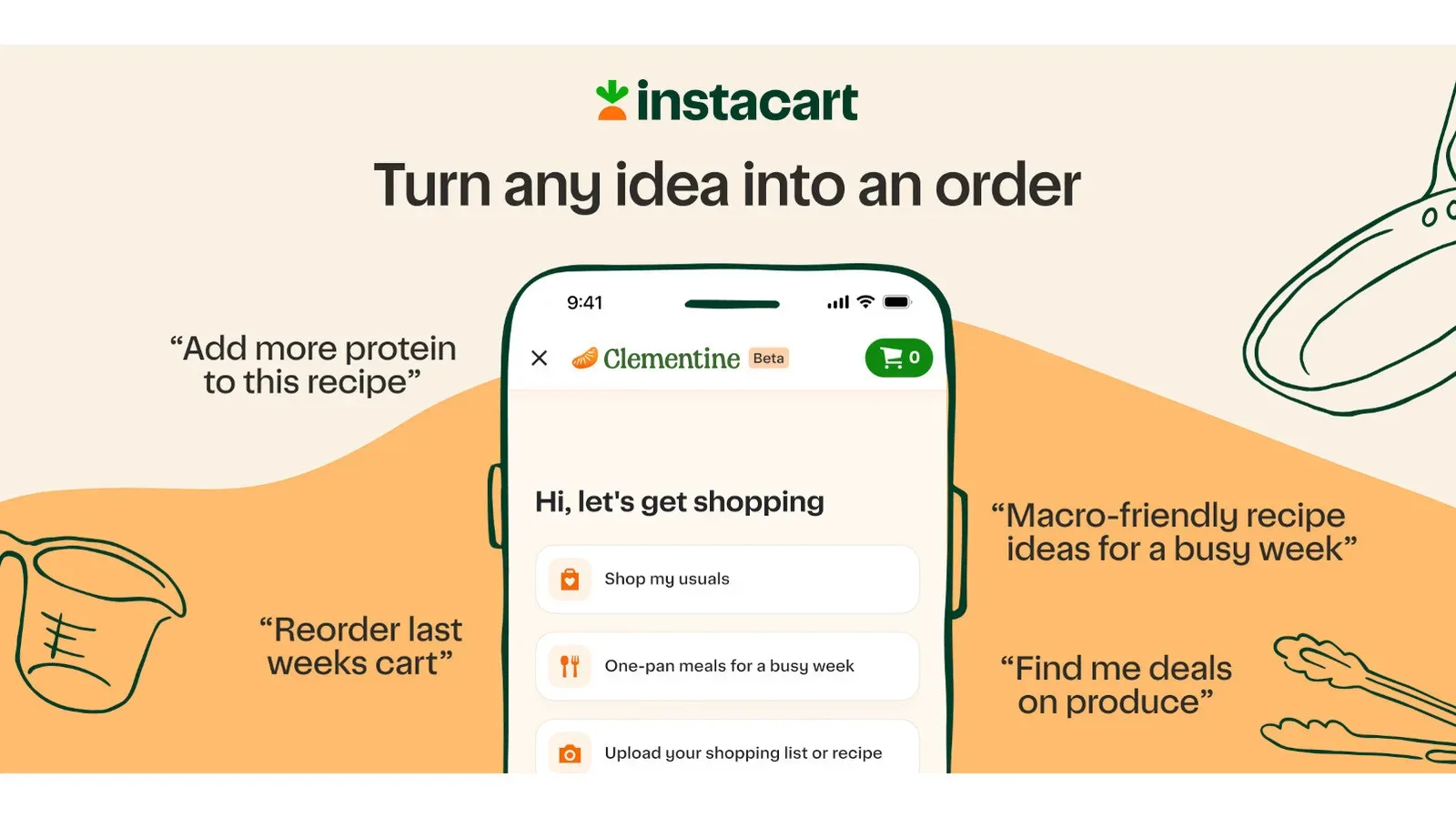
Instacart has introduced Clementine, an AI shopping assistant built into the Instacart Marketplace across North America. Its job description is refreshingly ordinary: help answer the dreaded “what are we eating?” question, then make the transition from idea to grocery cart as frictionless as possible.
That makes Clementine less like a chatbot bolted onto a shopping app for decorative futuristic sparkle and more like a grocery-planning layer. A shopper can describe a meal in everyday language—say, an easy high-protein dinner for two—and the assistant can return a recipe alongside ingredients that can be added to an Instacart cart with a tap. In theory, it is trying to skip the familiar sequence of opening recipes, scanning cupboards, making a list, searching a store, discovering an item is unavailable, and then eating toast while staring at a half-finished cart.
There is a suitably game-like appeal to the premise. Dinner is a daily resource-management challenge involving a budget, dietary rules, limited inventory, time pressure, and occasionally a party member who regards vegetables as an optional expansion pack. Clementine is designed to help manage several of those variables at once.
Recipe suggestions are meant to reflect the store you selected
The most important stated part of Clementine’s approach is its connection to local store availability. Its meal recommendations are intended to use what is currently obtainable from the shopper’s chosen location, rather than offering a beautiful recipe built around ingredients that are absent from the digital shelves. That distinction matters more than it may initially sound.
Generic recipe tools are very good at imagining meals. Grocery shopping requires an answer that survives contact with actual stock. An assistant that can begin with a meal request and end with an ingredient list aligned to a selected store could make meal planning meaningfully more practical, especially for people ordering under time constraints.
The recipe flow also leaves room for the real-world pantry. If a suggested list includes items the shopper already has, those items can be removed before the rest is moved into the cart. Clementine is therefore not presented as a mandate to buy every component of a generated dish; it is a starting list that users can edit.
That edit step should remain important. Store availability can change, preferences can be incomplete, and a household’s definition of “already have olive oil” may range from a pristine bottle to a teaspoon left in the one that has been living behind the toaster since an earlier civilization. An AI-assisted cart is still a cart worth reviewing.
Preferences put dietary needs closer to the beginning of the process
Clementine also uses choices from an in-app preference center. Instacart says shoppers can set requirements such as nut-free, vegetarian, or gluten-free, allowing the assistant to tailor food ideas around what a household can eat.
That is a sensible direction for a grocery assistant because dietary needs should not be treated as a late-stage filter. A recommendation is more useful if it begins within the shopper’s boundaries instead of asking them to inspect every suggestion afterward. At the same time, users dealing with allergies, celiac disease, or other medically significant restrictions should continue to check item details and packaging themselves. A preference setting can narrow the field, but it does not remove the need for care around ingredients, substitutions, labels, and cross-contact concerns.
For broader household preferences, the feature could simply reduce repetition. Someone who routinely cooks vegetarian meals or avoids particular ingredients should not have to restate that information in every prompt. The value here is not that Clementine knows food better than the person buying it; it is that it may save them from repeatedly translating the same needs into searches and filters.
“Usuals,” pantry restocks, and the handwritten-list shortcut
Meal inspiration is only one part of the assistant’s scope. Clementine can also be asked to restock a pantry or shop a user’s usual items. In those cases, it draws from previous orders to assemble a list that can be added to the cart and checked out.
This is arguably the least flashy feature and possibly the one that fits grocery shopping most naturally. Many orders are not culinary quests. They are milk, coffee, paper towels, pasta, snacks, and the things that mysteriously vanish at the exact moment someone says they are definitely still in the cupboard. Past-order information can make recurring purchases quicker to retrieve than a manual search through a large marketplace.
Clementine also accepts photos of handwritten grocery lists and can turn them into a list of items ready to add to a cart. That feature recognizes that paper lists are not an extinct technology. They are fast, visible, shareable within a home, and capable of surviving a dead phone battery. The new twist is using a photo as a bridge between a handwritten note and online shopping.
Handwriting recognition and product matching are the kinds of conveniences that reward a quick review. A scribbled “basil” should not become an unexpected detour into a similarly spelled item, and a brand-specific note may need a shopper’s confirmation. Still, the general proposition is clear: Clementine aims to remove the chore of re-entering a list item by item.
Convenience can make the cart grow
Instacart says orders placed with Clementine typically run above its $115 average basket size. The company suggests that the ease of accepting recommendations may be part of the reason. That is not necessarily a surprise. A tool designed to move from a natural-language request to a tap-to-add ingredient list reduces the small moments of resistance that usually make a shopper pause.
Those pauses are sometimes useful. They are where someone notices they already own rice, decides a side dish is unnecessary, or remembers that their budget was supposed to cover the whole week rather than one exceptionally ambitious Tuesday. Clementine’s ability to remove items before adding the list is valuable for precisely this reason, but shoppers may also want to consider a few habits before checkout:
- Review every recommended ingredient rather than accepting a full list automatically.
- Check quantities, particularly for pantry staples and spices that may already be on hand.
- Use dietary preferences as a starting point, then verify product information for stricter needs.
- Compare the completed cart with a planned budget before placing the order.
- Watch for substitutions or changes that could alter the intended meal.
The assistant’s usefulness and its potential to encourage a larger cart are not contradictory. They are two sides of the same streamlined interaction. Less effort can mean more completed shopping—and more opportunities for extras to hitch a ride.
Instacart’s AI strategy extends beyond Clementine
Clementine is Instacart’s own assistant, but it sits alongside the company’s recent work connecting grocery shopping to other AI interfaces. Instacart has partnered with technology companies to bring grocery integration to ChatGPT, Claude, Gemini, and AI Mode in Google Search.
The larger pattern is that food shopping is becoming something a user may start from multiple conversational surfaces. A person might ask a general-purpose assistant for dinner ideas, search for a recipe, or open a marketplace directly, then move toward an Instacart cart. Clementine gives Instacart a native version of that experience within its own marketplace.
It also illustrates a more grounded version of the current AI push. Rather than asking a chatbot to offer a sweeping answer about life, the tool is being used for a recurring, narrow, occasionally annoying task with clear inputs and a concrete output: recipes, lists, products, and checkout. There are still meaningful questions around recommendation quality, dietary reliability, privacy, and spending behavior. For a wider look at why major AI claims deserve scrutiny rather than automatic applause or panic, see this examination of AI-risk claims and the need for evidence.
For Clementine, the immediate test is simpler than a grand theory of artificial intelligence: can it help a shopper choose a dinner they genuinely want, using ingredients they can actually get, without turning a modest grocery run into a $115-plus side quest? Instacart has built the assistant around that everyday challenge. The cart review screen, as ever, remains the final boss.