Berlin’s IFA, reintroduced in 2026 as Innovation For All, ran from September 4 through September 8 and brought its usual mountain of screens, smart-home hardware, computers and accessories. For players, the interesting part was not one giant console reveal. It was a collection of gear aimed at the places and routines surrounding games: the handheld in a backpack, the television on a living-room wall, the crowded home network, the desk where someone edits video between matches, and the lights that turn a co-op session into a tiny private cinema.
That framing matters. Gaming hardware is increasingly an ecosystem rather than a single machine under a television. A controller can move between Nintendo Switch 2, SteamOS, Android and Apple devices. A display needs to make room for both films and fast-moving games. Even a router or TV mount can change the practical experience of playing at home. IFA 2026’s most relevant announcements and demonstrations were a reminder that the less glamorous links in that chain can have an outsized role in how comfortable, responsive or immersive a setup feels.
JSAUX brings a compact controller to Switch 2 and beyond
The most directly game-focused item in the group is the JSAUX Voidjoy SkyLark S1 Pro Portable Controller. It is designed to work with Nintendo Switch 2, Apple and Android devices, and SteamOS. That platform range is important for anyone who splits time among a dedicated console, mobile games and a handheld PC-style library rather than pledging allegiance to one screen forever.
JSAUX’s stated focus is portability without stripping away the controls players expect. The SkyLark S1 Pro has action buttons with a clicky feel, quick triggers, analog controls and a responsive D-pad, all in a streamlined wireless design intended to remain pocketable. The promise, in short, is to make the “I will just use touch controls for this trip” compromise slightly less inevitable.
The Switch 2 connection also arrives as Nintendo’s newer hardware continues adding games and services to its catalogue. Players keeping an eye on the system’s library can also see how Star Fox Adventures joined Switch 2’s Nintendo Switch Online GameCube library. A travel-friendly controller that can shift among Switch 2, SteamOS and phone use fits a landscape in which old games, current games and streaming-adjacent devices increasingly overlap.
The television is no longer meant to look like dormant hardware
TCL’s Designer 4K TV (A400U), formally part of the QD-Mini LED Designer Series, makes its case as much through interior design as raw panel specifications. The ultra-thin television is intended to sit flush against a wall and is offered in sizes up to 85 inches. Rather than treating the powered-off display as an unavoidable black rectangle, the design asks it to blend more naturally into a room.
For games, the useful figures are a 144Hz refresh rate, QD-Mini LED technology, and support listed for Dolby Vision, HDR10+ and DTS:X. TCL also emphasizes bright color, contrast and deep black levels. Specs alone do not settle the usual questions around latency, game-mode behavior or the exact capabilities of every input, so those are details prospective buyers would still need to verify. Still, a 144Hz panel is a notable gaming-friendly target, especially for players connecting a PC or other hardware able to deliver higher frame rates.
The television’s appearance has a practical social advantage, too. A large screen can be central to game night without making the room feel as though it has been permanently converted into a spaceship bridge. That is a victory for anyone who has had to negotiate the visual footprint of an 85-inch display with another human being.
Projectors, adaptive mounting and lights target the whole living room
XGIMI’s AURA 3 Pro takes the alternate route to large-format play and viewing: an ultra-short-throw projector. It uses RGB triple-laser 4K Ultra HD projection and is described with Dolby Vision and IMAX Enhanced support. Ultra-short-throw setups are compelling in rooms where placing a projector across the room is inconvenient, although any final home-theater plan still needs to account for the space, wall or screen, lighting conditions and installation requirements. The AURA 3 Pro is positioned as a centerpiece for a home theater being planned for 2027.
Perlegear’s AX1 Smart Adaptive TV Mount addresses a problem people often notice only after their neck has made a formal complaint: a screen mounted too high. This motorized mount can raise a TV when it is not in use and lower it for viewing. Perlegear says its adaptive AI positioning and camera controls are meant to place the display at a suitable eye level. It is a particularly interesting idea for a shared living room, where a wall-mounted TV may need to suit furniture, décor and actual viewing ergonomics rather than just occupy the one open patch of wall.
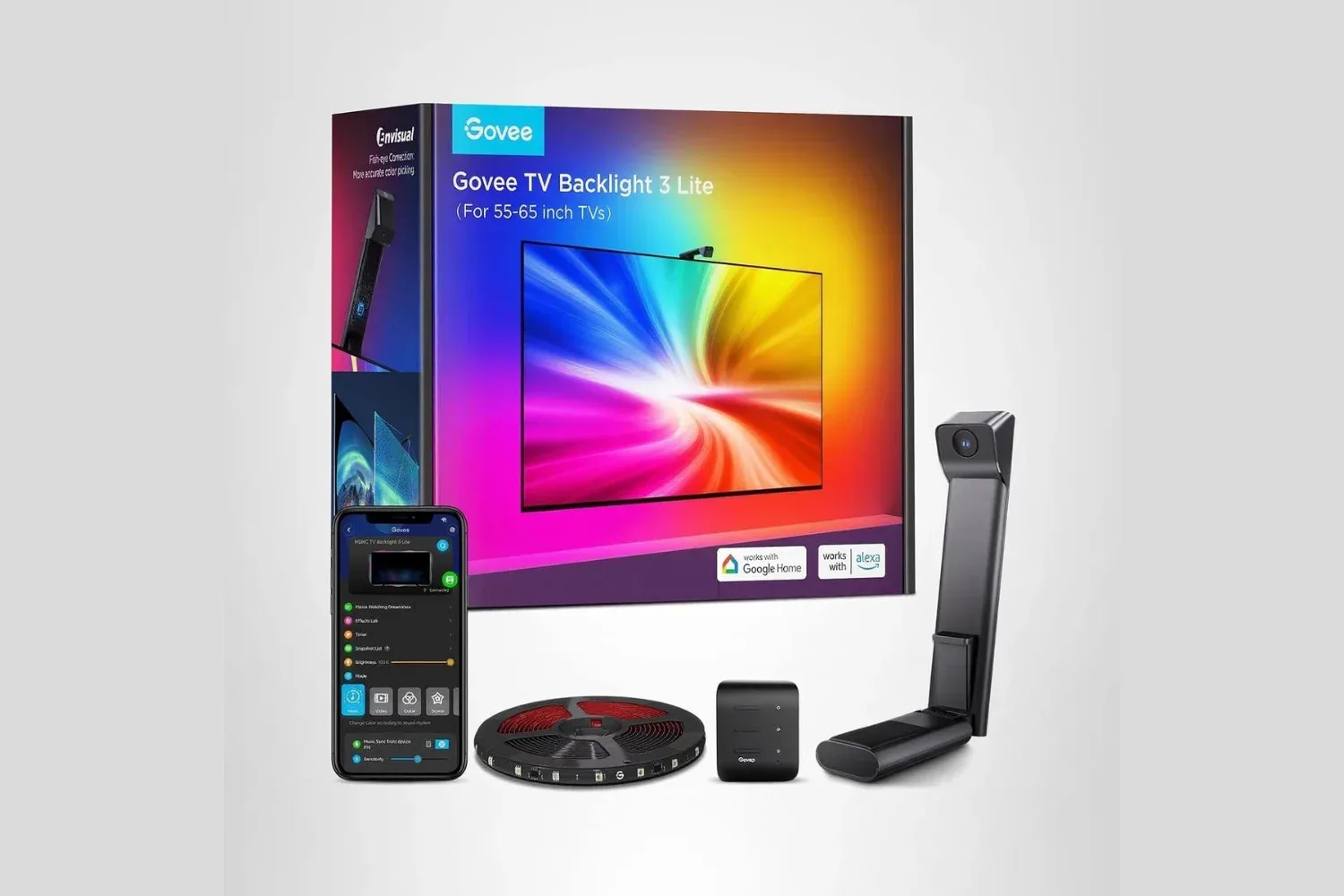
Then there is the lighting layer. Philips Hue Play expands its entertainment-sync approach with color-changing strips, stands and bars that react to a television’s content. The new Hue Play Sync Box 4K takes visual color information from HDMI-connected streaming devices, while Hue Play Screen Sync is a camera-based option that tracks what appears on the TV to match colors and movement. For games, reactive lights are unapologetically extra—and sometimes that is exactly the assignment. They can extend a game’s palette beyond the bezel, whether the screen is showing a neon racer, a cave system or a menu screen someone has been staring at while deciding what to play.
Govee’s COB Strip Light 2 Pro provides another room-lighting option. Its triple-layer LED construction is intended to provide an even, smooth spread of illumination across the strip, covering saturated colors as well as natural-white lighting. That makes it relevant for a setup that needs mood lighting for films and games but also ordinary practical light when the controller has disappeared behind the sofa.
Wi-Fi 7 and desktop connectivity are the backstage crew
No one brags about a router until it stops a match from turning into a slideshow. TP-Link’s Deco 8 is a tri-band Wi-Fi 7 mesh router rated for wireless speeds up to 22Gbps and wired speeds up to 10Gbps. A three-unit configuration is said to support as many as 200 devices. It also lists up-to-8K streaming support, which is an appropriately intimidating phrase for a home where consoles, phones, TVs, PCs, cameras and smart-home kit all want attention at once.
Actual network performance will naturally depend on an internet connection, home layout, client hardware and the number of active devices. Yet the core appeal is easy to understand: better capacity and stability for a house in which somebody is downloading a huge update while another person is streaming video and someone else is trying to convince a squad that the lag was definitely not their fault.
At the desk, the Lexar PexarBolt Ultra, powered by Lexar, is a Thunderbolt 5 desktop dock with 22 ports. Its collection includes eight USB-C ports, three of them Thunderbolt 5; four USB-A ports; DisplayPort 2.1 or HDMI 2.1; Ethernet; audio inputs and outputs; plus CFexpress Type B, UHS-II SD and UHS-II microSD card slots. A five-inch display provides status information, and a dial is included for controls. It is creator-centric hardware first, but a dock with this kind of connectivity could be useful for a PC gaming desk that is also tasked with capture devices, storage, displays, microphones and peripherals.
ASUS showed the ProArt GR1X Mini PC, a compact desktop built around NVIDIA RTX Spark hardware and aimed at AI-assisted creative workloads, 3D rendering and content production. It is not presented as a dedicated gaming PC, but it underscores how blurred the boundaries have become between the creator desktop and the game-adjacent workstation. People making mods, video guides, streams, art or 3D assets do not always want separate machines for every part of the hobby.
Personal audio and the comfort of staying at the desk
Audio announcements also offered a couple of gaming-adjacent points of interest. Beyerdynamic’s Aventho Y wireless headphones list active noise cancellation, a replaceable battery and up to 90 hours of battery life per charge. A $149.99 price was cited for the headphones. The replaceable-battery aspect stands out in a product category where long-term repairability is frequently less exciting than another acronym but often more valuable.
Status Audio’s Pro X: GoldenSound Edition earbuds were developed in partnership with audio engineer GoldenSound. Their feature list includes hi-res audio, active noise cancellation, multipoint pairing for two devices, customizable action buttons and optical wear detection that can respond when the earbuds are inserted or removed. Those are the small quality-of-life details that make a device better suited to a day moving between a game, a call, a podcast and whatever task briefly interrupts the game.
Finally, the LiberNovo Omni Pro brings the unglamorous but essential seating component. The ergonomic chair has broad adjustability and five recline positions for dynamic support during desk work or gaming. It may not flash colorful LEDs or promise 22 ports, but a chair that can be adjusted to the person using it is arguably the most sensible piece of gear in this entire techno-carnival.
IFA 2026’s gaming story is therefore one of infrastructure and atmosphere. The SkyLark S1 Pro is the clear handheld-play accessory, while the TCL A400U, Deco 8, Philips Hue Play and supporting desktop gear illustrate how many components now shape a session. The console or PC remains the star, naturally. But the router, screen, lighting, controls and chair have stopped being mere background props. They are the party members quietly ensuring the main character does not walk into the boss fight at 12 frames per second with a cricked neck.