Fantasy football has always lived somewhere between informed sports analysis, group-chat bravado, and the deeply suspicious feeling that one perfectly timed waiver-wire pickup can change a person’s entire personality for a week. Google is moving further into that weekly ritual with new Search features built around the football season, including AI Mode assistance for fantasy decisions and a more detailed way to follow games in progress.
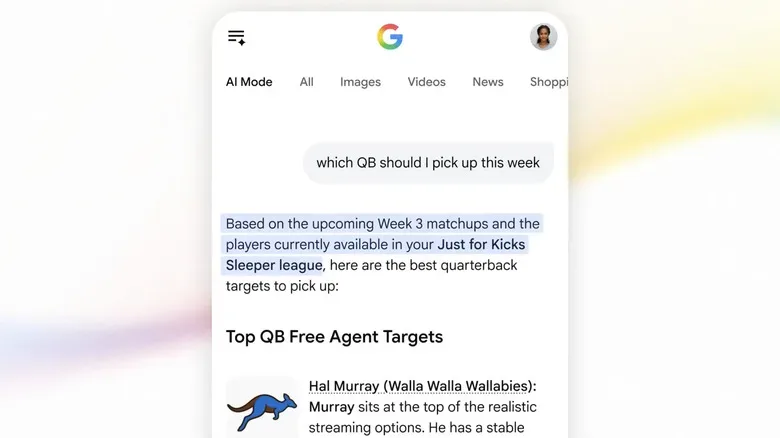
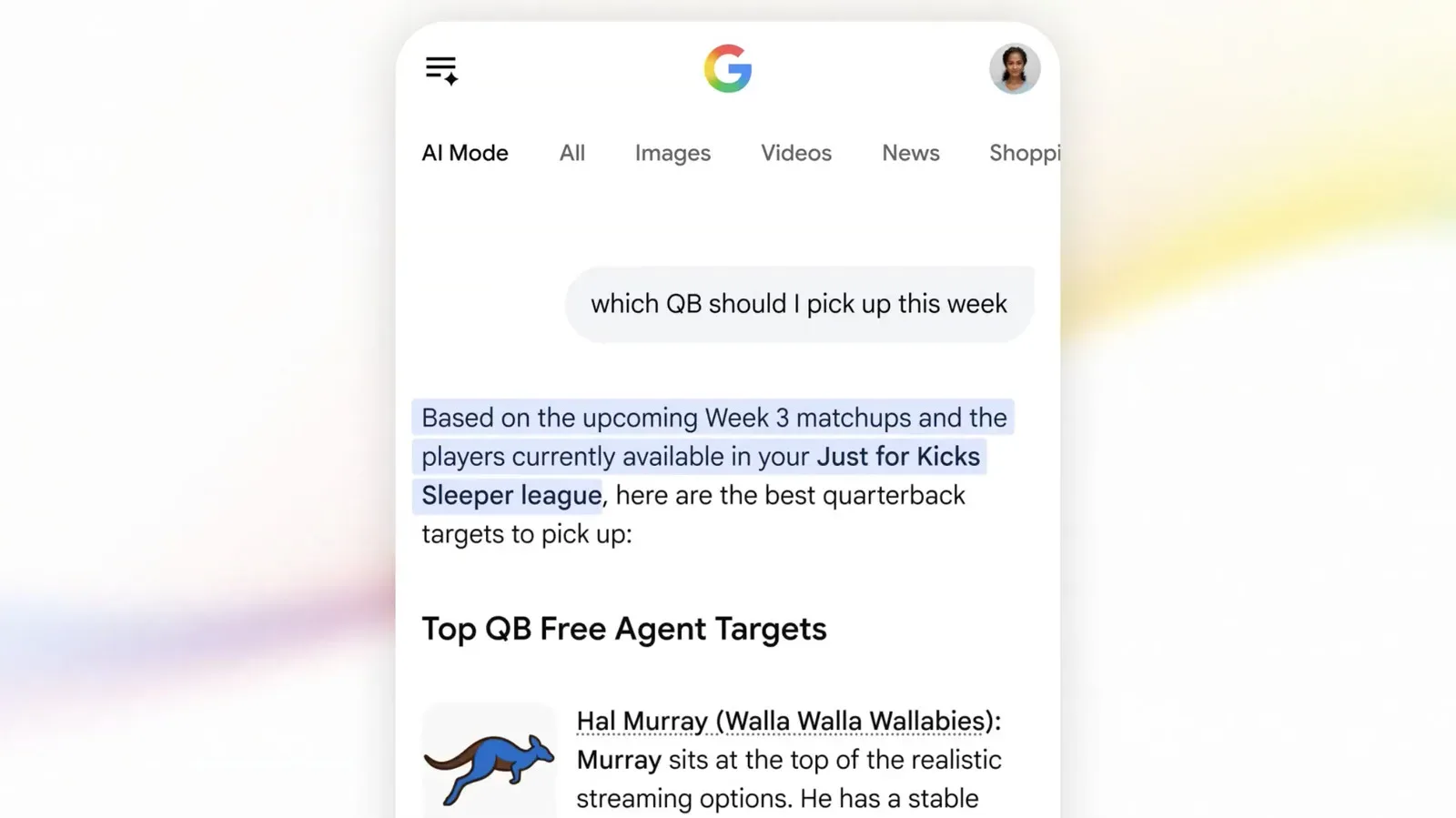
The headline addition is an option to connect a Yahoo Fantasy or Sleeper account to Google Search. With that connection in place, Google says AI Mode can use the context of a person’s current roster and tracked leagues to respond to fantasy football questions. The intended use cases include help choosing starters and identifying free agents who may be worth adding.
That is a meaningful distinction from simply asking a general-purpose chatbot whether a particular player is a good start. Fantasy choices are rarely isolated questions. League scoring, available players, roster construction, matchup timing, and the particular disaster currently unfolding on a bench all matter. The promise here is that AI Mode can take some of that account-level context into consideration rather than offering a generic answer detached from a manager’s actual situation.
There is also an unavoidable philosophical wrinkle: for plenty of players, the agony of deciding whether to trust a volatile wide receiver is the game. An AI recommendation may be welcome research support, but it can also feel like assigning the most entertaining part of management to an extremely confident spreadsheet with conversational skills. Google’s feature does not remove the need for a manager to make the final call, but it gives the manager another voice in the room—and this one will not forget the scoring format or disappear for three hours after proposing a trade.
AI Mode gets a fantasy-football lane
Google frames the fantasy feature as an extension of AI Mode’s ability to work with external apps for additional context. In this case, the outside services are Yahoo Fantasy and Sleeper. Once an account is connected, queries can be grounded in the user’s live fantasy environment: the players they roster and the leagues they follow.
The company specifically points to two familiar questions:
- Which players should be in the starting lineup?
- Which free agents could be useful additions?
Those examples cover the decisions that tend to dominate the fantasy calendar. Start/sit choices arrive with each game week, while free-agent research becomes especially frantic after injuries, surprise breakouts, or a teammate’s suspiciously precise “nothing to see here” message in the league chat. The ability to ask in natural language could make the feature less intimidating for casual managers who do not want to dig through a stack of stat pages before making a move.
Still, recommendations are not guarantees. Fantasy football is full of variables that no interface can erase: late injury news, changes in usage, unexpectedly lopsided games, weather, and the timeless curse of watching a player score 28 points precisely one week after being dropped. AI Mode can offer suggestions based on available context, but it cannot turn a probabilistic sports decision into a certainty.
Users should also recognize the practical boundary of the announced support. Google named Yahoo Fantasy and Sleeper, not every fantasy service. The feature is useful only for people comfortable connecting one of those supported accounts, and its advice will naturally be most valuable when the connected roster and league details accurately reflect the question being asked.
Search wants to be the game-day dashboard
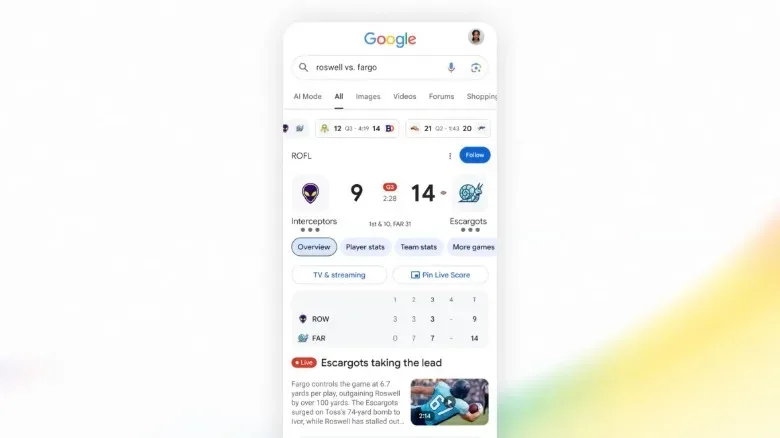
Alongside the fantasy additions, Google is changing what happens when someone searches for a game already underway. A new Live Game Feed is designed to surface several pieces of game information together: the live score, a summary of what has happened so far, play-by-play updates, and video highlights.
It is a familiar goal for modern sports products: reduce the number of tabs, apps, texts, and frantic searches necessary to answer “What happened?” A fan who cannot watch may want a quick narrative recap in addition to the score. Someone who has only glanced away for a few minutes may be more interested in the sequence of plays that produced a sudden swing. The Live Game Feed is intended to cover both needs inside Search.
Searches for matchups and individual players are getting their own expanded presentations. Looking up a matchup can bring up a carousel of scores from other games in the league. Searching for a player can surface current playing statistics. Google also says Search may show a team’s win odds and, in a bracket setting, the opponent it could face next.
These tools position Search less as a destination for a single fact and more as a live information layer. That may be particularly helpful during packed sports windows, when a fan is tracking an NFL game, following fantasy production, and periodically checking what another matchup means for standings or a bracket. Collectors following the sport may find the broader context useful, too; historical football-card interest often turns on the same blend of standout performances, player attention, and season-long narratives explored in a look at why 1966 Topps Football remains a compelling vintage set.
What is available, and where
Google says the AI Mode fantasy football capability and Live Game Feed are available now in English in the United States. The regional and language limitations matter: neither feature was described as a global launch in the announcement.
The expanded score carousel and player-stat results have a broader footprint. Google says those mobile Search results are available globally. In other words, the new live-score and player-data discovery tools are the widest part of the rollout, while account-connected fantasy assistance and the Live Game Feed are initially aimed at English-language U.S. users.
Nothing in the details provided suggests that the new fantasy function independently runs a league, completes roster transactions, or makes decisions automatically. It is described as a recommendation tool. That is an important difference in a hobby where the commissioner has rules, league members have opinions, and the consequences of a questionable transaction can outlast the season.
The convenience-versus-control question
Sports information has long been shaped by tools that convert a flood of live events into manageable choices: scoreboards, alerts, projections, injury reports, matchup charts, and lineup optimizers. Google’s update brings its AI interface into that workflow by combining conversational questions with live account context. For managers who already use Search as a quick reference point, that could make routine research faster.
But faster is not necessarily simpler. A recommendation is only as helpful as the assumptions behind it, and fantasy managers have very different goals. One player may chase weekly upside, another may prioritize a safe floor, and a third may be managing a league format where a subtle scoring rule changes the value of an entire position. A useful response must account for the circumstances, not merely declare one athlete “better.” Google’s account connection is meant to supply some of that specificity, yet users should still consider whether a recommendation suits their own risk tolerance and league strategy.
There is a social angle as well. Fantasy leagues frequently work because managers have imperfect information and wildly different theories. One person’s stat-driven pickup is another person’s inexplicable late-night gamble. If AI tools become a common source of suggestions, leagues may spend more time debating the quality of the model’s logic alongside the usual debates about football. The waiver wire will remain competitive; it may just acquire a new, politely worded accomplice.
For viewers who do not play fantasy at all, the Live Game Feed and expanded Search cards may be the more immediately useful update. Scores alone explain little about a game’s shape. A recap, play-by-play, and highlight access can supply the context that makes a live result meaningful, while league-score carousels and player statistics make it easier to follow several storylines at once.
Google’s football-season update ultimately offers two versions of assistance. One is strategic, with AI Mode designed to help Yahoo Fantasy and Sleeper users examine their roster decisions. The other is observational, presenting live games and player performance in a richer Search experience. Both aim to make football information more immediate. Whether managers use the AI advice as a trusted second opinion or as one more argument to ignore before kickoff is, fittingly, a decision they still have to make themselves.