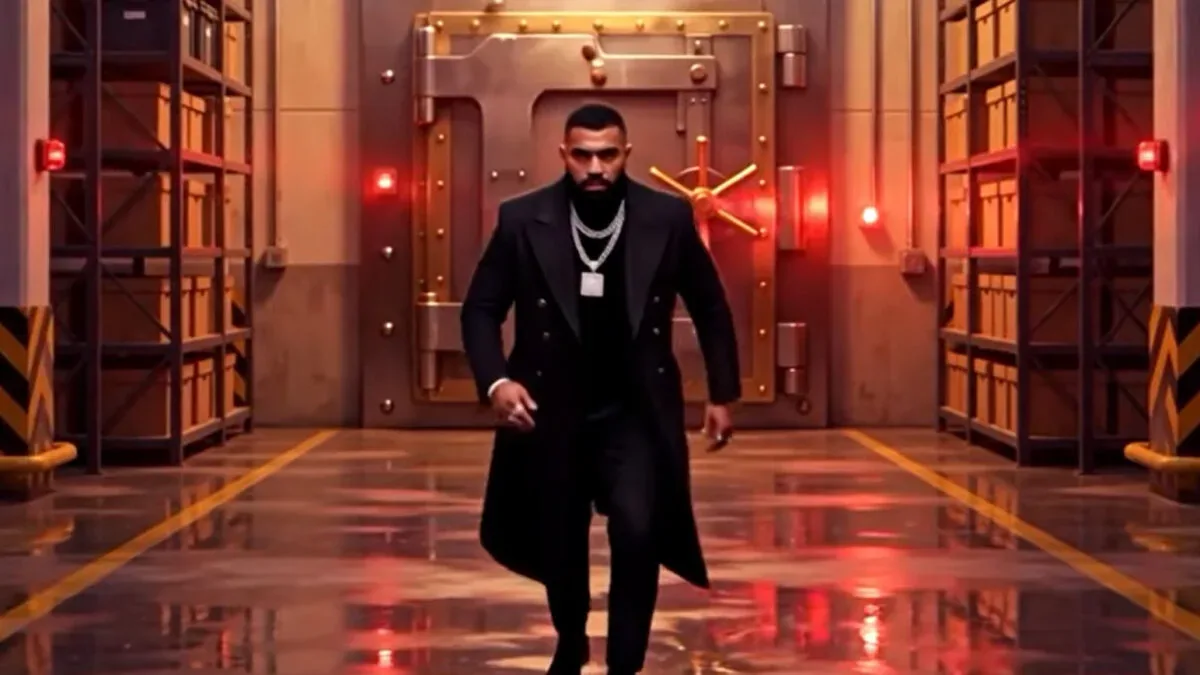
Ginuwine has entered video games with My Ride: The Ginuwine Story Game, an AI-developed beat-’em-up that turns a dispute over music ownership into an intentionally direct action-game premise: play as Ginuwine, break into Sony Music headquarters, battle security personnel and retrieve master tapes.
The musician presented the game as a story about getting his masters back after more than 30 years and living freely. It is important to separate that stated game narrative from a legal finding or a documented account of any real-world event. The game uses a fictionalized raid as its central device, not a reported depiction of an actual break-in.
Its arrival is also a conspicuous example of a public figure using generative AI to make a small game around a personal grievance. Ginuwine thanked Anderson Westfield for creating the project, and Westfield has been open about the use of AI. That disclosure matters, particularly in a games business where AI-generated material has prompted arguments about labor, creative ownership, quality control and the extent to which a rapid prototype can be treated as a finished product.
A simple brawler built around a pointed premise
A beat-’em-up is a combat-focused game format built around close-range fighting against groups of opponents. The genre’s basic language is easy to recognize: walking through levels, encountering hostile characters, using punches and kicks, then moving on once the space has been cleared. My Ride follows that template. Players punch and kick guards while alarms sound during the raid on the Sony Music building.
That stripped-down structure is useful for the idea Ginuwine is presenting. There is no need for the game to simulate music-industry contracts or rights negotiations to communicate its emotional point. The objective is literal: get to the vault and reclaim the recordings. It is closer to a compact revenge-fantasy scenario than to a management game, documentary or legal explainer.
The target selected by the game has a corporate-history connection in the premise. Sony purchased Epic Records in the late 1980s, and Ginuwine frames the mission around tapes held by Sony. But “masters” are not simply a synonym for an artist’s songs. In music-industry terms, a master recording is the particular recorded performance from which releases can be manufactured, licensed and distributed. Ownership of a master can be distinct from ownership of songwriting or publishing rights. The game’s blunt goal therefore draws power from a real and often misunderstood distinction: control over recordings is not automatically the same thing as control over the words and composition of a song.
Supafriendz collaborators appear in AI-made form
Between fights, the game sends Ginuwine to a recording studio. AI-generated likenesses of fellow Supafriendz collaborators Missy Elliott and Timbaland appear there, alongside Magoo, Static Major and Aaliyah. The characters encourage him through the mission.
Those cameos are a major part of why the project is likely to invite scrutiny beyond its rough visual presentation. Magoo, Static Major and Aaliyah are deceased, and the use of AI-made representations of real people—especially deceased artists—raises questions that a conventional cameo does not settle. The supplied information identifies the appearances as AI-made likenesses, but does not establish permissions, participation by estates, licensing arrangements or how any voices were produced. Those details should not be assumed.
Related coverage includes Ginuwine Takes on Sony in an AI-Made Beat-’Em-Up.
Practically, that uncertainty is central to the wider AI debate rather than incidental trivia. A model can produce something that resembles a recognizable performer quickly, but a resemblance still carries artistic, ethical and potentially commercial consequences. A game can frame those figures as supportive companions; audiences may nevertheless ask whether their inclusion honors a collaboration, repurposes an image without sufficient context, or both. The available information does not answer that question.
Its technical roughness is part of the story
The game has drawn attention for conspicuous AI-era visual oddities. Its environments reportedly contain rain puddles even in the depths of a Sony vault. Ginuwine’s character appears to float slightly above the floor. The victory scene places members of a sold-out audience in front of and behind the stage at the same time.
These are not just amusing glitches; they illustrate a common problem in quickly generated visual material: object permanence. In this context, the phrase means that objects, settings and spatial relationships should remain consistent as a scene continues. A venue has an established stage orientation. An interior vault ought to obey the logic of being indoors. A character should appear to connect with the ground. When a system produces imagery without preserving those relationships, the result can feel dreamlike or disconnected even when individual elements look plausible at a glance.
The reported voice delivery has a similarly artificial quality, described as stiff and commercial-like rather than natural conversation. Together, the drifting character movement, inconsistent spaces and synthetic-sounding lines create a particular kind of spectacle: a game that is immediately legible as a playable fantasy, but equally legible as a product of tools still struggling to maintain a coherent world from moment to moment.
That can be funny, but it also limits what AI automation currently communicates to players. Technical polish is not only about high-resolution art. It is about continuity, collision, timing, animation, sound, level logic and purposeful interaction. A brawler lives or dies on whether motion and impact feel understandable. If a character looks as though they are hovering, the game may undermine the very physicality its genre depends on.
Why the game is landing in a fraught AI moment
Generative AI has become an unusually charged topic in games because it touches every stage of production: concept art, writing, voice work, character assets, programming support and marketing. Supporters often focus on speed and accessibility. Critics raise concerns about the effect on creative jobs, ownership of training material, consent around voices and likenesses, and a growing volume of low-effort content that becomes harder for players to navigate.
My Ride does not resolve those disputes. If anything, it concentrates them into one eccentric package. It is a celebrity-fronted release created with openly acknowledged AI, its story is tied to rights and ownership, and its supporting cast includes AI versions of named artists. The project’s message—an artist fighting for control over masters—sits next to a production method that itself intensifies arguments about control of creative work.
That tension is more revealing than the game’s novelty alone. The technology makes it possible to transform a personal thought experiment into a shareable interactive object quickly. Yet speed does not automatically provide the layers of authorship, context and craft that people expect from games or from portrayals of real cultural figures. The awkwardness on screen is therefore matched by an awkwardness behind the screen: who gets to make the work, whose identity is used inside it, and what counts as a meaningful finished game?
Not a substitute for an industry explanation
Players should not mistake the game’s premise for a guide to how master ownership works or how disputes over recordings are addressed. It presents an exaggerated, physical solution because that is what makes a beat-’em-up immediately understandable. Real questions involving recording rights, label relationships and catalog control are not explained by fighting guards in a virtual office.
Still, the premise may direct more attention toward the significance of masters. For listeners, the practical takeaway is that a beloved performer’s public association with a song does not, by itself, reveal who owns the underlying recording. “Artist,” “songwriter,” “publisher,” “label” and “master owner” can overlap, but they can also be separate roles with different interests. A game cannot untangle those arrangements, but it can make the issue memorable.
Its timing also inevitably invites comparisons with online chatter around making bespoke crime games with AI tools, particularly as some players voice disappointment about the direction of GTA VI’s evolving audio ambitions. Ginuwine’s game takes that “make your own fantasy crime spree” impulse and makes it strikingly literal. Rather than wait for a giant studio production, it packages one artist’s imagined mission into a smaller brawler.
Whether that makes it a convincing case for AI-made games is another matter. The available details point to a project whose value lies chiefly in its specificity and bizarre presentation: Ginuwine versus a music-company headquarters, encouraged by AI-generated collaborators, in a world where puddles appear in a vault and the audience wraps around the stage. It is a memorable proof that current tools can produce a game-shaped artifact around a sharply defined idea. It is not, on the evidence available, proof that the tools have solved the creative, technical or ethical problems now surrounding AI in games.