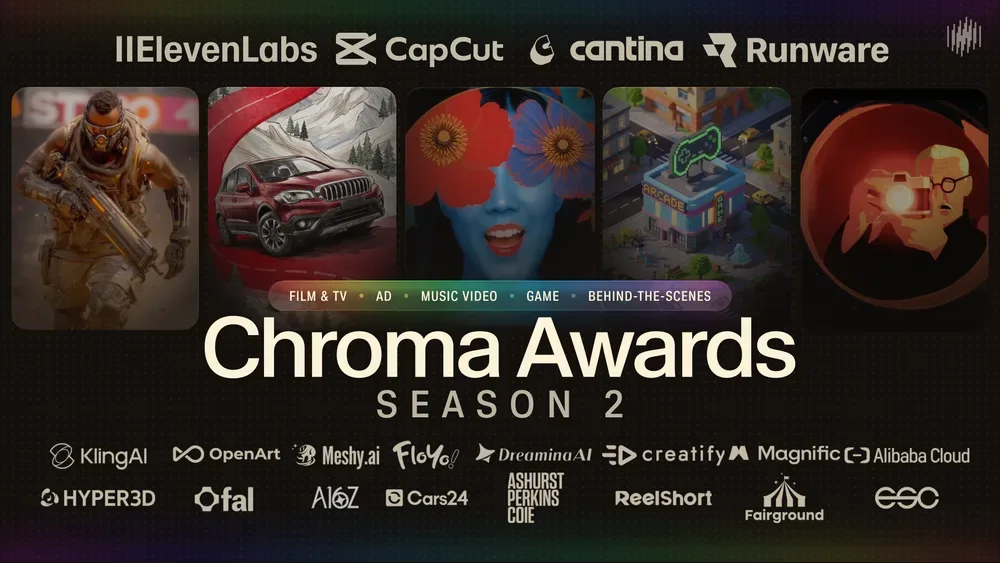
The Chroma Awards is back for a second season, inviting AI-native creators worldwide to submit work across film, music videos, advertising and video games. Organizers say entries will remain open through January 7, 2027, with winners set to be announced in a global livestream in mid-February before an inaugural red-carpet gala.
Founded by ElevenLabs in 2024, the awards occupy an increasingly important space for creators using emerging tools in screen-based work. Their first entry cycle, opened in 2025, attracted more than 6,600 submissions from 5,550 creators representing 122 countries. That response matters less as a simple participation statistic than as evidence of the range of people now trying to turn AI-assisted production into finished creative work.
For games in particular, the competition’s continued video game division puts interactive projects alongside more familiar visual-media categories rather than treating them as a side attraction. It also reflects a broader industry question: as creative technology becomes more accessible, what separates a compelling game-related project from a technically impressive demo? The awards’ stated emphasis on both cinematic standards and familiarity with emerging tools suggests organizers are looking for more than novel output.
Season 2 keeps games in the frame
The second Chroma Awards season is being presented by ElevenLabs with CapCut, Cantina and Runware. It maintains the four divisions used in its first year: film, music videos, advertising and video games.
That structure is notable because the work associated with AI can cross conventional production boundaries. A games submission might involve visual development, voice work, 3D assets, trailers or other materials that sit at the intersection of interactive design and audiovisual storytelling. The awards have not detailed category rules in the information provided, so creators should not assume what kinds of game projects qualify solely from the division name. They should instead consult the submission portal and requirements before committing time or computing resources to an entry.
The video game category nevertheless gives creators working in that space a defined route into a competition that is also designed to connect entrants with technology and entertainment companies. That potential visibility sits alongside the prize offering: organizers cite more than $1 million in promotional giveaways, plus $450,000 in cash prizes and travel perks supported by partners.
In a creative field where access is often as consequential as raw ability, giveaways, trials and exposure are not interchangeable benefits. Cash can fund a project or reduce personal production costs. Software access can make a specific workflow possible. Industry exposure may create a future opportunity, but it is less predictable than a prize. Applicants weighing the value of entering should recognize that distinction rather than treating the headline total as money available to every entrant.
A category for the work behind the work
The largest change for Season 2 is a behind-the-scenes division centered on the creative process behind AI film production. Organizers describe the addition as a way to spotlight artists’ creativity, humanity and craftsmanship, not just the images or scenes seen in a completed piece.
That is a meaningful shift in emphasis. “Behind the scenes” in this context means the development process: the human decisions, creative direction and practical work that lead from a concept to a finished project. It should not be confused with a claim that a tool independently made a work. The new division explicitly acknowledges that a finished AI-assisted production has creators behind it.
Although the new category is described around AI film production, the underlying point will be familiar to people making games. Interactive projects are built through choices: determining the experience’s purpose, deciding how art supports an idea, revising material that does not fit, and shaping assets into something coherent. Tools can change the speed or cost of pieces of that work, but they do not eliminate the need for judgment.
For creators, a process-focused division can also reward clearer documentation of authorship and decision-making. That is an interpretation of the category’s purpose, not a published submission instruction. Still, it is a practical reminder that creators should retain project records, permissions and original materials, especially where work uses third-party elements or depicts recognizable people.
Copyright, IP and likeness rights are part of the standard
The awards say all entries must meet strict criteria covering copyright, intellectual property and likeness rights. These terms are connected but distinct.
- Copyright generally concerns rights in creative expression, such as a video, image, recording or written material.
- Intellectual property, often shortened to IP, is a wider umbrella term that can include copyright and other protected creative or commercial material.
- Likeness rights concern the use of an identifiable person’s appearance, identity or related attributes.
The organizers’ decision to explicitly foreground these requirements is important. Generative and AI-assisted tools may lower some barriers to production, but they do not remove responsibilities around what a creator submits. An entry can be visually ambitious and still face rights issues if it includes material without appropriate permission or uses someone’s likeness in a way that does not meet the rules.
The judging panel is expected to include people with backgrounds in both traditional entertainment and AI. The stated aim is to assess entries through cinematic standards as well as fluency with newer tools. “Fluency” here should not be read as a requirement to pursue technology for its own sake. It describes an understanding of how emerging tools are being used in the work. Craft, rights compliance and creative intent remain central to the framing of the competition.
Why access remains the practical issue
Runware co-founder Ioana Hreninciuc identified the cost of operating AI at scale as a major obstacle between an idea and a completed project. That observation helps explain why the competition combines awards with free software trials, educational resources and industry exposure.
“AI at scale” refers to using computational systems extensively enough to produce substantial work, which can require access to tools and infrastructure beyond a creator’s ordinary budget. The issue is not merely generating one piece of material; it is the cost of iteration. Creative work usually involves trying ideas, rejecting weak results, revising and assembling a final piece. When each stage carries a cost, the distance between an initial concept and a polished entry can grow quickly.
The Chroma Awards’ partner list includes Kling AI, OpenArt, Meshy, Floyo, Dreamina, Creatify, Magnific, Alibaba Cloud, Hyper3D, fal, A16Z, Cars24, ReelShort, Ashurst Perkins Coie, Fairground and Escape. Their involvement is presented as a way to provide entrants with opportunities beyond the prize pool.
That is particularly relevant to creators who have ideas but limited access to conventional production pathways. The awards’ partners and organizers are positioning the program as an attempt to reduce the obstacles faced by emerging filmmakers and other creative workers. Whether it delivers meaningful results for individual entrants will depend on the terms of the available resources and the opportunities ultimately offered, neither of which is fully detailed here.
What this means for game creators
For developers, artists and teams considering the video game division, the practical takeaway is simple: a competition entry should be approached as a complete creative submission, not as an excuse to ignore the ordinary work of rights clearance and presentation. The awards’ rules around intellectual property and likenesses make that especially clear.
The continued inclusion of games also arrives as attention on the games business remains high. Broader discussion around major releases has emphasized their potential to provide momentum across the sector, as explored in coverage of hopes for a blockbuster launch to lift the games industry. The Chroma Awards is a different kind of opportunity, focused on creators and AI-assisted work rather than one major retail release, but it points to the same reality: visibility and production access remain valuable currencies in games.
Season 2 submissions are open globally until January 7, 2027. Creators interested in applying can use the Chroma Awards submission portal and should review the competition’s current requirements carefully, particularly the criteria governing rights and eligibility.