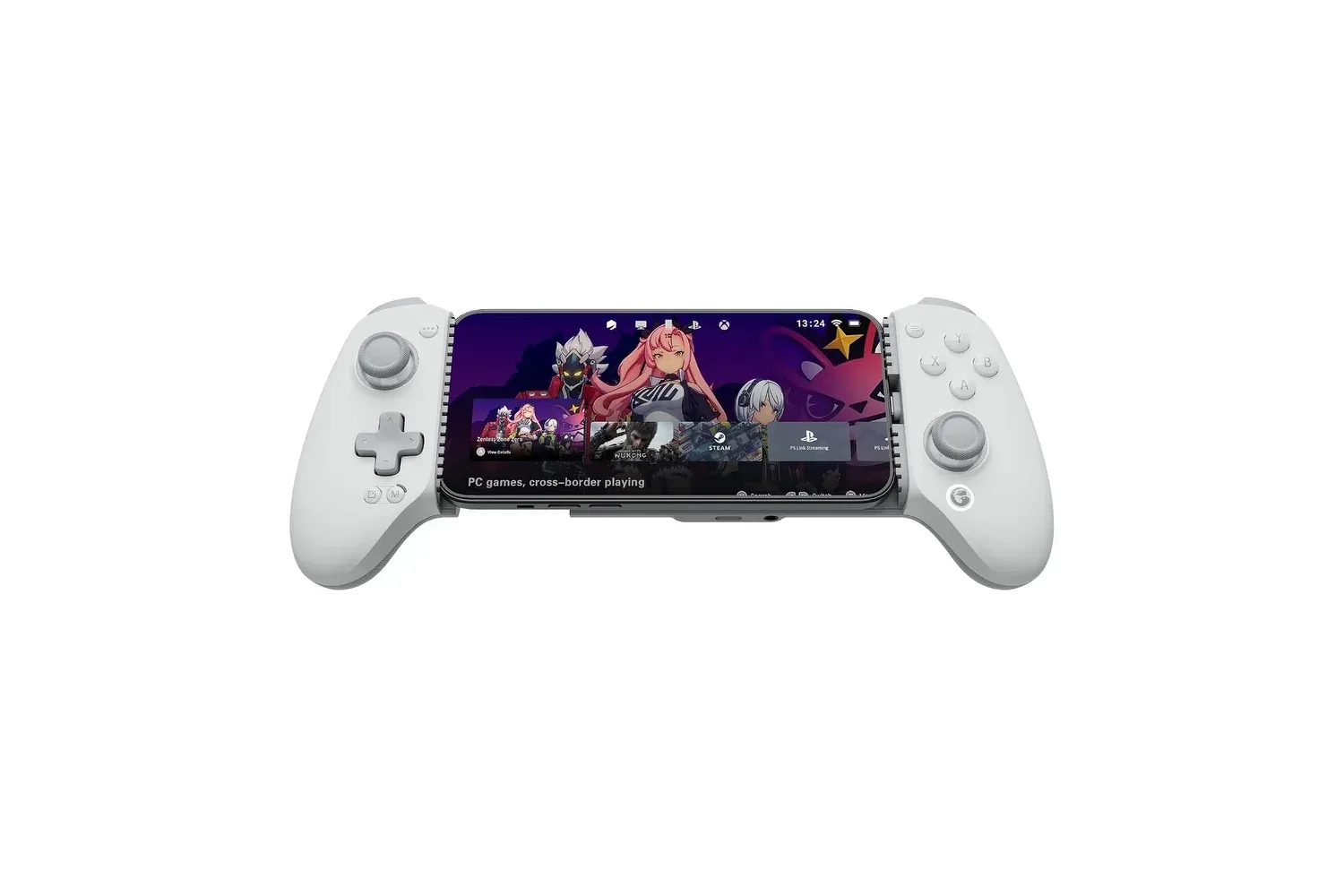
The GameSir G8 Plus MFi controller is currently listed for $64, down from a stated regular price of $80. That is a $16 reduction, or 20% off, for a mobile controller designed to clamp around a phone or smaller tablet and make it feel closer to a traditional handheld gaming setup.
The deal is potentially most interesting for players who already use an iPhone, USB-C iPad or Android phone for controller-compatible games, Apple Arcade, or cloud gaming. The G8 Plus is not simply a Bluetooth pad that happens to work with a handset: it attaches around the device and connects through its USB-C port. That physical connection is central to both its appeal and the checks shoppers should make before treating the $64 price as an automatic buy.
A wired mobile controller built around USB-C
GameSir says the G8 Plus fits devices roughly 4.9 to 8.5 inches wide, which covers most smartphones and extends to the iPad mini. It supports iPhone and iPad, carries Apple’s MFi certification, and also works with Android devices. MFi, short for Made for iPhone/iPad, is Apple’s accessory-certification program. In practical terms, it indicates that the controller is intended to work within Apple’s accessory ecosystem; it does not mean every game on an Apple device accepts controller input.
That distinction matters. Hardware compatibility describes whether the controller can communicate with the phone or tablet. Game compatibility determines whether a particular title will recognize and properly use a controller. GameSir identifies Apple Arcade, cloud gaming services and supported mobile games as use cases, but buyers should still confirm controller support for the specific games they play most. A well-equipped controller cannot add native controller controls to software that does not support them.
The USB-C link is described as providing very low latency. Latency is the delay between a button press and the game responding. A wired connection can avoid the extra wireless communication step associated with Bluetooth, which is especially relevant in fast reactions: aiming, timing a turn in a racing game, or responding to an on-screen prompt. The extent to which that matters will vary by game and by the broader setup, including streaming conditions for cloud titles, but direct connection is a sensible design choice for players who prioritize immediate input.
There is another practical advantage: GameSir says the controller has no internal battery. Rather than charging the controller separately before a session, the user places a compatible device in the grip and connects it. That makes the accessory simpler to pick up and use, though it also makes the phone or tablet’s available charge more important.
Pass-through charging addresses a common mobile-gaming compromise
Mobile gaming puts the game, display, controls and network functions on one battery-powered device. The G8 Plus includes pass-through charging, allowing a compatible phone or tablet to be charged through the controller while it is in use. For players using a device for longer sessions, that may be a more meaningful feature than cosmetic extras because it removes the choice between continuing to play and stopping to charge.
The controller also includes a 3.5mm headphone jack for wired audio. Wired headphones can be useful for anyone who wants audio without relying on a separate wireless connection. Together with the physical USB-C controller connection, it creates a compact setup in which the handheld device remains the screen and computing hardware, while the G8 Plus supplies the grips, buttons, sticks and triggers.
Related coverage includes GameSir G8 Plus MFi Controller Deal Drops iPhone Handheld Setup to $64.
That does not mean the controller turns every phone into a dedicated portable console in every respect. A phone still has its own case, port placement, dimensions and operating-system requirements to consider. The stated 4.9-to-8.5-inch fit range is helpful, but size is only one part of compatibility. Prospective buyers should check that their device uses USB-C, that its physical shape fits the controller’s clamps, and that any protective case does not interfere with the direct port connection.
Why Hall Effect sticks and triggers are the headline hardware feature
The G8 Plus uses Hall Effect analog sticks and Hall Effect analog triggers. Hall Effect technology uses magnetic sensing rather than relying on a conventional physical contact point to read movement. GameSir presents this as a way to avoid stick drift and deliver smooth 360-degree control.
Stick drift is the unwanted movement registered when an analog stick is not being touched. In a game, it can appear as a character walking on their own, a camera slowly panning, or a vehicle pulling off line. It is one of the frustrations players most associate with analog controls, so a controller using magnetic sensors has an obvious practical appeal. GameSir says its sticks are rated for up to 5 million cycles, although that is a manufacturer durability claim rather than a guarantee of a particular lifespan in every user’s hands.
The analog triggers similarly aim to offer graduated input. Instead of functioning only as a simple on-or-off button, a trigger can register degrees of travel. That is useful in racing-style games, where throttle and braking inputs can benefit from finer adjustment. The controller also has a Hair Trigger mode intended to make a trigger respond more immediately for shooting games. Put simply, it favors a quicker activation point over the longer analog pull useful in a racer. These are two different control preferences, and having both available is more versatile than treating every genre the same way.
Console-style ergonomics, plus a few meaningful customization options
The controller’s full-size grips and textured surfaces target a basic problem with touchscreen play: holding a thin slab for a long period while keeping fingers clear of the display. GameSir positions the G8 Plus as a console-style alternative, with physical controls placed around the screen rather than over it. Comfort remains personal, but the larger grip format should appeal more to players who find compact clip-on controllers or touch-only layouts cramped.
Two rear buttons can be remapped through the GameSir app or assigned with on-the-fly mappings. Rear buttons can be useful because they allow certain commands to move away from the face buttons without forcing the player’s thumbs off the analog sticks. The value depends on a game’s supported inputs and an individual’s preferred layout, but it is a feature usually associated with giving players more control over how they reach frequent actions.
The GameSir app is also used for saved control configurations and other settings. The controller includes removable thumbsticks, removable ABXY buttons and a magnetic faceplate, giving users physical layout flexibility alongside its software settings. Those details will particularly matter to people who have established preferences for stick height or face-button labeling. They are less important for a buyer who wants a plug-in controller with no setup, but they make the unit more adaptable than a fixed-layout alternative.
Dual vibration motors provide haptic feedback, and GameSir describes their operation as asymmetric, meaning the motors can produce differing feedback at the two ends of the controller. The intended effect is to add distinction to events such as impacts, collisions and explosions. As with controller compatibility generally, vibration support depends on what the game and platform provide.
Who the $64 deal suits—and who should pause
At the advertised price, the G8 Plus is most straightforward for someone with a USB-C iPhone, iPad mini or Android handset who already plays games with controller support and wants a single-piece handheld-style form factor. The combination of direct USB-C input, pass-through charging, headphone support and full grips speaks to a player who intends to use the setup regularly rather than occasionally pair a small wireless controller.
It is also a reasonable fit for players who value Hall Effect controls specifically. Magnetic stick and trigger sensing is not merely a line-item upgrade; it is aimed at reliable analog control and at reducing concerns around drift. The adjustable trigger behavior broadens the appeal for people moving between driving games and shooters.
On the other hand, this is not an accessory to buy solely because it is discounted. Buyers should verify their device’s USB-C arrangement and dimensions, account for cases, and review whether their regular games support a controller. Cloud gaming users should remember that low-latency local input does not eliminate the network conditions that can affect streamed play.
Shoppers comparing device-related discounts may also want to separate the accessory’s price from the cost and suitability of the handset it will be attached to. That same caution applies when evaluating a mobile-device price cut and its comparison points: a lower headline number is only useful after the relevant hardware, features and use case are established.
For the right USB-C device and a controller-friendly library, $64 represents a clear reduction from the stated $80 standard price. The G8 Plus’s strongest case is not that it adds every possible mobile feature, but that it combines a wired handheld layout, charging passthrough, configurable controls and magnetic-sensing sticks and triggers in one accessory.
Shop the products
Check current price, model and availability at the retailer.