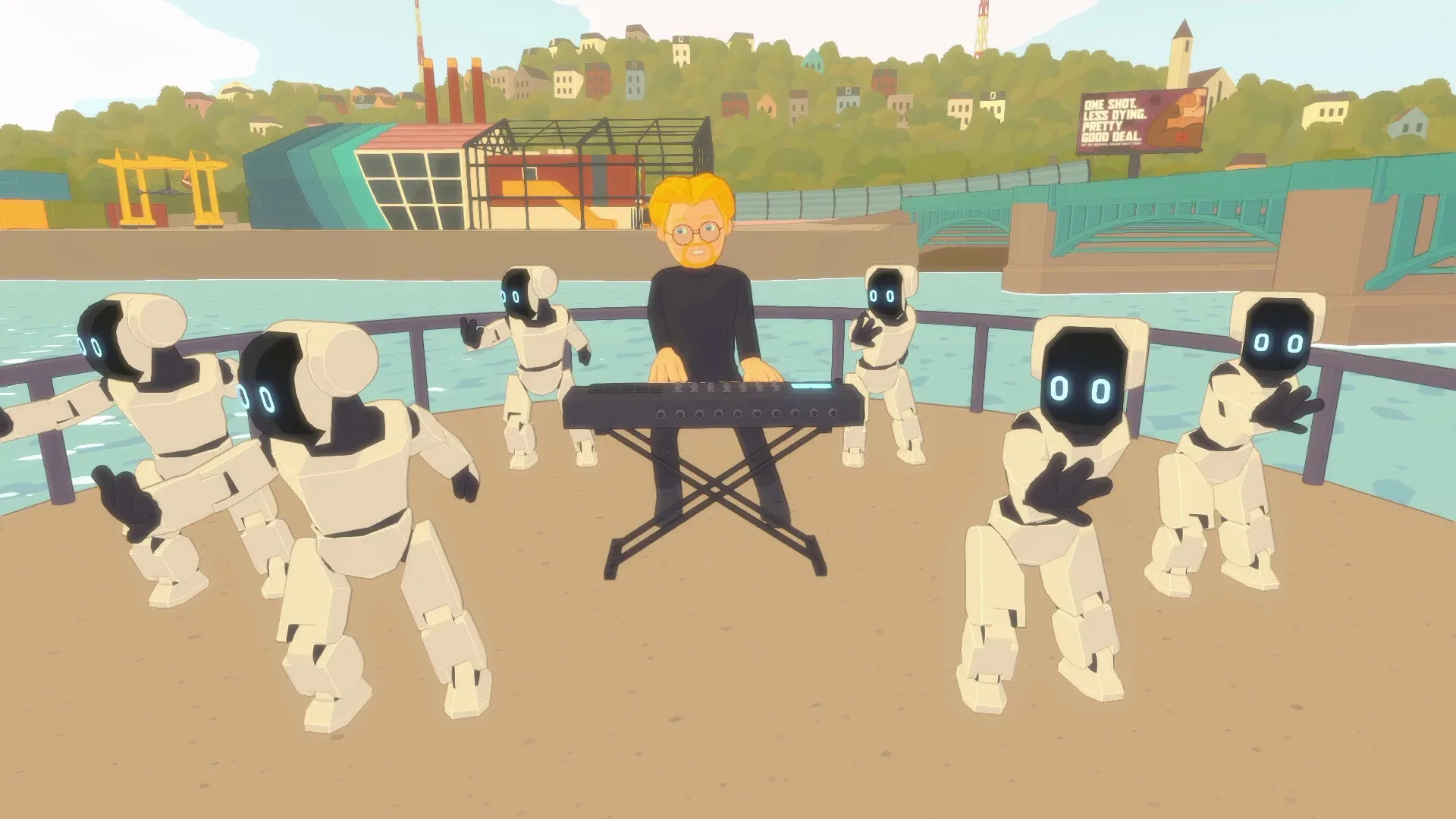
Future? No Thanks!, the adventure game from Paolo Pedercini, also known as Molleindustria, has removed its generative-AI voices and music after their use became a point of controversy. Pedercini has also said that purchasers who still feel betrayed can seek refunds through PayPal and Venmo.
The dispute is unusually pointed because of both the game’s premise and Pedercini’s public political identity. Released in September, Future? No Thanks! imagines a future in which climate change is being addressed, democracy is flourishing and technology serves the public interest. Its central character is an irritable older man trying to finish his bucket list before choosing assisted suicide.
Pedercini described the project as an “ecosocialist utopia” made with local talent and minimal participation from capitalists, marketers or profiteers. That framing helped turn what might otherwise be a small production-method disclosure into a larger argument about whether a game’s stated values should affect its choice of creative tools.
What was in the game
Pedercini confirmed that the game initially included two text-to-speech voices and two music loops made with Suno, a generative-AI music service. He also said that a very small amount of the game’s code had been debugged using ChatGPT and Claude.
Those categories matter. Text-to-speech refers to software-generated spoken audio, rather than a performance recorded by a voice actor. Generative music refers here to music created through an AI system rather than composed and recorded in the conventional way. Debugging is the process of locating and fixing faults in code; AI assistance in that process can range from suggesting a correction to helping explain an error.
The disclosed material was limited in scope: two voices, two loops and what Pedercini called a tiny fraction of debugged code. But the discussion has not been only about how much AI appeared in the final work. It is also about disclosure, symbolic weight and the difference between using a technology as a subject of criticism and using it as a production tool.
Removal addresses the audio, not every AI-related claim
In a follow-up post, Pedercini said the AI-generated content had been removed from the game, with the code work explicitly identified as the exception. He argued that the removed loops had, in early demos, been intended to mock people who enjoy low-quality AI output, and that the synthetic voices worked better as a joke in that setting.
He also said he believes the altered game is only marginally worse without those elements. That is an important clarification for players trying to understand what has changed: the reported removal applies to the generative music and voice assets, while the previously AI-assisted debugging is not something that can simply be excised as a standalone audiovisual asset.
In practical terms, players who object primarily to generated voices and music have been told those materials are gone. Players whose objection covers any involvement of ChatGPT or Claude in development may still regard the game’s production history differently. The refund offer appears designed to acknowledge that split rather than insist that every buyer must accept the revised version.
Why the response has not ended the argument
Pedercini has characterized AI in exceptionally harsh terms, calling it a technofascist, anti-human and anti-art project. That wording sits in direct tension with his own admission of using generative services. The controversy therefore is not simply that an independent developer used AI in a small number of places. It is that the developer’s stated critique of the technology is so sweeping.
There are at least two ways to read that contradiction. One reading is that an artist can use a contested tool in order to satirize it, especially when the intended output is deliberately ugly, hollow or comedic. Another is that satire does not require deploying the thing being criticized, particularly if the criticism concerns the technology’s labor, cultural or environmental consequences.
The supplied statements do not settle that philosophical dispute, and neither does the removal. They do show why the reaction has been stronger than a conventional argument over whether AI audio was “good” or “bad.” For critics, the issue is consistency between method and message. For Pedercini, the small scale and satirical purpose of the material appear to be central defenses.
Pedercini has said his next game will be entirely hand-coded.
That commitment points toward a clearer line for future work, although it does not retroactively change what was used in Future? No Thanks!. “Hand-coded” ordinarily means the developer writes the code themselves rather than relying on generative tools to produce or troubleshoot it. In this case, the statement is significant because Pedercini specifically acknowledged using ChatGPT and Claude for a limited debugging task on the current game.
Disclosure is a separate issue from artistic intent
The use was initially undisclosed, which is likely to remain a major part of the response even after the assets are removed. People may disagree about whether generated audio has a place in a satirical game, but a buyer who learns after purchase that a work included such material has less ability to make an informed decision beforehand.
That is why the refund offer matters. It does not establish a universal industry standard, and Pedercini has not presented it as one. It is a direct remedy for customers who believe the game they bought no longer aligns with what they expected from its creator or its politics. The sarcastic tone of the accompanying explanation, however, may make the gesture feel less conciliatory to some of the people it is meant to address.
For developers, the immediate lesson is more practical than ideological: describe material generated with AI clearly and early, especially when a project is marketed around human labor, local production, political critique or a particular vision of technology. A narrow use can become the dominant story when it is revealed only after release and seems to clash with the project’s central language.
A fittingly awkward conflict for a political game
Pedercini is known for browser games with overt political subjects, including works about the Confederate flag, Soviet workers’ clubs and the editorial priorities of a major newspaper. Subtlety has not been the point of that body of work. That record helps explain why the AI issue has drawn attention: audiences familiar with games that foreground systems, ideology and power are likely to examine the production choices behind a new project just as closely as its fictional setting.
Future? No Thanks! asks players to consider a world where technology has been put to public use. The debate around its production asks a less fictional question: what does it mean to make that argument while using commercially available generative tools, even briefly and even for a joke?
There is no evidence here that the game’s entire development depended on AI, nor that the removed material represented a large share of its content. The confirmed facts instead describe a limited set of generated audio assets, limited AI-assisted debugging, subsequent removal of the non-code elements, an offer of refunds and a pledge to hand-code the next game. Yet limited use does not guarantee limited significance. In an explicitly political work, process can become part of the text.
The broader games industry is still negotiating that boundary in public. Creative labor, disclosure and authorship are becoming increasingly hard to separate from discussions of a game’s themes. That makes stories about production choices relevant alongside more conventional development news, such as planned major updates for established PC games.
For Future? No Thanks!, the immediate outcome is clear enough: the AI voices and music loops are reported to be out, eligible dissatisfied purchasers have been offered refunds, and the remaining disagreement is about whether that remedy answers the concerns raised by the game’s earlier undisclosed use of generative AI.