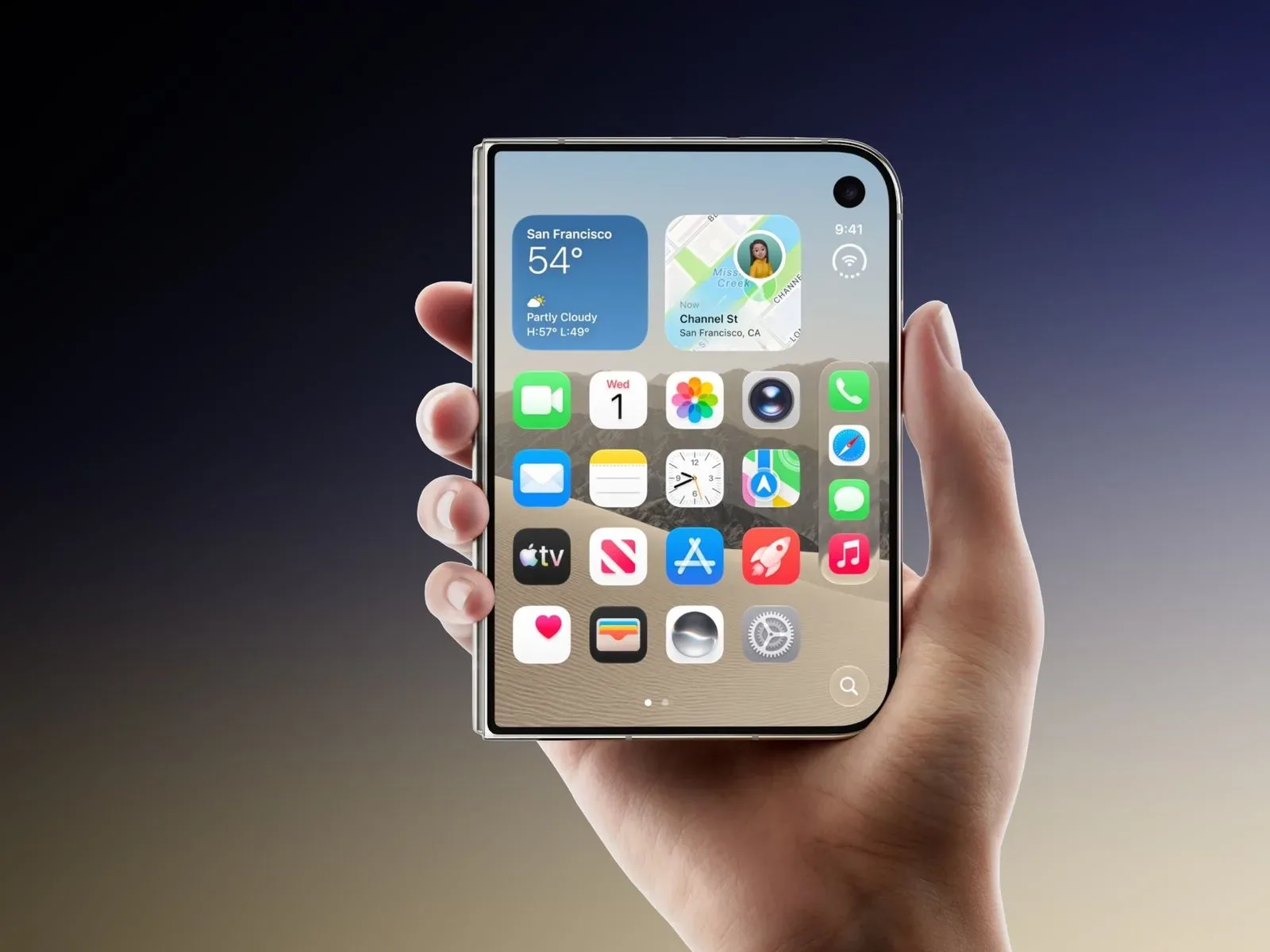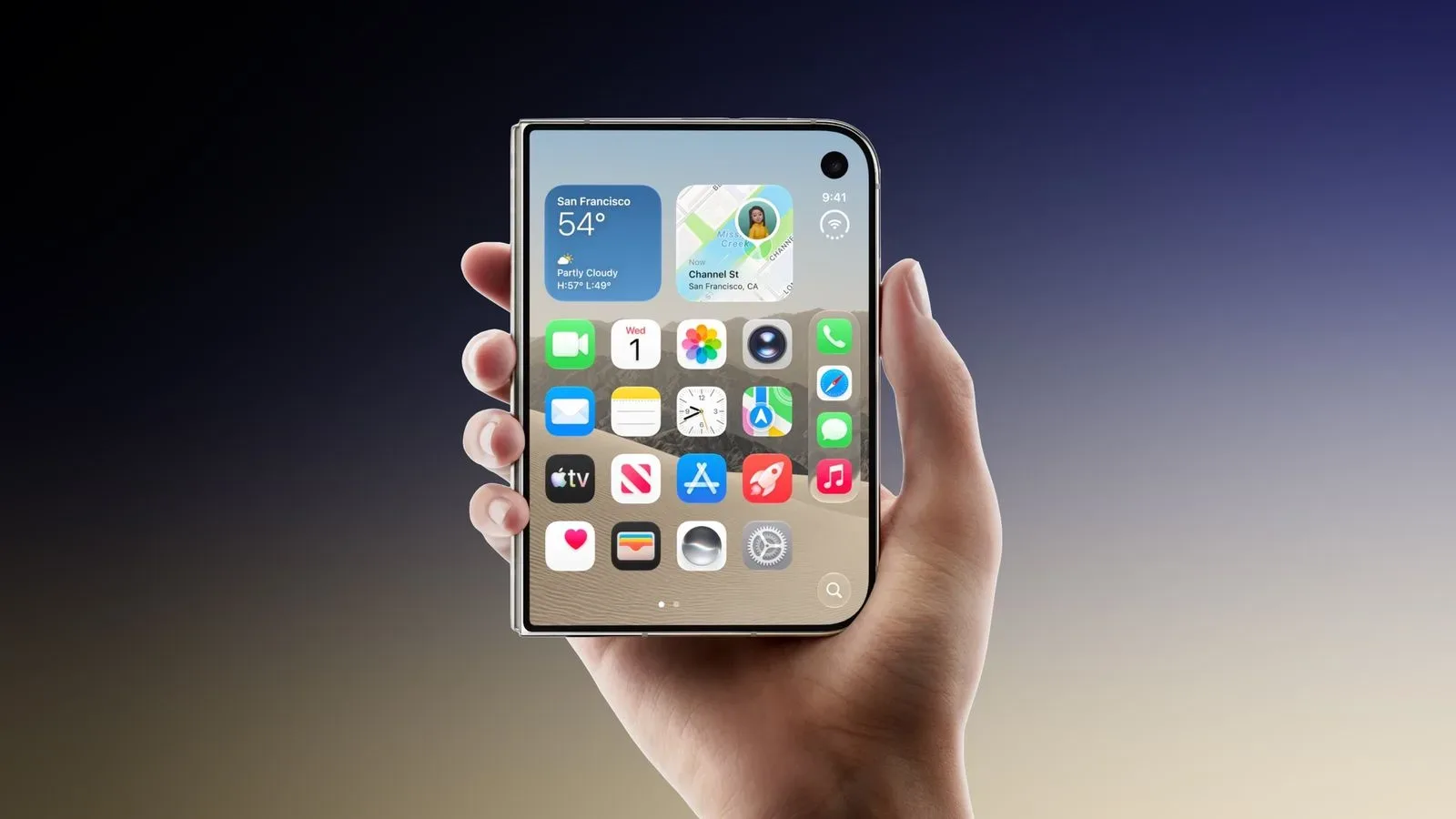
Apple’s expected entry into foldable phones could reshape a market that is projected to barely grow overall. A new forecast places the iPhone Duo at 29.8% of global foldable smartphone shipments in 2027, following an estimated 24.8% share in 2026. That would put Apple close behind Samsung, which is projected to stay in first place at 31.9% in 2027.
The important word is forecast. These are projections rather than confirmed sales results, and the figures describe shipment share: the proportion of devices sent into the market, not necessarily the number of phones ultimately bought and activated by consumers. Still, the estimates outline a potentially dramatic redistribution at the top of the foldable category.
Samsung’s projected share declines from 35.1% in 2026 to 31.9% in 2027. Apple rises from 24.8% to 29.8% across the same period. Huawei is forecast to move from 24.8% to 21.3%. If those estimates play out, the gap between the first- and second-place companies would narrow to just 2.1 percentage points in 2027.
A large share in a market with limited overall growth
The forecast estimates roughly five million iPhone Duo shipments in 2026, while total foldable smartphone shipments are expected to increase by only 0.5%. That pairing matters. It suggests the competition may be less about a rapidly expanding foldable audience and more about which companies can take the largest portion of a relatively stable market.
In practical terms, a company can gain share in two different ways: by bringing new buyers into a product category, or by winning customers who might otherwise have selected a competing device. With overall foldable shipments projected to grow just 0.5%, the second route becomes particularly significant. Apple’s anticipated share gain, in this view, would coincide with falling projected shares for Samsung and Huawei.
That does not automatically mean every lost point from one company transfers directly to another. Shipment forecasts are not a one-for-one record of consumer switching, and the figures do not establish why any individual buyer chose a particular model. They do, however, paint a clear competitive picture: the foldable market could become substantially more concentrated among three major participants, with Apple moving swiftly toward the lead.
Why software compatibility matters as much as the hinge
Foldable phones have an obvious hardware proposition: a device can change its physical shape to offer different screen space. But the useful experience depends on software responding appropriately to that changing canvas. The forecast identifies Apple’s integration of chips, operating system and developer ecosystem as a major potential advantage for the iPhone Duo.
That phrase is worth unpacking. Chip integration concerns the processor and related components that run the phone. Operating-system integration is the way the phone’s core software manages displays, performance and applications. A developer ecosystem is the community and toolset through which app makers create and update software for a platform. When those three layers work together, an application has a better chance of behaving consistently as the device changes between folded and unfolded states.
App compatibility is especially central for a foldable because a larger or differently proportioned display is not inherently useful if software treats it as an awkwardly stretched standard phone screen. Compatibility, in this context, means apps properly adapting their layouts and controls to the available space. That could include preserving readable text, arranging interface elements sensibly and supporting more than one active app without turning the extra display area into clutter.
For gaming and other media-heavy mobile use, display space can be appealing, but it is only one part of the proposition. Interface design, performance behavior and the way apps scale from one screen state to another all affect whether a foldable feels purposeful. The forecast’s emphasis is not simply on a screen that bends; it is on a platform where the software can take advantage of the changing form factor.
That platform question also helps explain why hardware reliability remains prominent. A foldable device asks users to trust moving parts and an adaptable display as part of routine daily use. The forecast expects app compatibility and hardware reliability to improve. Neither is merely a specification-sheet concern: both influence whether consumers and developers see the category as a practical long-term format.
Multitasking is the key competitive claim
The projected shift is expected to steer foldable competition toward multitasking efficiency. Multitasking means using multiple applications or tasks in parallel rather than continually replacing one full-screen activity with another. On a foldable, the larger available display can make side-by-side work more plausible, provided the operating system and the apps themselves support it well.
Efficiency does not simply mean fitting two windows onscreen. A useful multitasking system needs layouts that remain legible, controls that are reachable and app behavior that stays stable as the device is folded, unfolded or reoriented. The value proposition is therefore dependent on coordination: the hardware provides the adaptable screen, the operating system manages the change, and third-party developers make their apps responsive to it.
This is where Apple’s stated advantage could matter most. The forecast points to the company’s control across chips, operating system and developer ecosystem as a way to improve the foldable experience. It is an argument about execution rather than a guarantee that a larger display alone will generate demand. A foldable must make common tasks feel more capable without making ordinary phone use feel less dependable.
For developers, a more competitive foldable market could raise the importance of adaptable app interfaces. The available information does not identify new developer requirements or particular iPhone Duo software features, so it would be premature to assume any specific tools or behaviors. But the direction of the forecast is clear: compatibility will be part of the contest, and multitasking is expected to be an area where that compatibility is judged.
The 2027 leaderboard projected by the forecast
- Samsung: 35.1% of foldable smartphone shipments projected for 2026, falling to 31.9% in 2027 while retaining first place.
- Apple: 24.8% projected for 2026, rising to 29.8% in 2027.
- Huawei: 24.8% projected for 2026, declining to 21.3% in 2027.
The 2026 numbers put Apple and Huawei level at 24.8%, while Samsung leads at 35.1%. The next-year forecast changes that ordering: Apple moves into second at 29.8%, Huawei is projected at 21.3%, and Samsung remains ahead at 31.9%. The forecast therefore anticipates not just incremental movement, but a change in the company holding second place.
At the same time, the figures advise against treating the wider foldable market as a guaranteed explosion. A 0.5% projection for total shipment growth is modest. The prospect of Apple nearing 30% is notable precisely because it is presented against that subdued overall expansion. The category’s headline may be a changing hierarchy rather than a giant increase in total volume.
What to watch as the projection develops
There are several useful distinctions to keep in mind as future details emerge. First, shipment share is not the same as sell-through, revenue share or active-user share. Second, a forecast describes an analyst expectation, not a confirmed outcome. Third, the iPhone Duo’s projected influence is tied to the quality of the broader experience: app compatibility, reliable hardware and effective multitasking.
Those distinctions matter because foldables are not evaluated solely on how they look when opened. They are evaluated on whether their changing screen dimensions help people get through everyday tasks. The forecast argues that integrated hardware and software, combined with developer support, can improve that answer for Apple.
Apple’s potential foldable presence also sits alongside continuing attention on its wider device software direction. For more on the pending product context, see the latest iOS 27.3 developer beta coverage and the iPhone Duo features still pending.
For now, the most consequential number is 29.8%. It does not predict that Apple will take first place in 2027; Samsung is still projected to lead. But it does describe a market in which the top position is no longer distant, and where the next stage of foldable competition may be decided less by the novelty of a flexible screen than by how convincingly that screen supports apps and multitasking.