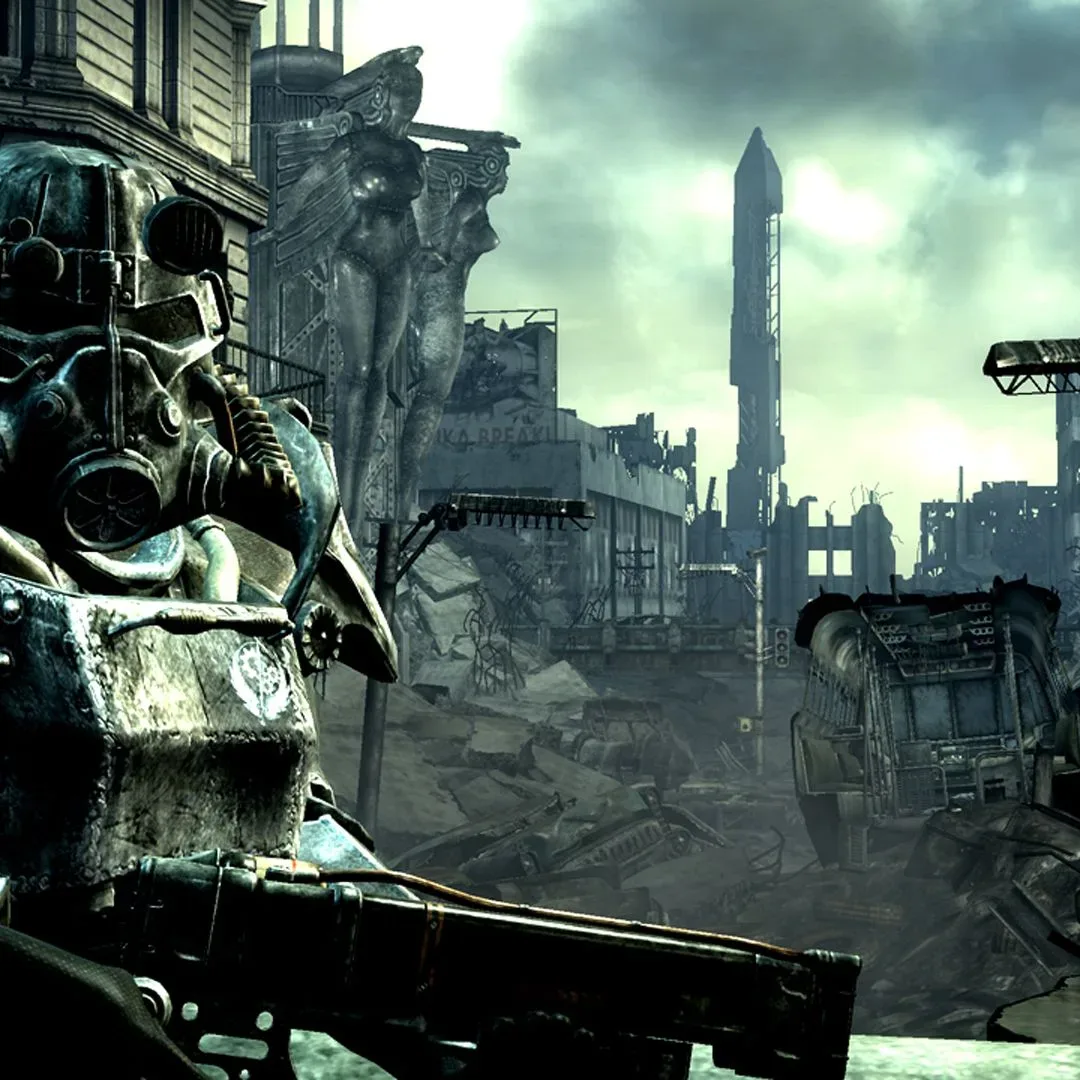
Before Fallout 3 became a defining name in the series’ modern era, Bethesda faced a fanbase argument that will sound familiar to anyone who has watched a beloved game change hands: many players did not think Bethesda should be the studio making it at all.
Bruce Nesmith, a longtime Bethesda developer who worked as a quest designer on Fallout 3 and later contributed to Skyrim and other Fallout games, has recalled the level of resistance surrounding the project in the mid-to-late 2000s. In his account, the reaction was not merely uncertainty about a difficult sequel. There was “huge pushback” to Bethesda receiving the license, especially from players who wanted Obsidian Entertainment to take on the wasteland instead.
That hostility, Nesmith says, became fuel. Bethesda’s response was not to try to litigate every disagreement with the community, but to make the strongest game it could and let the finished work stand as its answer. “We had to prove them wrong,” he said, adding that Fallout 3 was ultimately embraced by many of the people who had been skeptical.
A franchise transition with a lot riding on it
It is easy to flatten old debates after a game has found its audience. Fallout 3 is now part of the series’ central history, while Bethesda’s later Fallout 4 arrived in 2015 and Obsidian released Fallout: New Vegas in 2010. But at the time Bethesda was preparing Fallout 3, players were judging a proposed transition, not a finished game.
The concern Nesmith describes centered on identity. Fans attached to the earlier Fallout games wanted the new entry to retain what they remembered and valued about the series. The fear, as he recounts it, was that Bethesda would simply turn Fallout into Oblivion with a different setting.
That shorthand matters because it captures a real creative anxiety without necessarily describing a specific feature. A role-playing game series is more than its genre label. “RPG” can cover very different priorities: open-ended exploration, authored quests, player choice, tone, character progression, writing style, combat, or the way a world reacts to decisions. When a franchise moves to a different developer, fans often worry that the incoming studio’s established strengths will override the qualities they believe made the original special.
In this case, Bethesda’s reputation for large open worlds was set against the nuance many fans associated with the earlier Fallout titles. Nesmith’s recollection does not suggest every critic wanted the exact same thing, but it does describe a loud faction that saw the change of developer as a fundamental mismatch.
Why Obsidian was a natural fan pick
Obsidian was a particularly understandable alternative in that conversation. Its 2004 game Knights of the Old Republic 2: The Sith Lords had demonstrated the studio’s ability to work in expansive science-fiction role-playing territory. For players looking at Fallout through the lens of dialogue, choices, themes and established RPG sensibilities, that pedigree made Obsidian an appealing candidate.
Related coverage includes Fallout 3’s skeptics gave Bethesda something to prove.
Nesmith’s comments are useful precisely because they acknowledge that preference instead of treating it as incomprehensible. The eventual history of the franchise makes clear that both studios would become important to it: Bethesda made Fallout 3 and later Fallout 4, while Obsidian went on to make Fallout: New Vegas. But that later sequence was not available to fans debating the license before Fallout 3 released.
There was also no realistic way to promise away the concern. Bethesda could explain its intentions, but a franchise audience that believed a studio was wrong for the job was unlikely to be fully reassured by a press-cycle argument. A sequel or revival is judged on whether people feel it understands the series, and that judgment often cannot be settled until players have the game in their hands.
“Make the best game you can make”
Nesmith describes a pragmatic approach inside the team. While some fans would always rank Fallout 2 as the high point of the franchise, Bethesda tried not to engage directly with those debates. His reasoning was blunt: a studio is not going to win every argument or persuade every heart and mind.
“All you can do is make the best game you can make and let that be your statement.”
That is not an admission that feedback is irrelevant. Rather, it recognizes a limit to public back-and-forth when the disagreement is about taste, legacy and trust. A developer can respond to concrete questions through design decisions; it cannot make a single game that resolves every player’s preferred definition of what a long-running series should be.
For a team, that distinction can be healthy. Productive criticism can identify where an audience is worried. But a campaign to convince every skeptic before release can pull attention toward comparison rather than craft. Nesmith’s account frames Bethesda’s internal response as a shift from defending the assignment to meeting the challenge it represented.
There is a wider lesson here for fans as well. Studio pedigree is meaningful context, and audiences are reasonable to care about who is entrusted with a favorite property. Yet pedigree is not the same thing as the finished work. The strongest case for or against a new direction is usually the game itself, not the imagined version that might have been made by someone else.
What the Fallout 3 debate says about sequel expectations
The Fallout 3 story is a clear example of a recurring tension in games: continuity versus reinterpretation. Continuity is the desire to preserve the elements fans recognize as essential. Reinterpretation is the reality that a new team brings its own methods, interests and design language to an existing universe. Neither term automatically means good or bad. The difficult question is where the balance should sit for a particular series.
Fans who feared an “Oblivion” version of Fallout were not only making a comparison between studios. They were expressing concern over that balance. Bethesda’s open-world approach could offer one kind of role-playing experience, while the early games represented another set of expectations for some of the audience. The discussion was therefore about the direction of the franchise, not simply a studio rivalry.
According to Nesmith, Fallout 3 eventually reached at least some of the people who doubted it. That does not erase the people who continue to favor Fallout 2, nor should it. A long-running series can sustain competing favorites. The important point is that Bethesda did not treat the existence of an enduring preference for an earlier game as something it could—or should—defeat through argument.
That perspective is especially relevant whenever a franchise has several acclaimed entries made by different teams. A player can value Fallout 2, Fallout 3, New Vegas and Fallout 4 for different reasons without forcing them into one final, universal ranking. The disagreement is often evidence that the series has accumulated distinct creative identities over time.
The legacy continues, but the next major step is unclear
There is still no stated answer here to the biggest forward-looking question: when Fallout 5 will arrive. That remains unknown. Obsidian is also apparently working on another game set in the wasteland, though the available information does not establish further details.
Separately, Bethesda has confirmed a cat-themed, Fallout-inspired adventure following material that surfaced through the Australian Classifications Board. Beyond that basic description, there is little in the available information to confidently add. It is a reminder that “the wasteland” can support projects of very different scale and tone, but it should not be read as a substitute for a confirmed next numbered Fallout.
For now, Nesmith’s memory looks backward at the moment Bethesda had the most to prove. It also explains why the reaction to Fallout 3 was so charged: the game was being asked to honor a fiercely protected legacy while establishing a future for the franchise under a new developer. Bethesda’s answer, in Nesmith’s telling, was ultimately simple: stop trying to win an unwinnable debate and make the game.
That approach did not make every preference disappear. It did help create a Fallout era that later included both Bethesda’s subsequent work and Obsidian’s New Vegas. As the industry continues to wrestle with revivals, sequels and the stewardship of old favorites, Fallout 3 remains a useful case study: skepticism may be unavoidable, but the only convincing response is a finished game that earns its place.
For more on how changing circumstances can complicate hopes for a returning cult favorite, see the latest on concerns surrounding a rumored return for The Simpsons: Hit & Run.