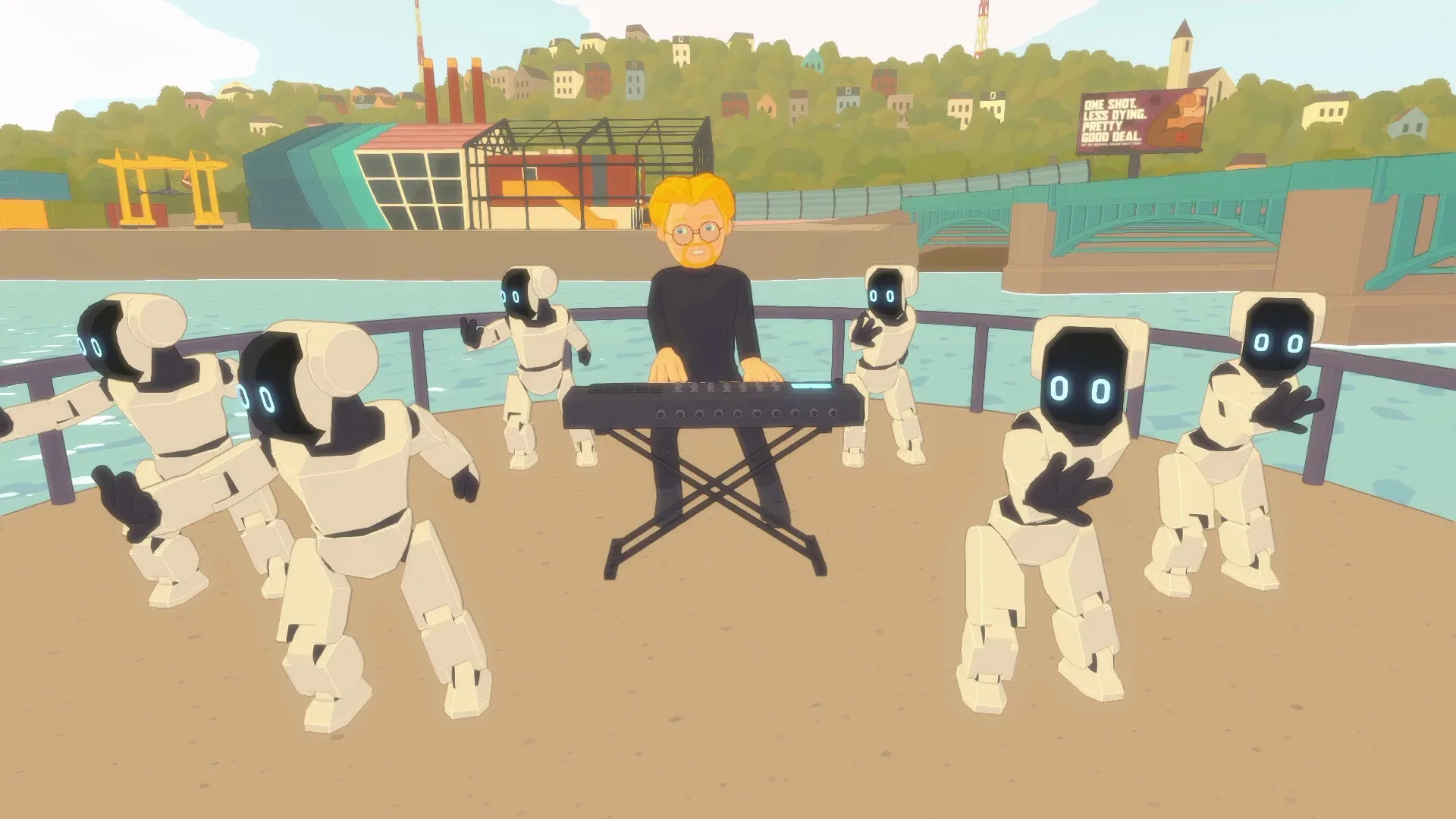
Embark is revisiting one of the most contentious creative decisions surrounding Arc Raiders: its use of generative-AI voice lines alongside human performances. The developer has now publicly discussed the issue in a video featuring chief creative officer Stefan Strandberg, audio director Bence Pajor and voice actors connected to the game.
The central update is straightforward. Arc Raiders launched in October 2025 with a mix of conventionally recorded dialogue and generative-AI voices. In March 2026, Embark said it had started replacing the AI material with lines recorded by human actors. Eight months later, the studio has used the video to explain its thinking—and the explanation has only sharpened the wider disagreement over what AI voice technology should do in games.
Embark’s argument focuses on the sheer volume of variations needed for contextual player communication, particularly the short public callouts often called “pings.” But that framing leaves an important question unresolved: is a difficult and repetitive recording assignment an argument for synthetic speech, or simply part of the work that production needs to plan, pay for and perform responsibly?
What changed after Arc Raiders’ launch
The game’s initial blend of human and AI-generated voices drew criticism. By March, Embark had committed to beginning the replacement process. That decision matters because it distinguishes two separate issues that can otherwise become muddled together.
The first is whether a synthetic line can sound convincing in isolation. The second is whether a game should use it in place of an actor’s recorded performance. Those are not identical questions. A line might be difficult for a listener to identify as generated, yet still carry concerns about creative ownership, employment and how a performer’s work is represented to the player.
Embark says it stayed quiet following the initial reaction while working to re-record material with actors as quickly as possible. Its new discussion therefore acts partly as a rationale for the original implementation and partly as an explanation of the subsequent shift to human-recorded dialogue.
The sequence also provides the clearest practical takeaway for players: the studio had already said it was moving away from the synthetic lines. The latest video does not erase the controversy that prompted the change, but it does place the production challenge at the center of Embark’s defense.
Why “pings” are central to Embark’s case
In multiplayer games, a ping is a brief in-context communication cue. It can flag a place, object, direction or threat for other players. When voice is attached, the system may need variations reflecting different situations, speakers or phrasing. These are not necessarily the lengthy scenes people picture when they hear “video-game voice acting.” They can be compact, functional utterances that nevertheless need to feel clear and appropriate at the moment they play.
Related coverage includes Embark Revisits Arc Raiders AI Voice Debate as Studio Replaces Synthetic Lines.
Pajor described the many required variants as impractical to record in full, saying actors would “go crazy” reading all of the material. That is the core of Embark’s position: a system with numerous possible contextual combinations can generate a scale of dialogue that the studio sees as unreasonable to capture conventionally.
There is a real production problem inside that claim. More variants mean more script preparation, session time, direction, editing, implementation and quality assurance. A game also has to ensure that a callout is understandable, fits the game state, arrives at the right time and does not create confusing overlap with other audio. Recording a line is one step in a broader audio pipeline.
But “more work” is not the same as “work that cannot be done.” Voice actors have long been asked to record extensive sets of alternate lines for games. The supplied discussion does not establish a precise number of Arc Raiders lines, the specific combinations involved, the amount of session time projected or why those needs could not be managed through conventional casting and recording. Without that detail, the assertion that comprehensive human recording was impractical remains a production judgment, rather than a demonstrated technical necessity.
Why sounding human is not the whole test
One especially revealing point in the video comes when Pajor notes that some people still believed lines were AI-generated even when actors had recorded them. He presents that reaction as evidence that audiences cannot always tell the difference—and asks, in effect, why the distinction matters if the result is not readily detectable.
That argument treats the debate as an audio-recognition contest. It is not.
For performers, the relevant question includes who did the work, whether they agreed to the use of their voice, what they were paid for and whether audiences are hearing a performance they can properly claim. For developers, it includes whether a tool expands a production around a performer or substitutes for work that would otherwise be commissioned. For players, it can include transparency and trust: whether the game’s stated creative process matches what is actually in it.
A listener failing to distinguish one line from another does not settle any of those questions. In fact, it can make disclosure and clear boundaries more important. If synthetic speech is designed to be perceived as a human performance, then the human performer’s involvement, consent and credit become more—not less—significant.
The two actors in Embark’s video touch on precisely that concern. They later reflect on whether they could genuinely “own” performances when much of what players heard was not actually them, and they conclude that they could not. That is a creative concern rather than merely a technical one. Acting is not simply supplying an initial template that can be expanded endlessly by a system; performance also involves the choices made in the delivered line.
What Embark’s messaging gets caught between
Strandberg says Embark is not in the business of replacing actors and argues that performers should be celebrated and given more space. Read alongside the studio’s decision to replace AI lines with actor-recorded material, that statement points toward a more human-centered result than the game had at launch.
Still, the timing creates tension. The studio’s own account acknowledges that criticism after release was a factor in the response. If AI use prompted an outcry and replacement work followed, it is difficult to separate the revised approach from that backlash. Saying that actors should have more room is welcome in principle; the harder question is why the initial implementation gave synthetic voices that room instead.
There is also a difference between using technology as an assistive production tool and using it to deliver player-facing dialogue that would otherwise be performed. The available information does not spell out every detail of Embark’s workflow, so it would be wrong to assume more than has been stated. But the distinction is vital when assessing claims that AI is not intended to replace actors.
A useful standard is to ask what happens to the job. Does the tool lead to more paid, directed, credited work for performers? Or does it reduce the amount of final, audible dialogue that actors are hired to record? In this case, Embark’s move to replace synthetic material with human performances suggests the studio ultimately recognized the value of having actors provide the released lines themselves.
Practical implications for players and studios
For players, this controversy is a reminder that the perceived naturalness of dialogue is only one dimension of a game’s audio. Contextual barks and callouts shape atmosphere, communication and character, even when they last only a few seconds. A repeated line can be functional, but a performed one can also carry intention: urgency, hesitation, humor, fatigue or the specific personality of the character speaking.
For studios, the issue is a planning challenge. If a communication system creates an enormous number of possible prompts, developers can make deliberate choices before recording begins:
- Reduce needless variation where it does not improve clarity or gameplay.
- Write reusable lines that actors can perform naturally across several contexts.
- Budget for recording, pickups and revisions as part of the feature rather than an exceptional burden.
- Be explicit with performers and players about how voice technology is being used.
- Keep final player-facing performances within terms that preserve performer consent, ownership and credit.
None of these steps eliminates the cost or complexity of making a large game. They do, however, frame that complexity as a production responsibility rather than a reason to treat acting as optional. The fact that Embark is now replacing the affected Arc Raiders lines illustrates that human recording remains a workable route, even where the dialogue system is demanding.
The broader conversation will not be settled by whether someone can identify a line by ear. It will be settled by the decisions studios make about consent, compensation, transparency and whose creative labor reaches the final game. For another look at the changing flow of PC game news, see our coverage of SKULD’s free Steam demo.
Embark’s current direction is a meaningful one: replacing synthetic lines with human-recorded performances. The company’s explanation for why AI appeared in the first place remains open to criticism, especially where it casts high-volume dialogue as beyond the reasonable limits of voice work. The better lesson is not that actors should somehow be spared from recording demanding material. It is that demanding material deserves a production plan that respects the people asked to bring it to life.