Double Fine Productions has long occupied a special place in games culture: a studio associated with imaginative work, unusual transparency and a publicly warm creative identity. That reputation did not prevent a deeply painful union drive from collapsing in May 2026. If anything, the failed effort suggests why organizing in a close-knit studio can be unusually difficult: affection for a workplace, trust in individual leaders and fear for the company’s future can all become part of the argument against collective action.
Workers at the Psychonauts developer filed a petition to unionize on May 7, with 32 signatories and an estimated 75% support among employees organizers believed were eligible. Two weeks later, on May 20, the petition was withdrawn. The immediate aftermath was marked by accounts of colleagues feeling hurt, excluded, pressured or misunderstood from nearly every side of the dispute. Then came a larger business shock: Double Fine was separated from Xbox, became independent again, and laid off 23 people on July 28—roughly a quarter of the studio. All eight organizing committee members who signed the union withdrawal were among those let go.
Studio head Tim Schafer has denied that union activity was a factor in the layoffs. He said the studio made retention decisions based on who was most needed to make its games and noted that seniority was a consideration. But for organizers and supporters who had already felt isolated after the petition fell apart, the pattern compounded an existing fear: that an informal workplace culture can leave workers with little protection when conditions suddenly change.
A studio’s friendly image is not the same thing as worker power
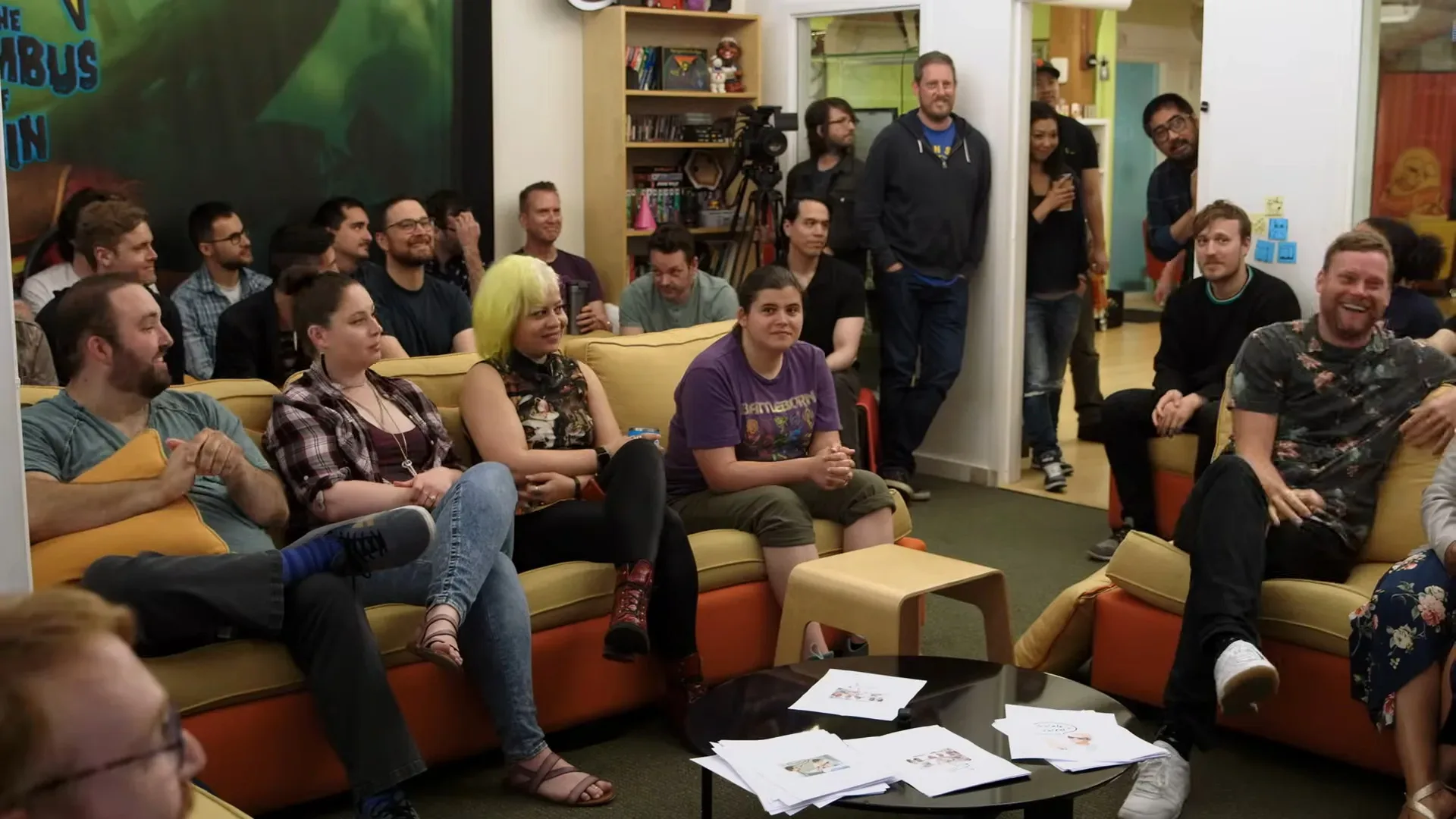
Founded by Schafer in 2000, Double Fine became particularly visible through documentaries covering the development of Broken Age and Psychonauts 2, as well as its 2019 acquisition by Microsoft. Its internal creative traditions, including Amnesia Fortnight—an event in which staff develop game ideas—helped establish the image of a comparatively humane, collaborative developer.
Many employees reportedly did describe the workplace in glowing terms. They credited colleagues with supporting one another through financial uncertainty and praised the studio’s creativity. That is important context. The union effort was not simply a revolt by people who believed the studio was uniformly dysfunctional. Some participants saw organizing as a way to preserve the things they liked: a mechanism for securing a voice over working conditions, layoffs, remote-work changes and the effects of corporate ownership.
Others pointed to concerns at Double Fine itself. Employees connected the organizing impulse to an uncomfortable 2019 meeting about potential crunch during Psychonauts 2 development. Crunch is industry shorthand for periods of sustained overtime, often near a game’s deadline. A former senior producer had said the game was made with no crunch, but multiple people said that experience was not shared across the whole studio.
Workers also raised claims involving bullying, harassment and alcohol-related workplace issues that they believed had not been addressed quickly enough. Schafer said he responded immediately to reported concerns. The available accounts do not resolve every claim, but they do illustrate a central labor-organizing principle: a union campaign often emerges not from one universally shared grievance, but from a collection of risks that affect people differently.
That distinction matters. A worker can value a studio’s creative culture and still want an enforceable process for conflict, discipline, severance or scheduling. A union is not a vote on whether every colleague is good or bad. It is an attempt to change who gets formal bargaining power when consequential workplace decisions are made.
Related coverage includes Double Fine Union Drive Collapsed Weeks Before Xbox Spin-Off and Layoffs.
The eligibility problem became the campaign’s fault line
The sharpest disagreement was over who could be in the proposed bargaining unit. A bargaining unit is the group of employees eligible to be represented by a union and covered by a future collective-bargaining agreement. U.S. labor rules generally exclude supervisors with authority over other workers, as well as contractors; workers outside the United States faced separate legal obstacles.
That framework can be hard to apply to modern game development. Roles shift project to project. Someone might lead a team, oversee a short-term initiative, have limited decision-making authority, or manage a single colleague while still doing hands-on development. At Double Fine, some experienced employees had moved abroad during the pandemic and were legally classed as contractors even where their work had otherwise remained similar. Other staff had managerial status at one point but not necessarily throughout their careers.
Organizers said the uncertainty was a wider games-industry problem, not a deliberate attempt to push out colleagues. Yet many people who were ineligible, or who feared they might be, experienced the campaign as exclusion from a community they had helped build. Their concern was not merely procedural. They worried that a union/non-union divide could change the studio’s open-discussion culture and prevent senior staff from participating in decisions that affected everyone.
That emotional reaction became politically decisive. Organizers were trying to build a union among eligible workers, not an all-staff club. But in a small studio where identity and belonging were closely tied to the group as a whole, the boundary drawn by labor law felt personal. Employees who supported unions in general could still recoil at being legally outside this particular one.
There is a practical lesson here for game workers considering an organizing drive: explain eligibility early, repeatedly and as plainly as possible. It will not eliminate disappointment, especially where job titles and authority are fuzzy, but silence can allow confusion to fill the gap. At the same time, organizers cannot always offer final answers before the formal process begins. Determining a unit’s exact composition is frequently contested or negotiated after a campaign becomes public.
Why “neutrality” did not make the process feel neutral
Microsoft had previously entered a labor-neutrality agreement with the Communications Workers of America, initially tied to the Activision Blizzard acquisition and later including ZeniMax staff. Labor neutrality generally means an employer agrees not to campaign for or against a union and may provide a more direct route to recognition when workers show majority support.
By the time Double Fine organizers prepared to go public, that agreement had expired and had not been renewed. Organizers were told that an effort to secure temporary neutrality for Double Fine could alert Microsoft’s legal team that a campaign was coming. They therefore believed they needed to move faster, filing in May before some questions—and relationships—had been fully settled.
Following the internal announcement, workers debated the campaign intensely in Slack and in person. Supporters said they encountered misinformation, social pressure and colleagues who treated them coldly. Some said managers became excessively cautious, acting as though neutrality meant they could barely speak to staff about ordinary work. Others described the discussions as impassioned but respectful and felt that organizers had not adequately answered direct questions about eligibility and the future structure of the union.
Both experiences can coexist in a workplace dispute. A conversation may be seen as a fair request for details by one participant and as an intimidating demand for public justification by another. The medium matters too. Organizers were advised to use private, one-on-one conversations rather than turn a company-run Slack space into an extended campaign debate. Critics interpreted that choice as evasive, especially because Double Fine had a history of tackling disputes in group settings.
There was no easy communication strategy left once the campaign went public. A large public meeting could have offered visibility but also exposed organizers to hostile exchanges; private discussions reduced that risk but could look secretive. The result was a trust vacuum. Workers who were already uneasy about the process interpreted caution as proof that something was being withheld. Supporters saw the demand for endless public answers as a way of exhausting or isolating the organizing committee.
A majority is not always enough
Union campaigns often aim for a supermajority before going public, rather than merely the smallest possible majority. The reason is straightforward: support can weaken once a campaign is visible, especially if employees feel anxious, receive conflicting information or worry about relationships with friends and managers. Organizers at Double Fine reportedly had about 75% backing among the people they believed were eligible—strong, but below the roughly 80% level often recommended to withstand a turbulent public phase.
In the second week, some signers began retracting their authorization cards. Some said they had not appreciated how many colleagues would be ineligible; organizers said they had not intentionally misled anyone but acknowledged that the overall picture could have been communicated more clearly. The committee concluded that proceeding with diminished backing would create a weak union and withdrew the petition.
It is tempting to frame that outcome as proof that Double Fine workers did not want a union. The evidence supports a narrower reading. A majority of the employees organizers considered eligible had initially supported a petition, but that support did not hold amid uncertainty and social conflict. That is not the same as a formal election result, and it does not settle how workers might respond under different conditions in the future.
It also demonstrates how powerful informal influence can be. Organizers believed Schafer’s view mattered enormously because he was not simply the formal studio head; he was a longtime colleague and central cultural figure. Schafer has said he is generally pro-union and understands why workers seek protection in an industry affected by crunch, burnout and layoffs. Yet legal neutrality limits what management can say during a campaign, and employees still interpreted his emotional response at an all-hands meeting in their own ways.
For a small studio, “we are like a family” can be a sincere description of mutual care. It can also make disagreement feel like betrayal rather than workplace politics. That dynamic is not unique to Double Fine, but it is particularly relevant to beloved independent developers whose public identity rests on closeness and shared creative purpose.
The layoffs changed the stakes
Weeks after the petition withdrawal, Xbox began a major reorganization. Double Fine was spun off from Microsoft and, on July 28, cut 23 jobs. The studio now faces a limited financial runway. Its crowdfunded Amnesia Fortnight campaign surpassed a $400,000 goal, raising $678,942 to greenlight the winning project, Plot Armor. Schafer said a successful release could help buy time while larger projects are developed, but described the post-Xbox runway as a matter of months.
That context turns a workplace dispute into a question of survival. Collective bargaining cannot guarantee that a studio will have funding or prevent every layoff. It can, however, create a formal avenue to negotiate over severance, layoffs and working conditions rather than relying exclusively on management discretion. Some laid-off workers reportedly felt the severance package was generous and credited Schafer’s work in negotiating it; others noted that an established union could have bargained collectively in a similar crisis.
The broader Xbox ecosystem remains full of active releases and platform commitments—see, for example, this recent Xbox Series X|S and PC launch—but a platform’s busy release calendar does not automatically translate to certainty for every individual studio. Double Fine’s experience is a reminder that corporate ownership can change quickly, and that independence brings both creative control and immediate financial exposure.
What the failed campaign leaves behind
Double Fine’s union effort is stalled, not neatly resolved. Some employees reportedly still feel alienated because they supported it; others remain convinced that the campaign threatened a culture they valued. The organizers’ removal in the subsequent layoffs makes a near-term revival less likely, regardless of whether anyone believes those layoffs were retaliatory. Schafer has firmly denied retaliation.
The useful takeaway is not that any one side had a monopoly on care for the studio. Many participants appear to have cared intensely about Double Fine and reached radically different conclusions about how to protect it. The breakdown came from legal complexity, timing, unclear expectations, sharply different perceptions of communication and a workplace culture where personal bonds carried enormous weight.
For the games industry, where job security can evaporate amid restructuring, those are not minor details. They are the terrain on which organizing succeeds or fails.