Diablo 5 is currently planned for spring 2029, an unusually early public release target for a game so far from launch. The declaration naturally invites skepticism: years of game development can absorb technical trouble, shifting priorities and events outside a studio’s control. But the Diablo team’s explanation is less about predicting an untouched road to release than it is about the state of the project today: it says the game is in full production, it has a defined creative direction, and much of its staff and technology foundation carry over from Diablo 4.
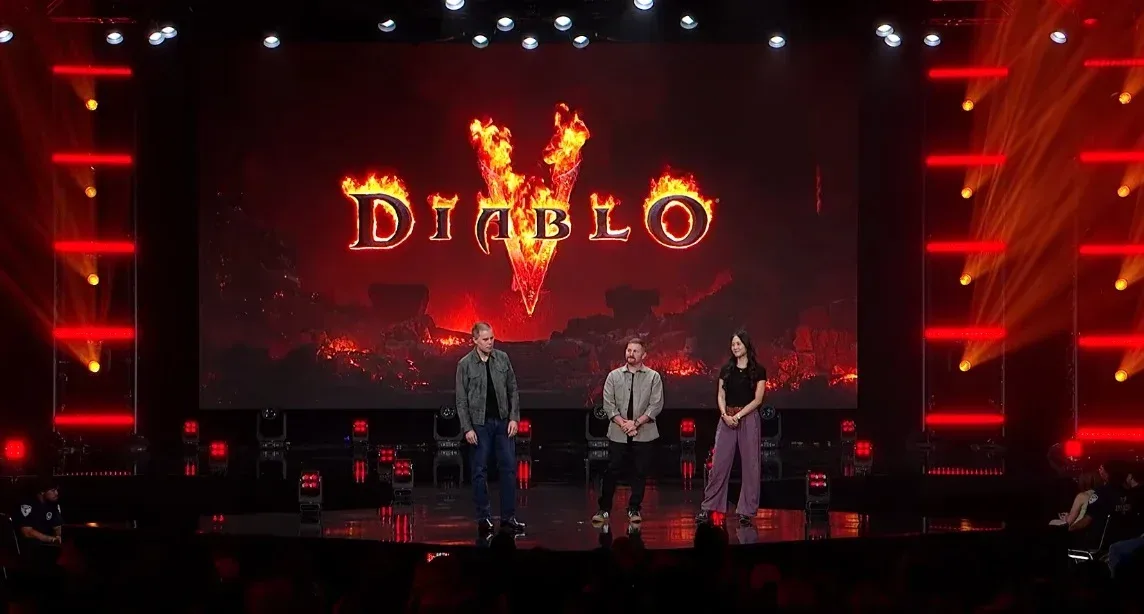
Senior production director Tiffany Watt and senior art director John Mueller have framed the unusually early reveal as a deliberate part of the game’s development method. In their account, Diablo 5 is not being announced simply to plant a flag on a calendar. The team wants to begin a sustained conversation with players early enough that feedback can still affect the work.
That distinction matters. A spring 2029 window is still a plan rather than a finished product, and the team’s confidence is not evidence that a delay is impossible. It does, however, give players a clearer sense of the studio’s intended timetable and of the production systems developers believe are already in place.
Why reveal Diablo 5 this far ahead?
Watt said the decision to tell players about Diablo 5 had broad agreement within the team. The developers believe they know what they are building, are confident in the planned feature set, and have a clear vision under game director Joe Shely and the project’s other leads. That, the team argues, made this an appropriate moment to open the game up to public discussion.
The stated goal is community involvement. Shely identified involving the community as early as possible as a core principle at the beginning of development, Mueller said. For an action role-playing game—or ARPG, a genre built around character progression, combat, loot and repeatable activities—that is a meaningful production choice. Player feedback can reach beyond a reaction to a trailer. It can test whether the systems intended to keep players experimenting and returning are actually compelling.
Mueller described Diablo’s players as particularly passionate and said early discussions with players have already been valuable. The team believes it had a positive experience communicating with the Diablo 4 community, while also seeing room to bring people into the conversation sooner next time.
There is a practical reason for that timing. Feedback received close to release can be useful, but it is harder to act on. Mueller noted that suggestions from earlier playthroughs with core players competed with other priorities and could take time to implement. When a team gets feedback too late, an idea may be deferred to a patch, routed into a list for later consideration, or simply lose out to more urgent work.
Early engagement does not mean every popular request becomes a feature. Development still requires prioritization, technical limits and a coherent design. But it can give developers more time to identify where their assumptions and players’ expectations diverge. In that sense, the long runway to 2029 is being presented as development time the team hopes to use, rather than merely waiting time for its audience.
Related coverage includes Diablo 5 Team Explains Why It Announced a Spring 2029 Release Window So Early.
What “full production” means in this context
“Full production” is a development term, not a promise that a game is content-complete. Broadly, it refers to the phase where a project has moved beyond establishing its initial concept and is actively scaling up the work needed to build it: environments, systems, art, tools and other deliverables. Watt’s point is that reaching this stage requires confidence in the team’s capabilities, internal processes and production pipelines.
A production pipeline is the sequence of people, tools and handoffs that turns a design goal into working material in the game. It can cover everything from building art assets to integrating them, testing the result and revising it. An effective pipeline does not eliminate problems, but it makes the work more predictable. A poor one can create bottlenecks where assets, features or fixes cannot get where they need to go on time.
Watt’s central argument is that Diablo 5 has an advantage in this area because the majority of its developers have worked on Diablo for a long time, with many coming directly from Diablo 4. Rather than beginning with an unfamiliar engine and an entirely new team dynamic, Diablo 5 is using an evolution of Diablo 4’s engine and technology stack.
A technology stack, in this usage, means the underlying collection of systems, tools and technical components developers use to make the game. Building on an existing stack can allow a team to reuse knowledge and refine established workflows. It is not the same as saying the new game will be identical to the old one. The stated plan is evolution: existing foundations are being carried forward while the team develops technology and content for Diablo 5 specifically.
Watt also emphasized that the project’s vision was set clearly early in development and that the team was able to scale production as it grew. Familiarity among developers can speed iteration—the cycle of making something, reviewing it, revising it and repeating—because people already understand the tools, the collaboration patterns and the types of trade-offs required.
For players, these details are not a feature list. They are a rationale for the date. The team is effectively saying it has reduced some of the risks that arise when a studio must learn new tools, establish working relationships and determine what its game is at the same time.
The procedural dungeon claim, explained
Mueller pointed to Diablo 5’s procedural dungeon work as a concrete example of the project’s technical continuity. He described the system as the third version of the technology and said the team is advancing it for Diablo 5, including procedural exterior environments.
Procedural generation is a technique where rules and systems assemble parts of an environment rather than artists building every possible layout one by one. It is often associated with dungeons because it can create variation across repeat visits. The aim is not necessarily randomness for its own sake; the challenge is to generate spaces that still look intentional, readable and appropriate to the game’s combat and atmosphere.
Mueller’s claim is that the current procedural exterior work looks as good as, or better than, the environment work delivered with Lord of Hatred, which he described as some of the strongest worldbuilding made with that technology stack. That is an assessment from the project’s art leadership, not an independent benchmark, and players will have to wait for material that can be evaluated directly. Still, it provides a useful clue to where developers believe their gains are being made: not only in dungeon variation, but in the visual quality of larger generated spaces.
There is a production benefit as well. Mature procedural tools can let artists and designers focus more time on the rules, set pieces and visual pieces that give areas character, while the system helps produce the permutations around them. Yet such systems are demanding to build and tune. The studio’s emphasis on a third iteration signals that it sees accumulated experience with the technology as a key safeguard against the kinds of tooling or pipeline surprises that can slow production.
Confidence is not immunity from change
The case for a 2029 target rests on coherent reasoning: a largely experienced Diablo team, familiar technical foundations, established pipelines, a declared full-production status and a desire to gather feedback earlier. Those are all relevant factors when a studio estimates a schedule.
They are also not a binding shield against disruption. The broader games business has faced instability, constrained funding, layoffs, hardware-cost pressure and unpredictable operational problems. Projects can change even when a team has a strong plan, and game development frequently involves unanticipated technical or production challenges. A public release window this early therefore creates an accountability point as much as a marketing moment.
That is why the announcement is noteworthy. The team is asking players to take its planning confidence seriously while giving itself years of public conversation in which the details can evolve. It has chosen visibility over the old model of keeping a project hidden until a late-stage grand reveal.
That approach has a trade-off. Players get a clearer timeline and a chance to make their priorities known earlier. In return, they should treat the spring 2029 timing and any pre-release plans as targets under active development, not as immutable facts. The useful question is not whether the date makes Diablo 5 invulnerable to delay; no long-range target can do that. It is whether the team can translate its claimed production maturity and community dialogue into a game that stays on course.
The Diablo team believes it can. Its leaders say the tools are working, the leads and staff are in place, and the project has been separated from the Diablo 4 work for more than a year to pursue the game it specifically wants to make. Over the coming years, the more revealing signs will be how clearly the studio explains Diablo 5’s systems, how it gathers and weighs community feedback, and whether its public milestones continue to support the confidence behind that spring 2029 window.
For a broader look at how studios turn enduring player frustrations into major development priorities, see this examination of the design thinking behind The Taken King.