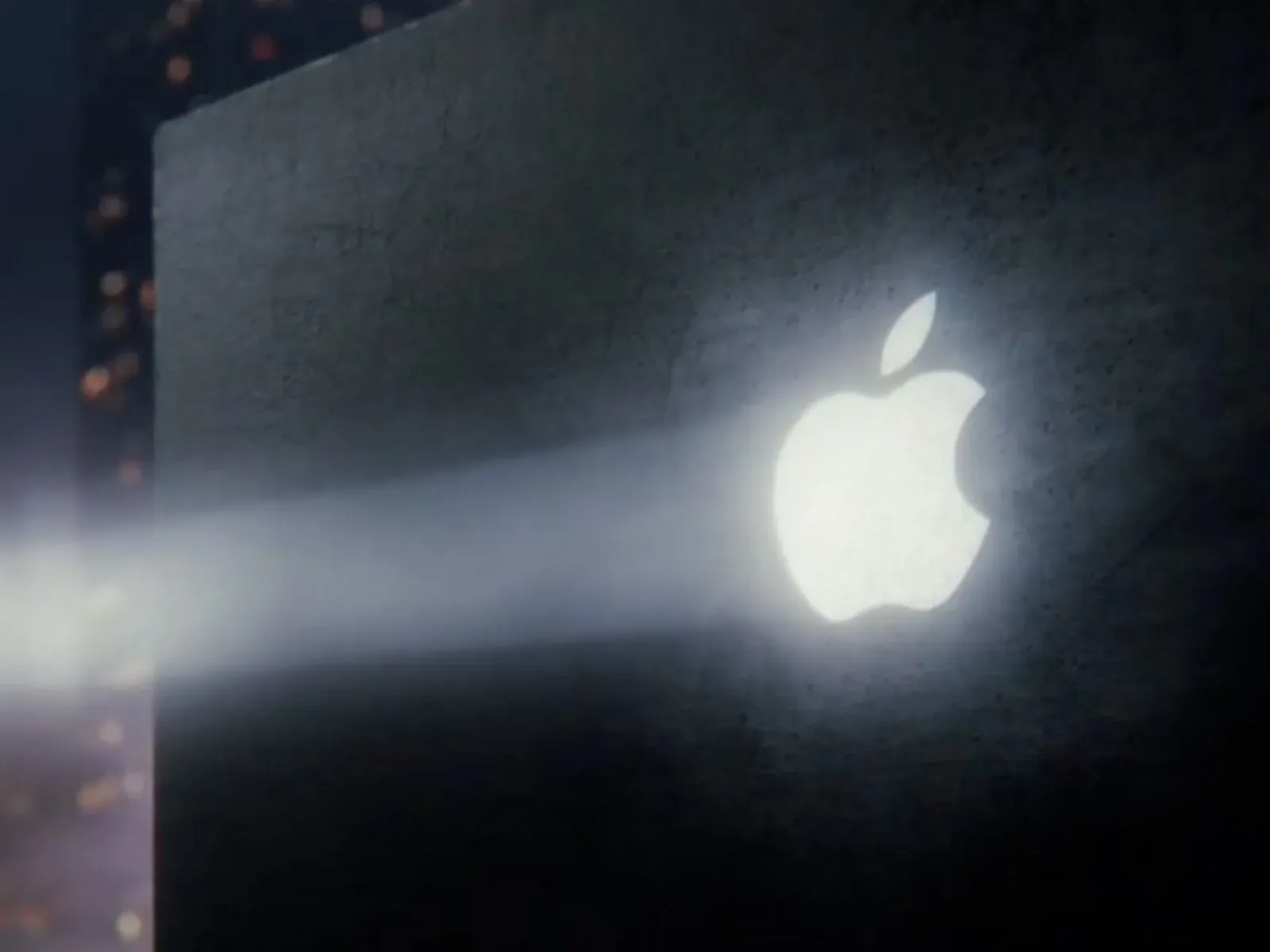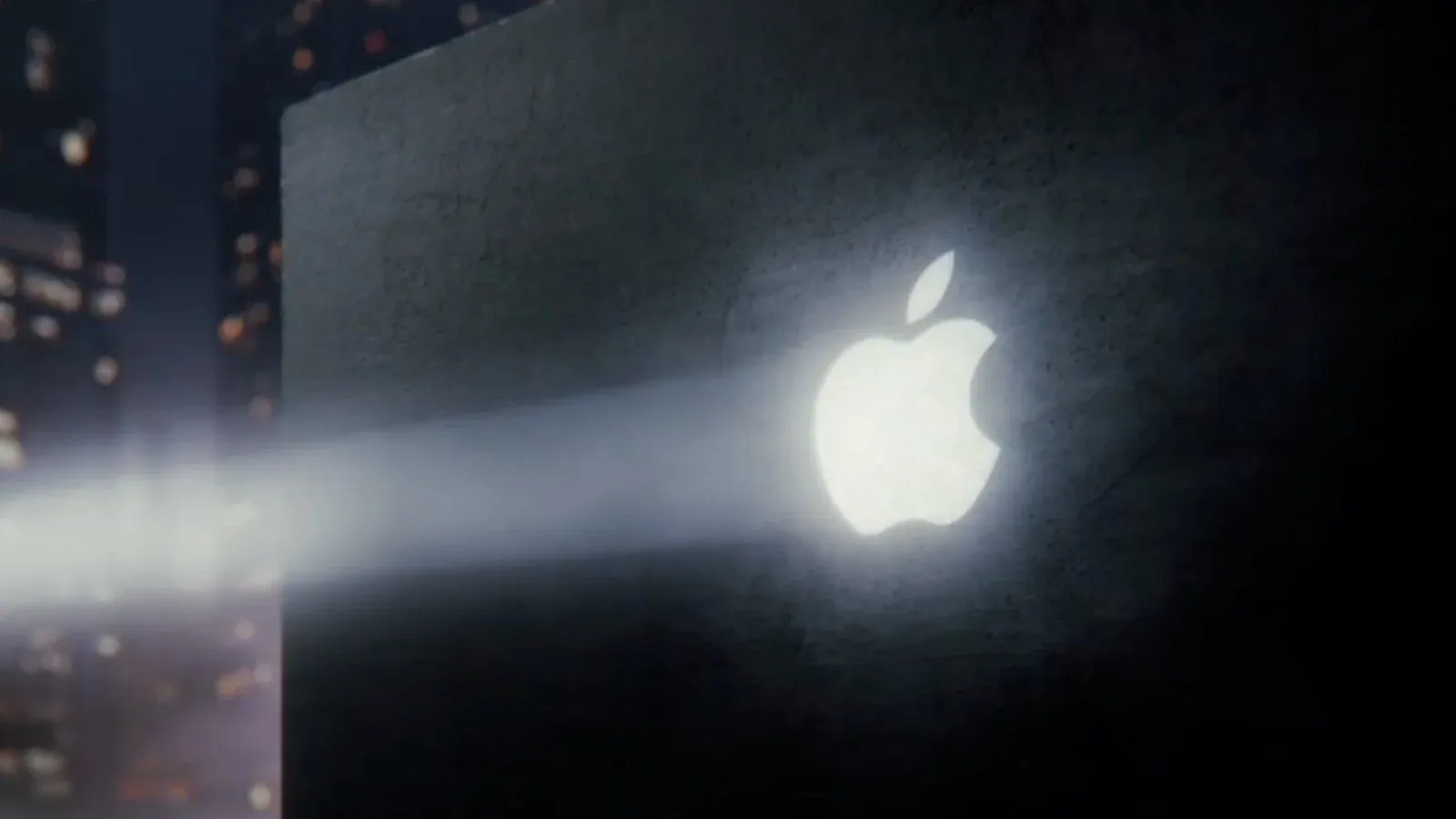
Apple has posted a teaser that is inviting a very particular kind of pre-announcement detective work: pausing on a projected Apple logo, looking past a city skyline, and asking whether the wall in the clip is meant to evoke a movie studio.
The resulting theory is that rumored MacBook models with touch-enabled OLED displays may be introduced under a new name: MacBook Studio. It is an appealing possibility because Apple already sells the Mac Studio desktop and Studio Display, and “Studio” would provide a clean umbrella for a portable computer pitched at creative work.
Still, the critical word here is possibility. The teaser does not state the product name, confirm the rumored display technology, list specifications, or establish that a glowing Apple logo is returning to a laptop lid. It is a short piece of marketing designed to create anticipation, and interpreting its visual language as a naming clue remains speculation.
What the teaser actually establishes
The clip shows an Apple logo projected onto a wall against a city skyline. Apple is also expected to present new MacBooks to selected technology reporters and content creators at an experience in Los Angeles at 10 a.m. Pacific Time.
That setting supplies the connective tissue for the “Studio” reading. Los Angeles is closely associated with Hollywood and film studios, while a projected logo on a wall can be read as a studio-like image rather than a generic cityscape. It is a coherent interpretation, but it is not the same thing as a product label appearing in the video.
Apple executive John Ternus shared the teaser, which naturally gives the post more attention than an ordinary cryptic social-media message. Even so, the strongest source-backed conclusion is modest: Apple is drawing attention to something connected to MacBooks, and its imagery has made “Studio” a plausible fan theory.
The image can support a theory, but it cannot settle one. Until Apple attaches a name to a product, MacBook Studio is only one candidate.
Why “MacBook Studio” would make sense as a product-family name
Names matter because they indicate who a product is for before a single technical specification is read. If Apple uses MacBook Studio, the most obvious reading would be a laptop positioned for creators: people working with video, music, visual art, photography, design, or other media-heavy projects.
That hypothetical positioning would sit neatly alongside Apple’s existing Studio branding:
- Mac Studio is a desktop computer.
- Studio Display is a display.
- MacBook Studio, if it exists, would extend the label to a portable Mac.
The broader branding advantage is clarity. “Studio” implies an ecosystem of tools for creative production without requiring the buyer to infer that purpose from a string of processor, display, or memory details. Apple could also promote its recently updated Apple Creator Studio suite of apps alongside such hardware, tying the computer’s name to software intended for creative tasks.
That does not mean a Studio label would automatically describe every aspect of the machine. A name is market positioning, not a technical specification. It would not by itself reveal its processor, ports, battery life, display size, price, chassis, or how touch interaction would work in macOS.
The OLED and touch claims need separate caution
The rumored machines are described as having touch-enabled OLED displays. Those are two distinct ideas that can easily blur together in teaser discussion.
OLED, short for organic light-emitting diode, refers to a display technology in which individual pixels generate their own light. In broad terms, that can enable very deep blacks because pixels can switch off rather than relying on a conventional full-screen backlight. But the presence of an OLED panel would not answer every screen-quality question. Brightness behavior, color handling, refresh characteristics, durability, and software tuning all matter, and none of those details are established by the teaser.
Touch-enabled means the screen is designed to recognize direct input from a finger or another supported method. That is potentially a major interface decision for the MacBook line, because it would change how people can interact with apps and on-screen controls. Yet it is important not to jump from “touch-enabled” to assumptions about the complete experience. The supplied information does not confirm gestures, app changes, accessories, hinge design, whether touch would be available across all models, or how Apple would frame the feature.
In other words, an OLED touch screen is a rumored foundation for the product story, while MacBook Studio is a separate branding theory. Both could ultimately prove accurate; either could also change before Apple speaks on the record.
MacBook Pro remains a live possibility
The most straightforward alternative is that Apple retains MacBook Pro branding. That outcome would not make the teaser meaningless; marketing clips often set a mood or signal an audience rather than spelling out a name. A studio-inspired setting could point to creative workflows while the devices remain MacBook Pro models.
Keeping the established name would carry obvious benefits. MacBook Pro already communicates a professional orientation and is an instantly recognizable part of Apple’s lineup. A new display or input method does not necessarily require a new family name. It could instead become the defining feature of a refreshed MacBook Pro range.
There is also a long-rumored MacBook Ultra possibility. “Ultra” would suggest a different kind of separation: not merely a creator-oriented device, but potentially an especially high-end tier. The teaser provides no firm way to choose between MacBook Studio, MacBook Pro, and MacBook Ultra. Treating any one of them as decided would be reading far beyond the available evidence.
Could the old glowing Apple logo be coming back?
The teaser has also inspired a secondary theory: that a glowing Apple logo might return to the outside lid of a MacBook. It is an understandable association when the central image is a shining Apple logo projected onto a dark surface.
But this interpretation is even more speculative than the naming discussion. The clip establishes that Apple chose a luminous logo as an image. It does not show a laptop lid, identify a physical design detail, or promise that the projection represents hardware behavior. Visual motifs in teasers can be literal hints, atmosphere, or simply recognizable brand imagery.
For readers deciding whether to wait on a purchase, this is the practical distinction to keep in mind: a teaser is not a product page. It is not a reliable basis for assuming any particular chassis treatment, display feature, or name. A cautious approach is especially useful when an event appears imminent, since verified product details may arrive quickly and make guesswork unnecessary.
What to watch for once Apple provides details
If a MacBook announcement follows, the useful questions go beyond whether “Studio” appears in the title. The answers that would affect prospective buyers include:
- Which models receive the new display? A single premium product and a broad lineup update would have very different implications.
- What does touch add to macOS? Hardware capability matters most when the operating system and apps make clear, practical use of it.
- How does Apple define the intended audience? “Creator” can cover many workloads, so Apple’s software demonstrations and configuration options would be more informative than branding alone.
- How does the new machine relate to Mac Studio and Studio Display? Matching names could indicate a unified creative-product message, but it would not mean the products serve identical needs.
- What remains unchanged? New branding and a headline display feature can attract attention while familiar factors such as ports, storage choices, memory configurations, and portability continue to determine fit.
The present teaser is effective precisely because it leaves room for several readings. A MacBook Studio name would be a logical expansion of Apple’s Studio vocabulary, particularly if the company wants to emphasize creative software and display technology. But logic is not confirmation, and the competing MacBook Pro and MacBook Ultra possibilities have not been ruled out.
For now, the responsible shorthand is simple: Apple appears poised to discuss MacBooks, a studio-themed clue has put MacBook Studio into the conversation, and the actual name remains unconfirmed. Anyone preparing a mobile creative setup may also find this small desk-and-travel charging upgrade relevant, but it should not be mistaken for evidence about Apple’s pending hardware.