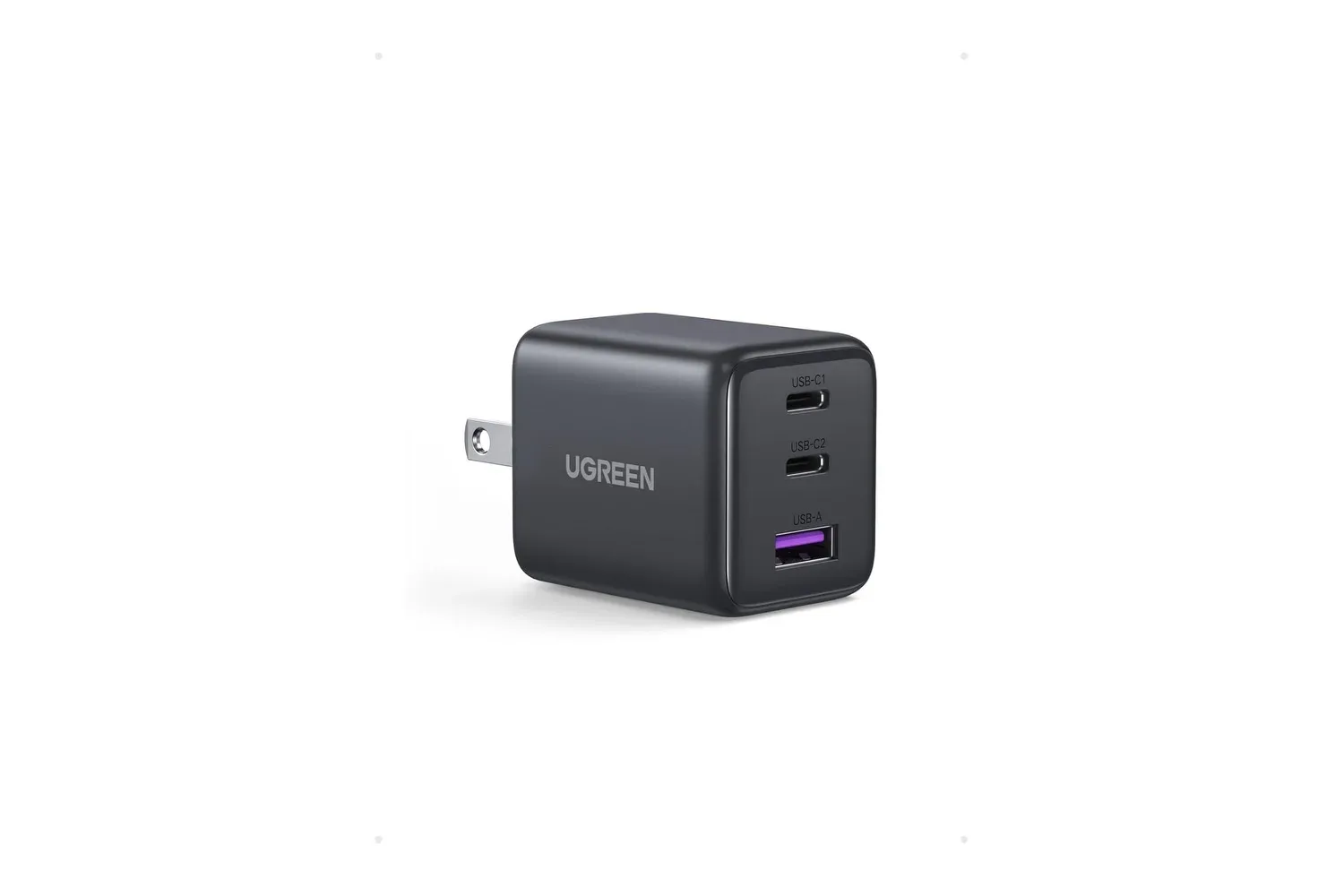
Charging gear is not glamorous until a phone, earbuds and smartwatch all reach low battery at once. UGREEN’s 3-Port 30W USB-C Charger Block is built for precisely that mundane-but-useful job: replacing several small wall adapters with one compact plug that has two USB-C connections and one USB-A connection.
The charger was listed at $10, reduced from $16, a $6 or 40% discount. At that price, its appeal is less about chasing the absolute fastest charging possible and more about consolidating the everyday devices that tend to occupy a bedside outlet, desk socket or travel-bag pocket. As with any retailer listing, pricing can change, so shoppers should verify the live price and product details before checking out.
Its core specification is straightforward. One USB-C port can supply up to 30 watts, while the USB-A port can supply up to 22.5W. The unit measures about 1.7 by 1.5 by 1.3 inches, and its power input is rated for 100 to 240 volts. That makes it a small, potentially versatile charger for phones, tablets and lower-power accessories, including on international trips when paired with the appropriate plug adapter.
What this charger is designed to replace
For many players, a portable setup is an ecosystem of modest power needs: a phone used for companion apps or authentication, a wireless-earbuds case, a smartwatch, perhaps an e-reader or tablet. Those devices do not always need their own full-size charger. The UGREEN model’s three ports make it possible to plug in a phone, earbud case and watch at the same time, rather than devoting multiple wall sockets to separate bricks.
That is the practical value of the design. It can simplify a nightstand, free room on a power strip, or reduce the number of adapters packed for a weekend away. The small dimensions also matter more than they initially sound: bulky adapters can interfere with neighboring outlets or crowd a densely packed travel pouch. A 1.7-inch-tall plug is easier to keep alongside cables and other essentials.
Its connection mix is also intentionally transitional. USB-C is increasingly the common cable connector for modern phones and tablets, but USB-A remains useful for older cables and accessories. Rather than requiring an immediate all-USB-C cable swap, this one charger keeps a USB-A port available while offering two USB-C ports for newer devices.
For readers comparing mobile-audio deals, the same general rule applies: the best charger is usually the one that fits the cables and devices already in use. That can be more meaningful than buying an adapter with a higher wattage figure that is unnecessary for a watch, earbuds or a secondary phone. Recent headphone and earbuds discounts are a timely reminder that a small USB-A port can still be useful in a mixed-device household.
Understanding the 30W claim
Wattage, expressed in watts (W), is a measure of power. In charging terms, a higher supported wattage can allow a compatible device to replenish its battery more quickly, but it does not guarantee that every device will receive that full amount. A phone, tablet, cable and charger negotiate what they can safely use.
UGREEN says the 30W USB-C port supports fast charging for iPhones, Galaxy phones, Pixel phones and iPads. It also claims an iPhone 17 or Galaxy S26 can reach roughly 60% charge in 30 minutes. That is a manufacturer claim, not a universal promise: results can vary with the device, its battery condition and charge level, the cable, ambient temperature, and whether the device is actively doing demanding work while connected.
The product supports several common fast-charging standards: PD, QC and PPS. PD stands for USB Power Delivery, a standard commonly associated with USB-C charging. QC refers to Quick Charge. PPS, or Programmable Power Supply, is a charging mode that can adjust voltage and current in smaller increments for compatible devices. In plain terms, compatibility with several standards gives the charger a better chance of negotiating an appropriate fast-charging rate with a wide variety of portable hardware.
The crucial phrase is “up to.” The 30W rating applies to the specified USB-C output rather than establishing that every port delivers 30W simultaneously. With multiple devices connected, available power has to be divided between them. UGREEN includes a user guide explaining the distribution across the ports, and that guide is worth consulting before treating this as a three-device fast-charging station.
What power sharing means in daily use
Power sharing is simply the charger allocating its finite output among connected gear. If one device is attached, it may receive a higher share than it would when two or three devices are connected. That does not make multiport charging ineffective; it means expectations should match the task.
- A good overnight scenario: a phone, earbud case and smartwatch can all be connected for a long, low-urgency charging window.
- A good daytime scenario: use the 30W USB-C port for a quick phone top-up, while the USB-A connection handles a smaller accessory.
- A scenario to verify first: charging several larger devices at once while expecting maximum speed from each. Check the supplied power-distribution chart before relying on that setup.
The USB-A port’s stated maximum of 22.5W is substantial for many accessories and can help preserve usefulness for existing cables. Still, users who want to prioritize the fastest compatible charging for a current phone should generally start with the 30W USB-C port and an appropriate USB-C cable.
Why GaN II matters to the size
UGREEN attributes the charger’s compact body to GaN II technology. GaN is short for gallium nitride, a material used in some power electronics to improve efficiency and help manufacturers build smaller chargers than traditional designs. “GaN II” is the product’s named implementation; the important practical point is that the company pairs it with heat-dissipation measures to fit multiport charging into a notably small wall adapter.
Compactness does not remove the need for ordinary charging care. Chargers can become warm during use, particularly when powering several devices or charging at higher rates. The provided information says this model includes overvoltage, overcurrent, overheating and short-circuit protections, plus a temperature sensor and flame-retardant housing. Those are meaningful safeguards, but they are not a reason to bury an active charger under bedding, obstruct it, or use damaged cables and adapters.
The stated 100–240V input range is particularly helpful for travel. It means the charger can accept electrical input used in different regions, but it does not change the shape of its plug. Travelers will still need a plug adapter suitable for the destination’s wall sockets. They should also confirm their own device and cable needs before leaving a larger adapter at home.
Who should consider it—and who should look closer
This UGREEN charger makes the most sense for someone whose routine revolves around a phone and small accessories. It has enough ports to reduce outlet clutter, retains USB-A support, and puts a 30W USB-C option in a body small enough for a backpack, purse or laptop bag. At the listed $10 sale price, it is an inexpensive way to add a spare charging point to a desk or carry-on kit.
It is also a sensible option for anyone who has accumulated several single-port adapters and wants fewer things plugged into the wall. A single charger cannot eliminate cables, of course, but it can eliminate some redundant blocks.
There are limits to recognize. The provided specifications frame this as a charger for mobile phones, tablets and portable accessories. Buyers should not assume that a 30W total output is the right fit for every larger or more power-hungry device, nor that each connected item will charge at its individual maximum rate. The model’s own power-sharing instructions should be the deciding reference when charging multiple items is the main reason to buy it.
For uncomplicated everyday charging, though, the pitch is clear: two USB-C ports, one USB-A port, a compact GaN-based design, and basic safety protections in one outlet-friendly package. The discounted listing makes that convenience unusually accessible, provided its port allocation suits the devices that will actually be connected.
Shop the products
Check current price, model and availability at the retailer.