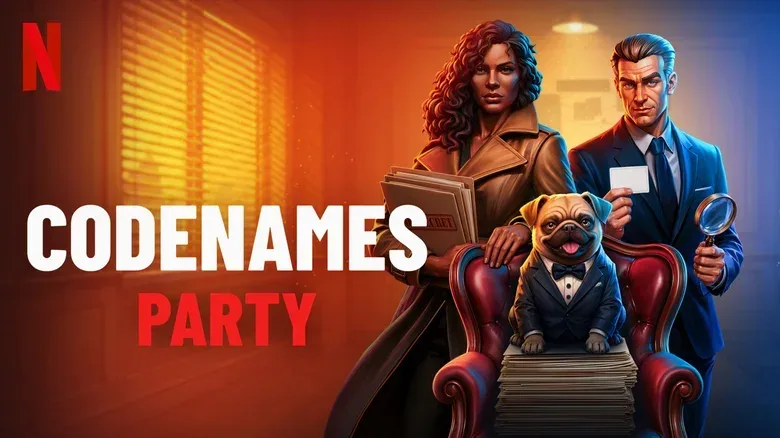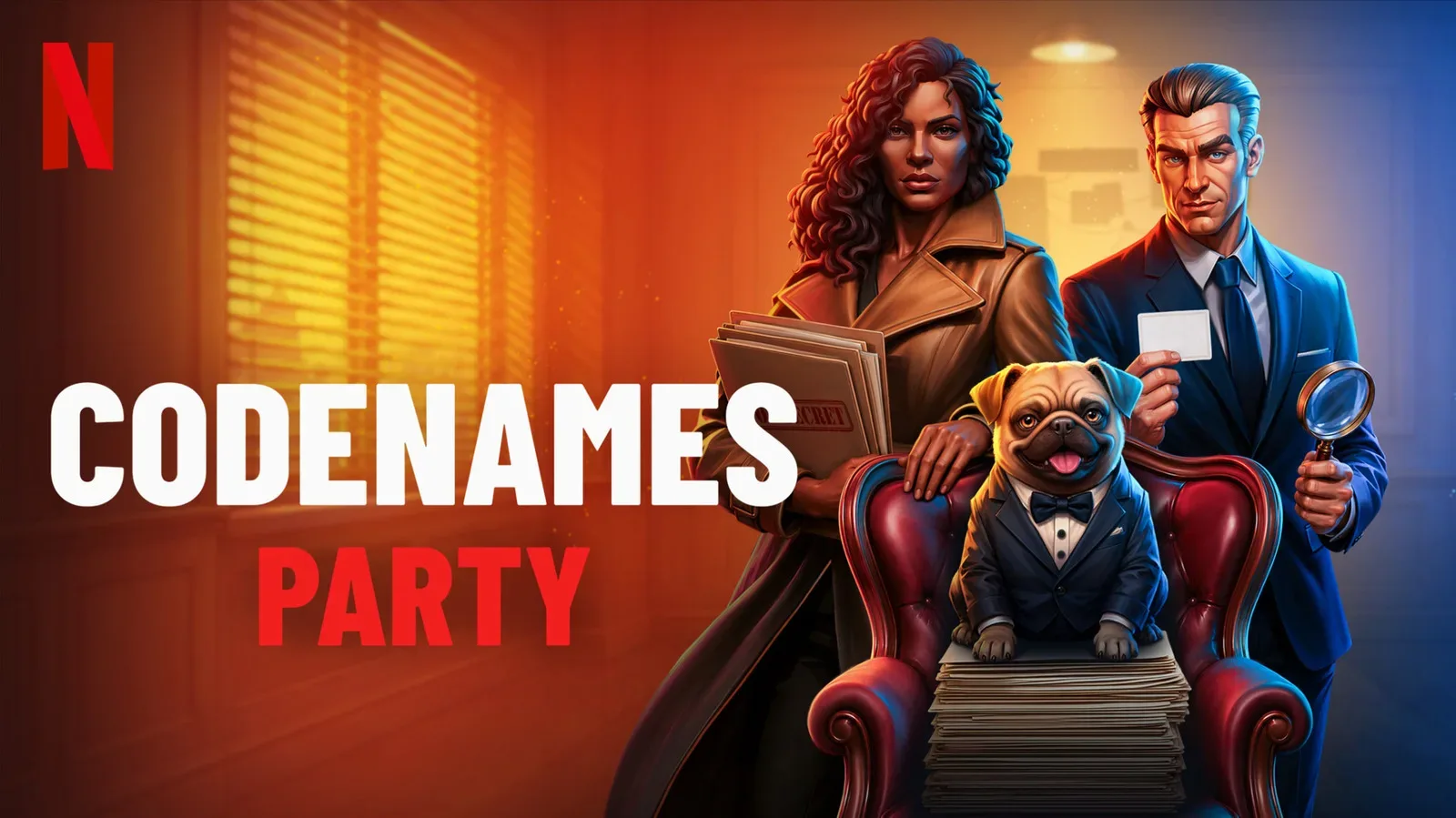
Codenames Party has joined Netflix Games, adapting the familiar word-association format for a shared-screen party setting where participants scan a QR code and play from their phones. The setup requires no separate game controllers, placing it alongside the service’s broader push into family-friendly and party-focused games.
The notable twist is a new Party Mode. Rather than putting players into competing teams with designated clue-givers, it makes every participant responsible for a personal set of words and a single clue intended to connect them. It is a format that changes the social math of Codenames: each player gets a moment in the spotlight, and points can come from both solving other players’ prompts and successfully guiding the room through one’s own.
How the classic Codenames format works
Codenames began as a tabletop social game and later received online versions for virtual co-op play. Its central mechanic is word association: players try to identify target words from a larger visible selection by interpreting a clue.
In the standard team-based structure included here, two teams play against one another. Each has a rotating Spymaster, the player who knows which words belong to their side and provides clues to steer teammates toward them. A useful clue must be broad enough to connect multiple intended words, but precise enough not to send the team toward the wrong choices. That tension is the whole deliciously dangerous sandwich.
The appeal is not simply having a large vocabulary. A successful round depends on understanding the mental shortcuts of the people at the table. One group may see an obvious connection between two words; another may find that same clue wildly misleading. The game therefore turns interpretation, confidence and occasional spectacular overthinking into the entertainment.
What Codenames Party adds
Netflix’s edition contains the classic team mode, but it also offers Case Studies. In that mode, players collectively guess answers from prepared sets of words and clues instead of assigning their own Spymasters. That distinction matters for a group that wants to start quickly or simply does not want the pressure of inventing a clue that must survive several different brains at once.
Party Mode is the entirely new option. The competitive teams are removed. Every player receives a unique batch of eight words, drawn from the same pool of 16 available words, and must create one clue to link their eight. When their turn comes around, the rest of the group attempts to identify that player’s code words.
Scoring works in two directions. Players earn points for correctly guessing words tied to other participants’ clues. They can also score when the group correctly identifies words from their own set. In practical terms, that gives everyone two connected jobs: interpret other clues well, then deliver a clue that gives their own selection a fighting chance.
Related coverage includes Codenames Party Joins Netflix Games With a New Solo-Scoring Mode.
Why individual scoring changes the table dynamic
Traditional Codenames asks a Spymaster to act as a navigator for a team. Party Mode instead distributes that responsibility across the full group. Every participant has a private puzzle to present, rather than waiting for a turn in a role that may otherwise rotate between rounds.
That could make the mode a better fit for a gathering where people want a more even share of the action. It also changes the nature of risk. In team play, a clue-giver is aiming to advance a collective board position. In Party Mode, a player’s clue must represent their own eight-word pattern while remaining readable to everyone else. The challenge is less about team coordination and more about persuading several people to follow the same associative path.
There is still plenty of room for the classic Codenames experience, though. The team mode preserves the familiar Spymaster role and its balancing act between ambition and ambiguity. Case Studies, meanwhile, supplies a more guided route into the basic idea. Together, the three options suggest a game designed to accommodate groups with different appetites for competition, clue-writing and chaos.
Phone-based joining lowers the setup burden
For the Netflix version, players join by scanning a QR code and use their mobile devices to take part. A QR code is a scannable square barcode that can direct a phone to the relevant game connection. The practical benefit is straightforward: a group does not need a stack of dedicated controllers before beginning a round.
That kind of entry point is particularly suited to a party game. The best social games usually lose momentum when the group must spend too long figuring out hardware, accounts or controller assignments. Here, the intended flow is to scan, join and start making slightly questionable intellectual leaps about which words belong together.
The mobile-device approach also leaves the shared game display free to function as the group’s common reference point, while each person can handle their own participation on a phone. Codenames is fundamentally about what the whole room can see and what each clue implies, so keeping that shared board at the center makes sense.
Who the modes appear to suit
- Classic team mode: For groups that want the familiar two-team contest and enjoy taking turns as the clue-giving Spymaster.
- Case Studies: For players who would rather solve pre-made clue-and-word arrangements than write their own clues.
- Party Mode: For groups looking for individual participation, with each player building a clue around a unique set of eight words.
The wider implication is that Codenames Party is not trying to replace one style of social word game with another. It packages several ways to approach the same core activity. Players who enjoy the tactical teamwork of classic Codenames can keep it, while newcomers or less competitive groups have a route with fewer responsibilities. Party Mode then provides the headline variation: a structure where every person gets their own mini-mastermind challenge.
It also arrives as Netflix continues to expand its party and family game selection. For households already thinking about how games fit alongside broader screen-use routines, our look at a family screen-time guide focused on conversation may offer useful adjacent context. Codenames Party itself is a social game first, however: its main proposition is getting people in the same room to debate whether a clue is clever, confusing or both at once.
That is why the new mode is more than a simple rules variant. It reassigns who gets to make the dangerous clue, who gets credit for reading the room correctly and who has to explain, after the fact, why “that totally made sense in my head.” For a game built on shared interpretation, that is a meaningful new party trick.