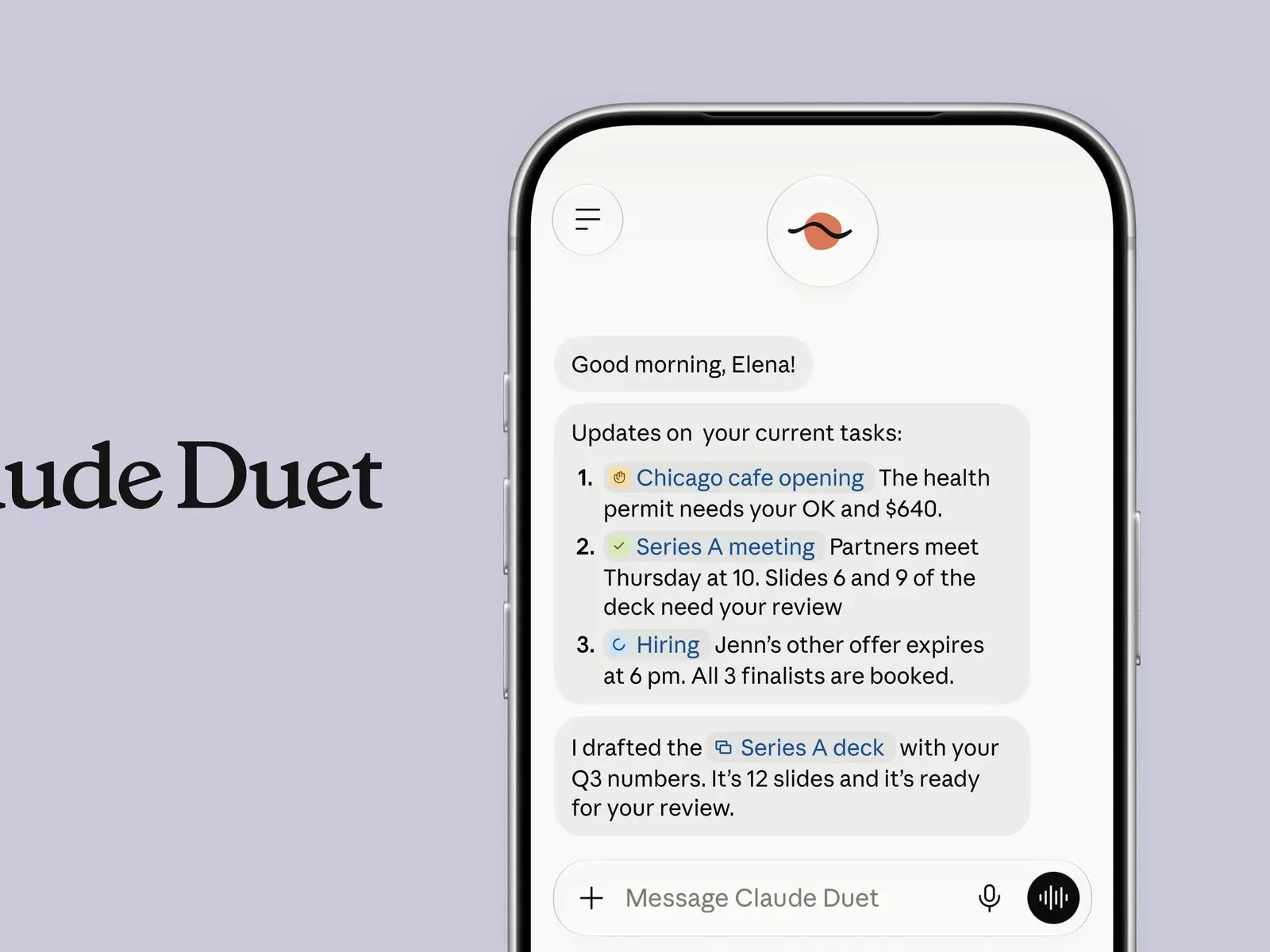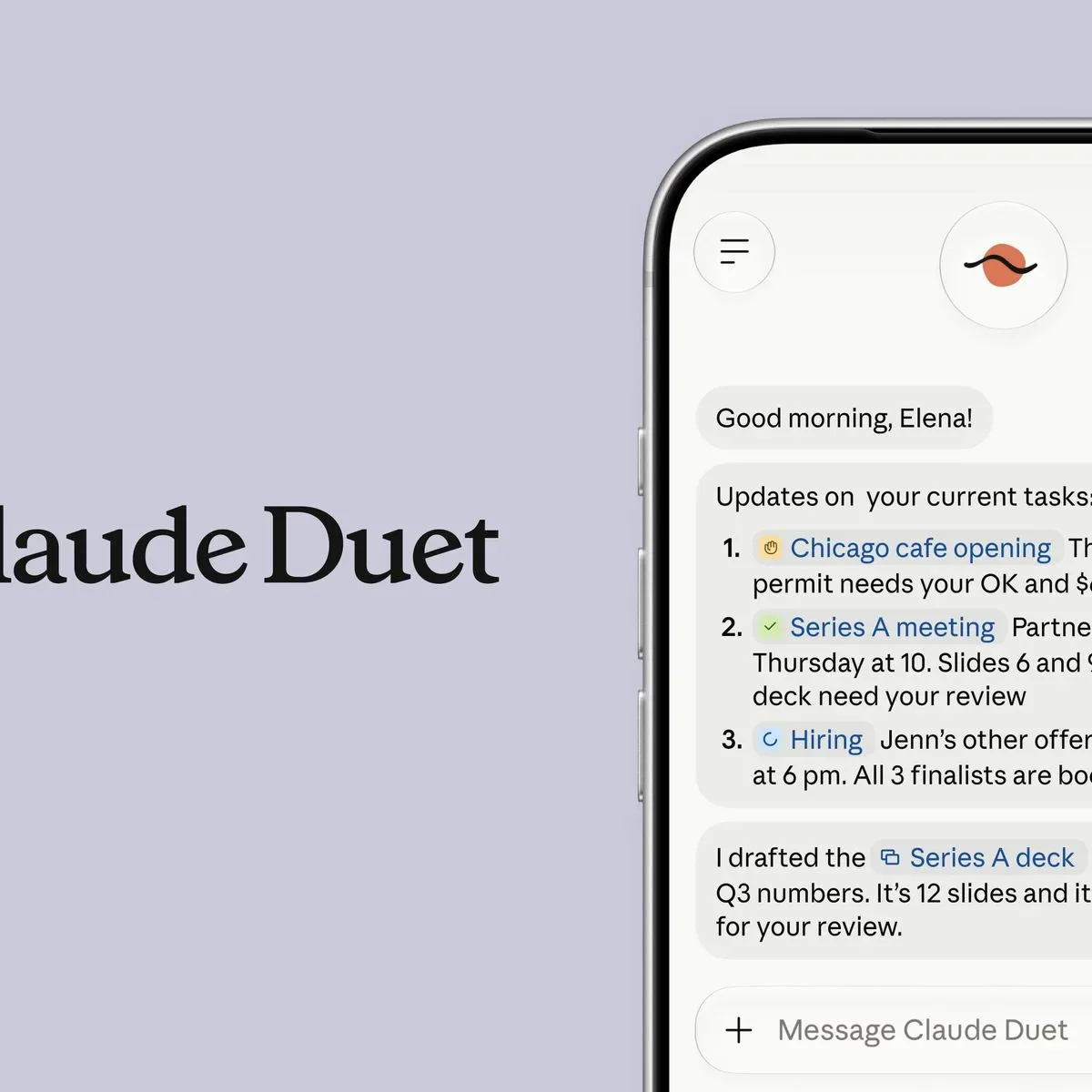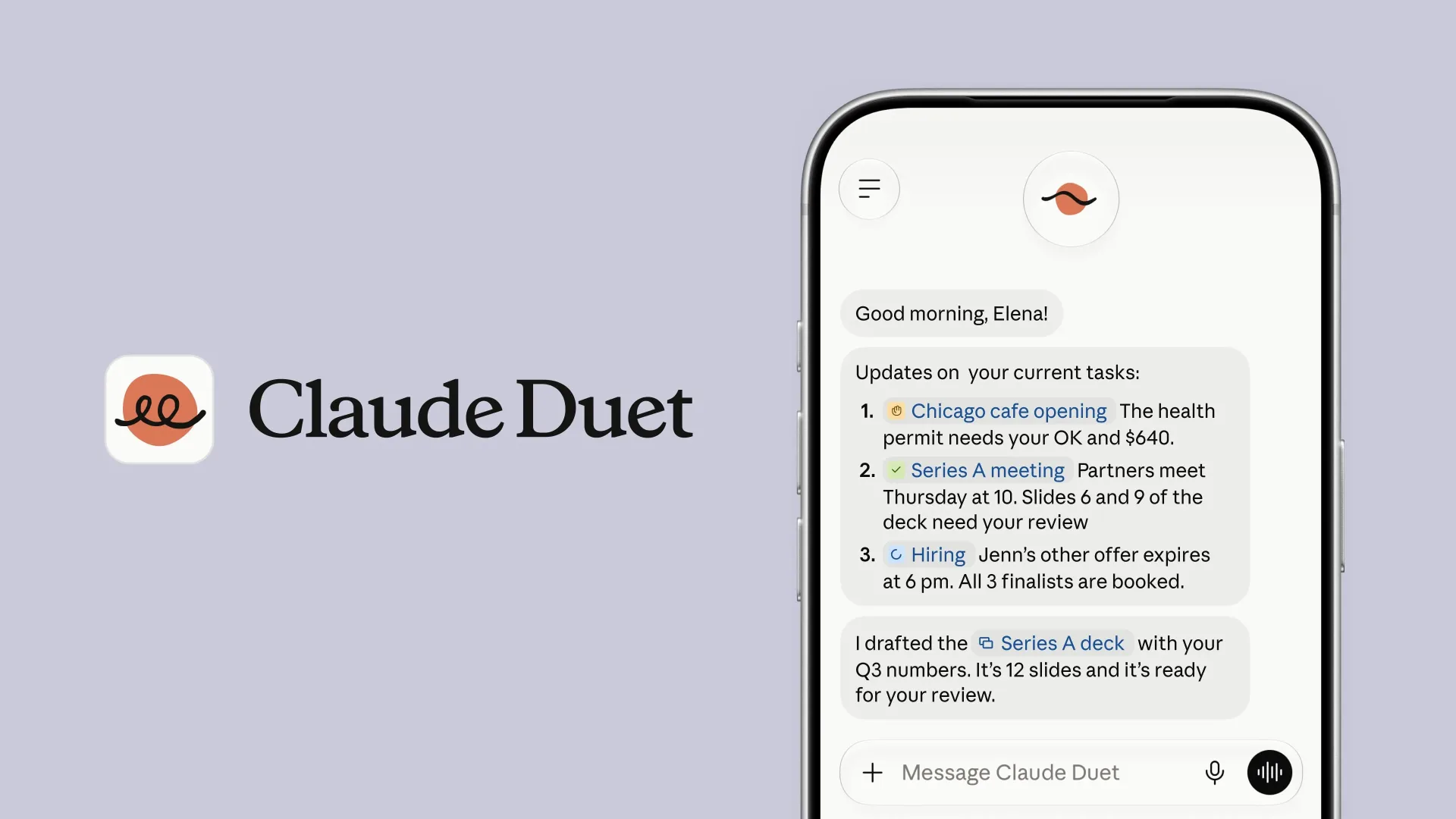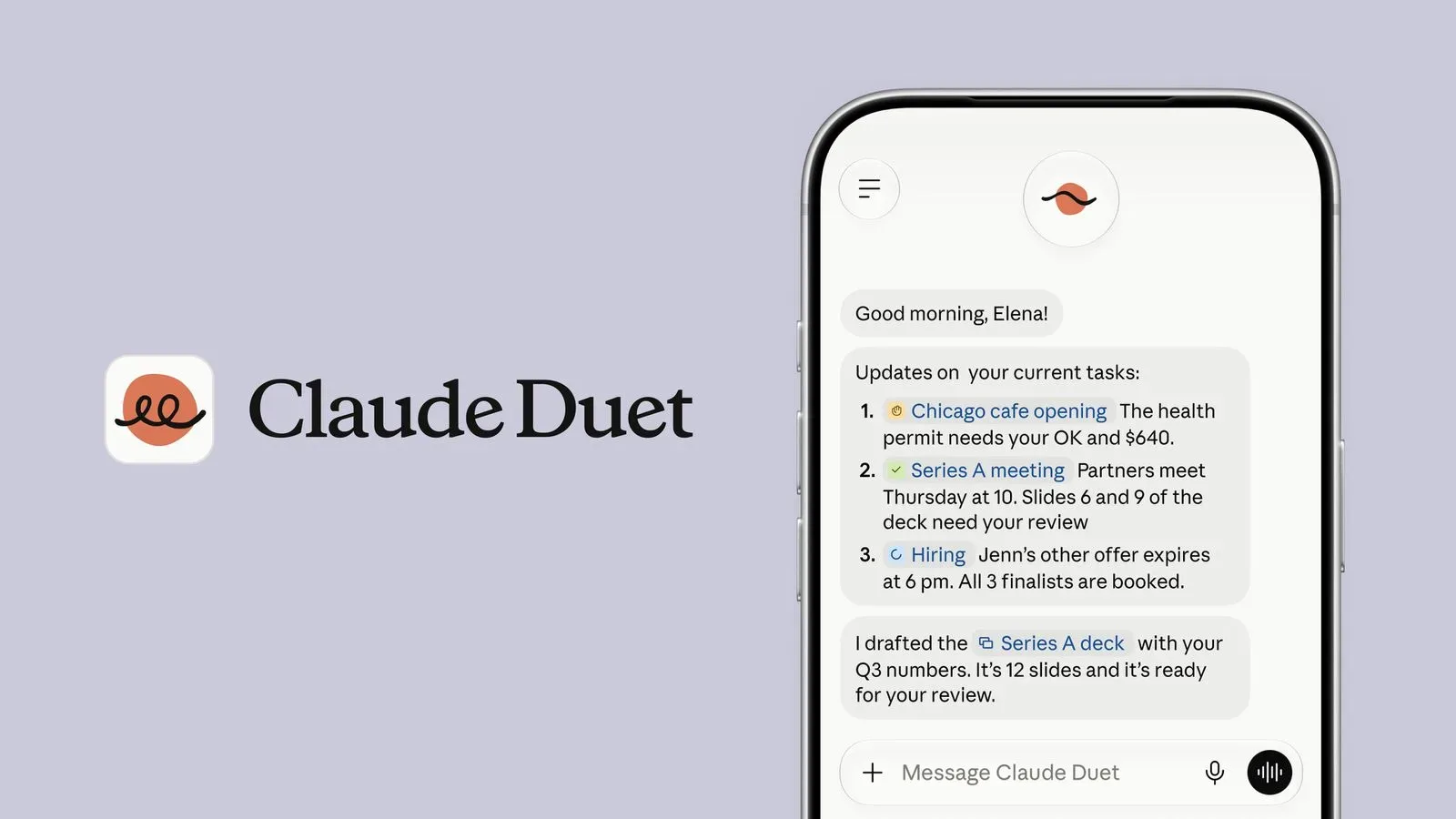
Anthropic has introduced Claude Duet, a standalone proactive AI agent designed to look for work that needs attention rather than waiting for a user to type a request. The product is entering research preview through a waitlist for Pro and Max subscribers in the United States, with access through the web and a dedicated iOS app.
Duet is aimed at professionals and small-business owners whose work is spread across too many apps, messages and administrative obligations. Its central promise is straightforward: connect relevant services, receive a concise morning brief of important items, then let the agent check those apps every few hours for developments that may merit attention.
That moves the product beyond the familiar chatbot model. A conventional assistant answers when prompted. A proactive agent is intended to observe a defined set of connected information sources over time, identify possible next steps and raise the issue without being asked first. It is a potentially useful distinction, but also one that makes the permission boundaries, notification quality and reliability of the system especially important.
What Claude Duet is meant to do
Duet is built around Opus 5.5 and can take on simple administrative work as well as more involved assignments, including building web apps. It operates in the cloud and does not require local access to the user’s computer. To perform tasks, it has a virtual machine with its own browser.
A virtual machine is an isolated computing environment that behaves like a separate computer. In this case, it gives the agent a place to use a browser while keeping that activity distinct from the user’s personal desktop. Cloud operation also means a task does not depend on the user leaving their own computer switched on and available.
The scheduled workflow described for Duet has two parts:
- A morning brief: a short daily summary drawing attention to important material in connected apps.
- Recurring checks: reviews every few hours, followed by an alert when Duet decides something needs attention.
The practical appeal is not just that an AI system can summarize information. It is that it may reduce the labor of repeatedly opening several services, sorting what changed and deciding whether anything is urgent. For a small-business owner or a professional managing many threads at once, that triage work can be a meaningful drain even when each individual task is minor.
Still, “needs attention” is a judgment, not a purely mechanical fact. The quality of Duet’s usefulness will depend on whether its briefs and alerts identify genuinely consequential items without constantly surfacing noise. An agent that overlooks a critical issue fails its core purpose; an agent that repeatedly interrupts over low-value changes creates a new inbox to manage. The research-preview label matters because those questions are likely to be central to real-world evaluation.
Autonomy comes with approval gates
Duet is designed to work independently, but certain actions require the user’s approval. Those include sending a message, making a payment, signing a document and deleting a file. This is a significant distinction between an agent that can prepare work and one that can unilaterally make an external commitment.
These actions have different consequences, but they share a common characteristic: they can be difficult or costly to undo. A message may make a promise or reveal information. A payment changes financial circumstances. A signed document may carry legal significance. A deleted file can remove material a user later needs. Requiring a confirmation step gives the person using the product a chance to inspect the action before it crosses that boundary.
In practice, the strongest use case may be a division of labor. Duet can gather context, organize a proposed response, prepare an administrative action or build a draft web app, while the person remains accountable for the decision that publishes, pays, signs or deletes. That approach does not eliminate risk, but it recognizes that automation is more valuable when it reduces routine effort without hiding consequential decisions.
Why approval is not the same as complete control
Approval checkpoints are a safeguard, not proof that every suggestion will be correct. A user still needs enough context to assess what the agent is proposing. A confirmation prompt is most useful when the action is clear, the relevant facts are visible and the user is not pressured into approving a long sequence of routine requests without review.
That is an important practical consideration for anyone considering proactive tools. The time saved by delegating background monitoring should not turn into a habit of blindly accepting actions. Users should treat an approval request as a decision point, particularly for communications, documents, payments and removal of data.
Account access and the security model described
Connecting an AI agent to apps naturally raises questions about credentials and sensitive information. Anthropic says Duet does not see passwords or login details when access is granted to accounts. It also says the product uses a dedicated classifier and a safety system prompt to evaluate messages and protect against leaks of sensitive information.
A classifier is a system that sorts or labels content based on defined patterns or categories. In a safety setting, it can help identify material that may involve sensitive information or a problematic instruction. A system prompt is a set of operating instructions supplied to an AI system to guide its behavior. Together, these measures are intended to provide checks around what the agent processes and how it responds.
The details provided do not establish that sensitive-data risks disappear, and users should not interpret “does not see passwords or logins” as a reason to stop considering what app access permits. The more apps an agent can review, the more important it becomes to understand the scope of each connection and to keep approvals meaningful. But the stated separation from raw login credentials is a notable part of the product’s proposed security posture.
A crowded race toward agents that act first
Claude Duet arrives in a broader push toward systems that are proactive rather than purely conversational. It is positioned alongside Meta’s Muse agent and OpenAI’s Dots agent, both of which are similarly framed around reaching out before the user initiates a request. All three reflect an industry interest in giving AI systems a browser-equipped environment that can pursue tasks rather than merely describe how a person might do them.
That context makes Duet’s focus on connected apps and recurring background checks particularly notable. The product is not simply trying to become a destination for occasional questions. It is trying to occupy a place in the ongoing rhythm of work: daily summary, periodic review, alert, proposed action, approval.
There is a related industry backdrop in the scale of spending and attention around AI initiatives. Meta’s recent results and AI ambitions underline how central this field has become to major technology companies. For users, however, the competitive framing will matter less than a more concrete question: does the agent reliably help with the work they actually have?
Limits, availability and what to watch during preview
Claude Duet is currently limited to U.S. subscribers on Claude Pro and Max plans, and entry is controlled through a waitlist. It is also a standalone product, even though it uses the subscriber’s existing Claude plan limits. Its background checks count toward those limits.
That last point has a direct practical effect. Duet’s most distinctive behavior—periodic monitoring—consumes the same plan allocation a subscriber already uses. The trade-off is therefore not merely whether the alerts are helpful, but whether the background activity is worth the associated usage. Someone considering the preview will need to factor in how often the agent checks connected apps and how that affects their regular Claude use.
The research-preview status also means prospective users should expect a product still being evaluated rather than a settled final service. For the people it targets, the most useful questions are likely to be specific:
- Do the morning briefs reliably surface the items that would otherwise be missed?
- Are periodic alerts timely without becoming distracting?
- Does the agent clearly show why it recommends a task or action?
- Are approval requests easy to evaluate before a consequential step is taken?
- Does the benefit justify the plan capacity used by background checks?
Claude Duet’s pitch is less about replacing judgment than about reducing the overhead around it. The agent can monitor, organize, suggest and, within defined limits, act. The user remains the person who must decide what deserves attention and what should ultimately be sent, paid, signed or removed. If the product succeeds, that balance could make a crowded digital workday feel less like a constant manual scan and more like a manageable queue of decisions.