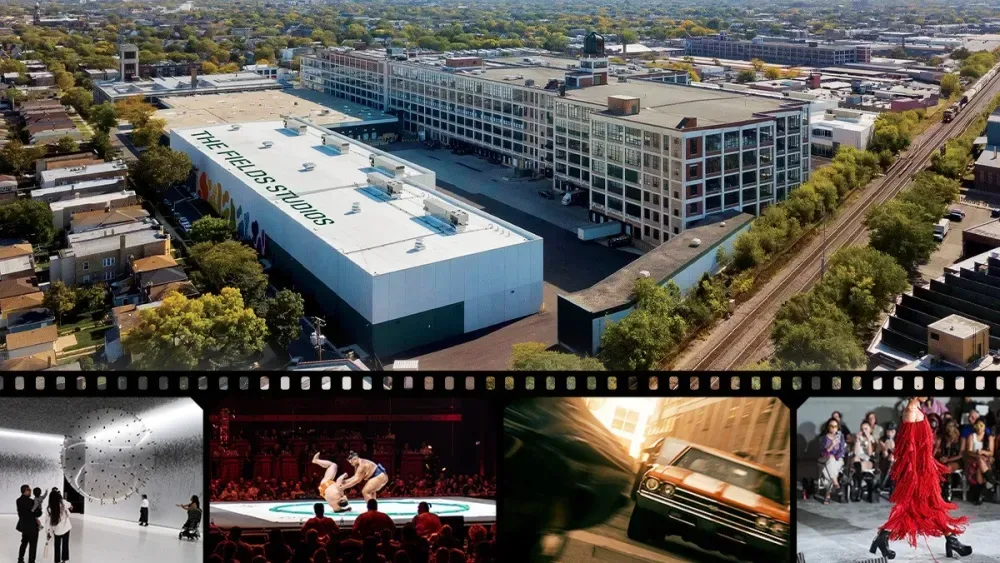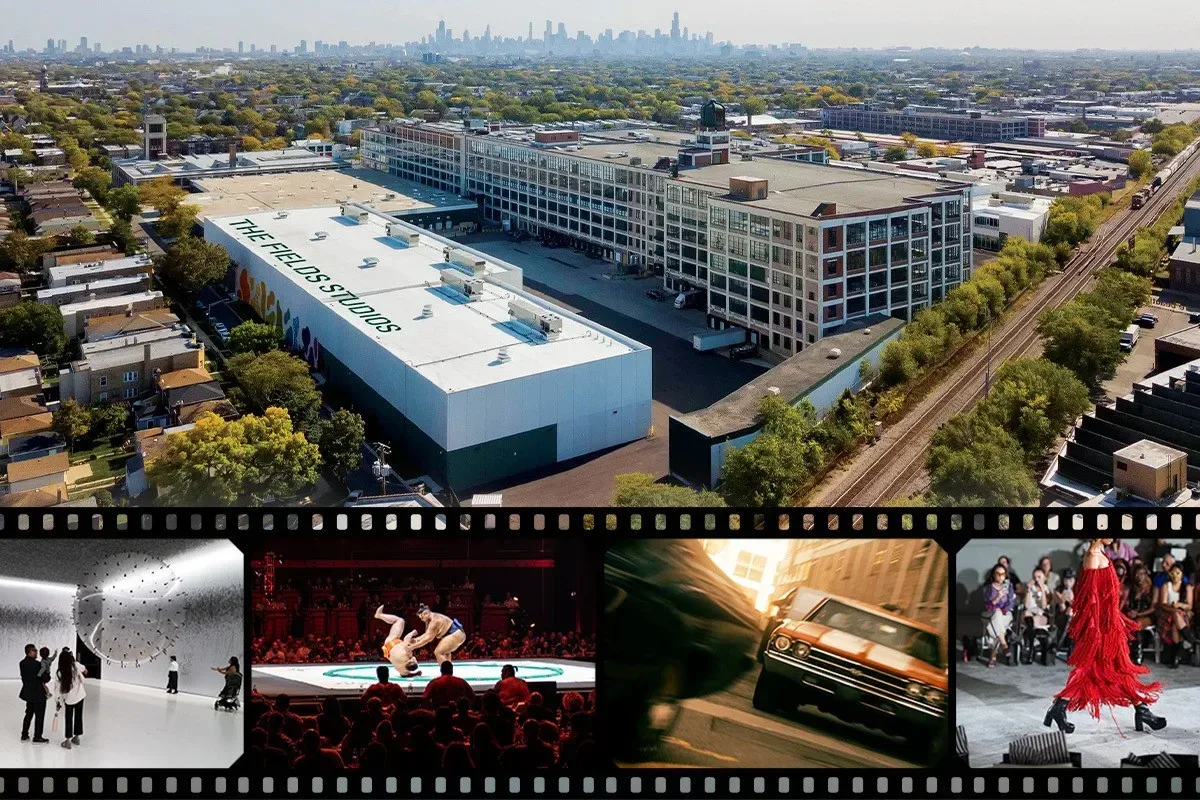
Soundstages remain fundamental to filmmaking and television production, but a Chicago facility is arguing that stages alone are no longer enough. The Fields Studios, a 23-acre creative campus on the city’s Northwest Side, is building its identity around flexibility: the ability to accommodate a scripted series, a commercial job or a large immersive installation without treating every production as if it has the same needs.
That proposition matters in a production economy shaped by cost pressure, rapidly changing on-set and writers’ room technology, and growing competition among jurisdictions offering incentives. In that environment, a studio operator’s challenge is not merely to lease a physical box. It is to make that box, and the wider site around it, useful when schedules, budgets and project types change.
Shawn Papazian, president and CEO of The Fields Studios, says physical production still needs soundstages, but he sees adaptable design as a baseline rather than an optional extra. His view is that a campus has to support a range of creative work instead of being planned only around a financial projection tied to conventional stage rentals.
A campus designed for more than one kind of production
The Fields Studios has nine soundstages, more than 200,000 square feet of production office and support space, on-lot parking and a 1.5-acre backlot. The complex also includes retail, an on-site grocery store and 123 high-end residential lofts. That combination is central to the facility’s argument: a production’s workday is not limited to the moment cameras are rolling, so the surrounding practical needs of crews and production offices are part of the offering.
A soundstage is an enclosed, controlled shooting environment. Its value is predictability: productions can construct sets, control sound and lighting, and avoid many of the uncertainties associated with a location shoot. A backlot, by contrast, is an outdoor area that can be used for exterior shooting, construction or production activity. Offices and support areas are less glamorous, but they are where departments plan, coordinate and manage the logistical work behind a shoot.
Putting those functions near one another is not unique to film campuses, but The Fields Studios’ model goes further by pairing them with mixed-use elements. The intention is to create what Papazian calls a home base rather than a site that is useful only while a stage is booked. For crew members working extended hours, immediate access to food, parking, offices and nearby residences can affect day-to-day comfort and the amount of travel required around an intensive schedule.
The property itself was not built from scratch as a studio. It occupies a manufacturing complex originally constructed in 1928 for Olson Rugs and later used by Marshall Field & Co. Its conversion gives the site an industrial history while redirecting its large-scale footprint toward screen production and live creative uses.
Immersive events are already testing the premise
The flexibility pitch is not only theoretical. The Balloon Museum, a large-scale art experience from Lux Entertainment, is currently using five of the site’s stages. Its presence illustrates the type of nontraditional stage tenant the campus hopes to host alongside film and television.
Immersive work can have production demands that overlap with screen work while producing a different end result. It may require substantial installation space, technical coordination and operations capable of receiving large numbers of visitors each week. In this case, the Balloon Museum cited the facility’s stage quality, operational flexibility, staff and relationships with city and state institutions as important to the partnership.
For a studio campus, the practical implication is diversification. A period without a scripted series booking does not necessarily have to leave soundstages idle if the spaces can support exhibitions or other creative activations. That does not mean the needs of an immersive installation and a television drama are identical. It means a site designed to reconfigure and coordinate complex use can potentially serve both, rather than relying on a single category of client.
RoseMary Prodonovich, general manager of The Fields Studios, has described the goal as making the campus a broad creative sandbox and an epicenter of Chicago’s creative culture. The wording is aspirational, but it also identifies the operational bet: facilities that can turn over efficiently between different uses may be better positioned than those tied strictly to the older build-and-lease approach.
What a production-minded operator means
Productions are unusual tenants. They often require large spaces for limited and shifting windows, then need to change the use of those spaces quickly. The schedule for principal photography—the period when a project is actually filming—can be altered by creative decisions, budget considerations and logistics. A stage operator that understands those pressures has a different relationship with a client than one providing a bare industrial rental.
Papazian says productions are looking for comfort as well as physical space: a partner that understands schedules, budgets and the needs of people working long days. That philosophy has a family precedent. He says his father, Robert A. Papazian, emphasized when they opened their first studio together more than 30 years ago that production workplaces should be comfortable and easy to use because crews spend so much time there.
The company says it selected personnel with production and real-estate backgrounds. The two disciplines address different questions. A production team must consider crew workflows and immediate shooting requirements; a real-estate operator must maintain the long-term stability of a mixed-use property. The Fields Studios’ thesis is that bringing both perspectives together helps it respond to needs at the start of filming while maintaining the broader campus.
That producer-first framing received a high-profile example through Dark Matter. Matt Tolmach, executive producer of the series, said its second season filmed at The Fields Studios last year and praised the team’s ability to adapt as the production’s needs changed. The season, produced by Sony Pictures Television for Apple TV, is now streaming.
The importance of facilities to screen projects also extends beyond television production. The wider business continues to pursue new film work, including game adaptations such as the planned Madison horror-game movie. Each project has its own creative and financial path, but productions of every kind ultimately need workable places for the many tasks that turn development into a finished screen release.
Illinois incentives are part of the calculation
Facilities do not compete only on amenities. Incentives are a material factor when studios, streamers and producers decide where a project can be made. Illinois recently extended and enhanced its production tax credit through 2039, with higher base incentive rates, a broader set of eligible expenses and a sustainability uplift that can take total savings above 40%.
A production tax credit is a government incentive designed to encourage eligible production spending in a particular place. The details matter: the value of the credit depends on which costs qualify, how the program is structured and whether a production can meet relevant conditions. The stated sustainability uplift is an additional incentive connected to sustainability criteria, rather than a universal saving automatically available to every project.
For producers, a long extension through 2039 may offer a measure of planning visibility. Productions frequently make location decisions well before filming begins, and stable rules can be useful when comparing a range of markets. At the same time, incentives are only one part of the decision. Stage capacity, crew availability, locations, travel, infrastructure and the ability to solve problems during a shoot can all shape where a project lands.
The Fields Studios sees Chicago’s growing local talent pool and turnkey infrastructure as complementary to the incentive. Turnkey in this context means a facility positioned for a production to begin work with core infrastructure available, rather than requiring a client to create every basic operational element independently. It does not remove the considerable planning demanded by a film or television shoot; it refers to readiness of the site and its essential production resources.
Chicago supplies the exterior world beyond the stages
Even a production that spends much of its time inside a soundstage often needs exterior locations. Chicago’s architectural variety and established production history are therefore significant parts of the city’s appeal. Papazian’s description of the surrounding area as “the real thing,” rather than a backlot, captures the distinction: productions can pair controlled interior work with actual neighborhoods and varied cityscapes.
The claimed advantage is efficiency combined with range. A project may use the campus for offices, set work and support functions, then move into the city for a location that does not need to be fabricated. Chicago is also a short flight from both coasts, another logistical point for productions that may involve personnel or partners in multiple regions.
The campus says it also works with educational institutions and creative organizations in Chicago to support a local production-talent pipeline. Building local capability is strategically relevant to any production hub. A facility can add stages quickly only with difficulty, but a reliable workforce is built through experience, education and continuing connections across a creative community.
The larger bet: resilient spaces, not just rentable square footage
The Fields Studios is not claiming that traditional soundstages are obsolete. Its leadership explicitly argues the opposite: boxes designed for physical production will continue to be needed. The difference is a belief that the strongest version of the modern studio is a flexible campus, capable of adapting its spaces and services when the market moves.
That approach responds to several pressures at once. Productions can chase cost savings internationally or across U.S. states. Technology has become a more direct element of production operations. Incentive programs are competitive. And projects themselves do not all look alike, as the use of five stages by an immersive art experience demonstrates.
For Chicago, the opportunity rests on connecting all of these pieces: stages, practical production services, local crews, real locations and a tax-credit program that now has a lengthy horizon. For The Fields Studios, the measure of success will be whether that connected campus can stay useful across different formats and changing production demands—not merely whether it can rent four walls to the next show in line.