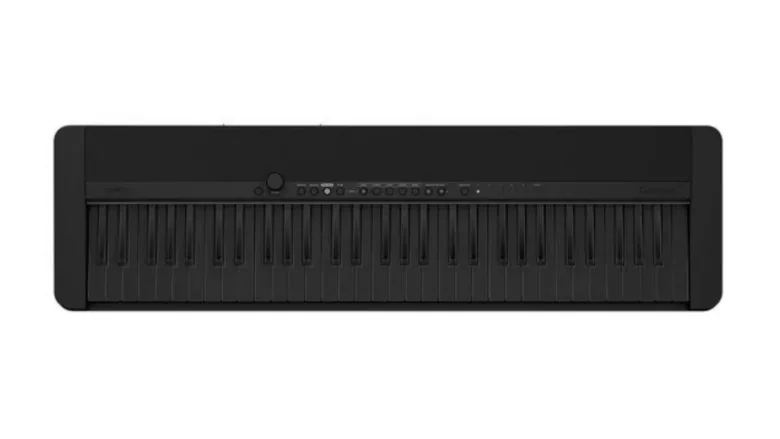
Casio’s CT-FS1 approaches beginner keyboard playing from a distinctly game-friendly angle: remove one of the most immediate failure states, then let players concentrate on staying with the music. Its new Feel Sync technology is designed to adapt the keyboard to a song uploaded through a companion app, so the notes triggered by the player remain in key with that track.
That is a meaningful distinction from simply giving a newcomer an easy songbook or illuminated prompts. The CT-FS1 is intended to work with a user’s chosen music, including songs with key changes and more complex structural sections. Instead of demanding that a player first know which note belongs at every moment, Feel Sync changes the musical context of the keyboard around the song.
For people whose musical confidence has been eroded by one too many accidental clunks, the sales pitch is easy to understand: press keys, follow the rhythm, and get a result that belongs with the track rather than fights it. Casio is also retaining conventional keyboard operation, so the CT-FS1 is not solely an assisted instrument. It is a 61-key, touch-responsive keyboard with built-in stereo speakers, a surround effect, a headphone output, Bluetooth support and a selection of sounds.
What Feel Sync is trying to solve
A beginner often has several tasks to juggle at once: finding a note, choosing the appropriate moment to play it, controlling how forcefully it is struck, and listening closely enough to recognize when something has gone wrong. That is a lot of simultaneous processing before someone has had much chance to simply enjoy making music.
Feel Sync appears to narrow that problem. A user uploads a song in the proprietary Feel Sync app. The system analyzes the audio and configures the keyboard so that played notes fit the song’s current key. Casio says the system can accommodate songs that move through multiple keys and sections, including bridges.
In plain language, being in key means a played note agrees with the collection of notes that forms a piece’s current tonal center. When someone is playing by ear without much technical knowledge, an out-of-key note can be the most jarring kind of mistake. Feel Sync’s purpose is to prevent that specific error while the music is playing.
That does not mean the player is secretly performing the original keyboard part. Nor does it mean musical skill becomes automatic. The provided details describe a system that keeps output in the relevant key; they do not establish that every press will reproduce a song’s melody, harmony arrangement or exact instrumental performance. A person can still play a rhythm that does not suit the arrangement, hit notes at awkward times, or create a pattern that is technically in key but musically unconvincing.
That limitation is not a flaw in the concept. It is the point of the design. By making pitch selection safer, the keyboard can direct attention toward parts of playing that remain fully human: pulse, pacing, dynamics and feel.
Related coverage includes Casio CT-FS1 Uses Feel Sync to Keep Players in Key.
Why timing and expression still matter
Rhythm is the organization of notes in time. Timing is how accurately a player places those notes against the beat. Expression covers choices such as emphasis, spacing and intensity that can make the same basic notes sound energetic, restrained, nervous or confident. A system that avoids clashes with a song’s key cannot perform those choices for the player.
That makes the CT-FS1’s premise closer to an accessible performance tool than a complete lesson plan. A newcomer could use it to practice entering on a beat, sustaining an idea through a section, responding to a change in a song and varying their touch. Those are useful musical instincts, even if the person is not yet learning the theory behind scales, chords or harmony.
The keyboard’s touch-responsive keys matter here. Touch response means the instrument can react to how forcefully a key is pressed. The supplied specifications do not detail exactly how the CT-FS1 maps that response, but the feature gives players a physical way to vary their performance rather than treating every press as identical. In assisted mode, that can leave room for personal control even when Feel Sync is helping with pitch compatibility.
There is a familiar parallel for game players. Accessibility options, aim support and forgiving difficulty settings can allow someone to engage with a challenge they might otherwise abandon. They do not necessarily make a player ready for every advanced technique, but they lower the barrier to participating, experimenting and building comfort. Feel Sync seems aimed at a similar early stage of music-making: less fear of an immediate wrong note, more room to remain engaged with the track.
The approach could be particularly inviting in casual social settings. People who would not volunteer to play a conventional keyboard may be willing to join in if the instrument is set up to keep their contribution harmonically compatible. The important caveat is that Casio’s stated feature is key-matching, not a guarantee that every performance will sound polished. The player still supplies the sense of time and the decisions.
A split mode for two levels of player
Casio says the Feel Sync portion of the CT-FS1 can be divided into two zones. One side can be used by a beginner in the assisted mode, while a more experienced player uses the other side to perform the actual notes.
This is an unusually practical feature for households, lessons and informal jams because it changes the keyboard from a solo confidence-builder into a shared instrument. The novice need not sit out while another person plays more conventionally. They can contribute within the protected Feel Sync zone, while the experienced musician retains a normal area for a specific melody, chord voicing or accompaniment pattern.
It is also a better framing of assistance than treating it as a permanent substitute for learning. A newer player can participate now, hear how their rhythmic choices interact with an established part, and later move toward playing outside the assisted zone. The available information does not define every behavior of the split setup, so prospective buyers should not assume more elaborate teaching or accompaniment functions than Casio has described. But the basic division has clear collaborative potential.
It remains a portable Casio keyboard
Behind the Feel Sync hook, the CT-FS1 has the expected fundamentals of a portable keyboard. It has 61 touch-responsive keys, built-in stereo speakers with a surround effect, selectable sounds, Bluetooth integration and a headphone output. The latter is especially relevant when practice needs to coexist with other people in the home; the player can listen privately rather than turning every experiment into a room-wide event.
Bluetooth gives the CT-FS1 another connection point in a setup built around songs and app interaction, though the supplied information does not specify the exact Bluetooth functions or the devices supported. That is worth distinguishing from the app-dependent Feel Sync workflow: Bluetooth integration is listed as a keyboard feature, while the song-upload and analysis process is described through Casio’s dedicated Feel Sync app.
On portability, Casio says the unit weighs just under 10 pounds and can run from AA batteries or an AC adapter. That makes it more flexible than an instrument that must permanently live beside a wall outlet. It can be moved between rooms, taken to a gathering or set up temporarily without turning the process into a furniture project. Battery operation also aligns with the keyboard’s social, pick-up-and-play premise.
Those looking at connected music features may also be interested in how audio services increasingly appear across devices and interfaces; for instance, Spotify’s appearance in Apple’s HomeView through CarPlay mirroring illustrates how playback ecosystems can be more layered than a single app icon suggests. For the CT-FS1, however, only the stated Feel Sync upload process and Bluetooth integration should be treated as confirmed.
Design, price and the questions buyers should ask
The CT-FS1 is available in black and white, but Casio has taken the monochrome idea all the way to the keys themselves. The black model uses black keys, while the white model uses white keys. It is a striking departure from the traditional visual contrast players expect on a keyboard, and it will not suit every taste.
That choice is more than cosmetic for some buyers. Conventional black-and-white keys provide a familiar visual map for locating notes and recognizing patterns. Since Feel Sync is aimed at players who may not be relying on that map at first, a fully monochrome look fits the product’s less traditional identity. Still, anyone who expects to spend substantial time learning standard keyboard geography may want to consider whether they are comfortable with the design before treating the CT-FS1 as their primary practice instrument.
Casio lists the CT-FS1 at $400, and it is available now. At that price, the central buying question is not merely whether someone wants a 61-key portable keyboard. It is whether Feel Sync’s app-based, song-adaptive playing experience is the feature that will make the instrument more likely to be used.
- It may fit a newcomer who wants to play along with songs quickly and is motivated by rhythm, experimentation and low-stakes participation.
- It may fit a family or pair of players who could use the split-zone option to play together at different ability levels.
- It may be less suitable as a standalone learning route for someone whose primary goal is structured instruction in scales, note names, traditional fingering and independent harmony.
- It is worth checking app requirements before purchase, since Feel Sync is described as operating through Casio’s proprietary app and the supplied details do not spell out supported devices, song-file conditions or other workflow requirements.
The CT-FS1’s most interesting idea is not that it eliminates musicianship. It separates one intimidating part of musicianship—choosing an in-key note—from the equally important work of listening, reacting and playing with intent. For people who have wanted to join the song but did not want to gamble on every keypress, that is a focused and potentially freeing proposition.