
A Canadian parliamentary petition is asking the federal government to help BioWare secure the capital needed to become independent and obtain ownership of its intellectual property, following EA’s reported closure of the studio.
Petition e-7898 was initiated by Brendan Routh of Burnaby, British Columbia, and sponsored by Vancouver Kingsway MP Don Davies. Its request is unusually ambitious: it is not simply seeking recognition of the studio’s cultural importance or employment support for its workers. It calls for federal assistance that could allow BioWare to operate independently and control the intellectual property associated with its work.
That distinction is central. A studio’s staff, tools and physical workplace are only part of the picture in a potential revival. Intellectual property, often shortened to IP, means the legal rights connected to a creative work: its name, characters, fictional setting and other protected material. Without rights to use a franchise, even an experienced former development team may be unable to make a direct continuation under the established name.
For fans focused on BioWare’s future, the petition therefore addresses the hard part of a hypothetical buyout rather than merely calling for a studio to be reopened. It seeks an arrangement in which the people who know the developer’s work best could have a chance to own and operate it.
What the petition asks of Ottawa
The petition asks the Canadian government to provide the capital BioWare would need to gain independence and ownership of its IP. It also calls for measures to protect Canadian businesses from being directed by foreign corporate interests.
Its language goes beyond economic policy. The petition argues that preserving BioWare would support values including inclusivity, tolerance, democracy, justice and civil rights, framing the developer as a meaningful Canadian contributor to the worldwide entertainment business.
That framing makes this more than a conventional fan campaign. It is an effort to put a game-studio closure into a public-policy conversation about jobs, national creative industries and who controls companies built in Canada.
Davies has publicly argued that the situation reflects a wider problem: Canadian businesses being acquired by U.S. companies and subsequently shut down, with the resulting loss of Canadian jobs. He has also argued that the developers themselves should receive the first opportunity, along with federal support, to buy and run the studio.
Related coverage includes Canadian Parliamentary Petition Calls for Support to Restore BioWare's Independence.
The petition’s central idea is that studio independence would require both a chance to purchase the operation and enough capital to make that purchase possible.
The signature threshold is not a rescue plan
At the time covered by the petition update, e-7898 had 2,861 signatures. That is considerably below the roughly 307,000 signatures reported for a separate fan-made Change.org campaign, but the two figures serve different purposes.
Canada’s parliamentary e-petition process requires 500 signatures before a petition can be presented to the House of Commons. The official petition has already passed that threshold. In practical terms, that means it has cleared the participation requirement for parliamentary presentation; it does not mean the government is required to fund a BioWare buyout, compel a sale, or transfer franchise rights.
This is an important technical distinction. A petition is a formal route for putting an issue before Parliament and seeking a government response. It is not itself legislation, a budget commitment or an acquisition agreement. Any real intervention would still need willing decision-makers, a workable financial structure and, crucially, an agreement with the party that owns the relevant assets.
That does not make the petition meaningless. Formal presentation can put a public record around the request and force a clearer discussion of what supporters want government to consider. But the distance between parliamentary discussion and a transaction involving a major game developer’s assets is substantial.
Why ownership of IP is the difficult piece
Calls to “save a studio” can sound straightforward because game development is often associated with creative teams. In reality, a company can be tied to contracts, technology, branding, publishing arrangements and intellectual property rights that may be held separately from the people making the games.
A government could theoretically consider support for workers, retraining, regional employment or domestic creative production without necessarily purchasing or transferring a game franchise. The petition asks for something more specific: support intended to let BioWare secure independence and ownership of its intellectual property.
That is why the proposal depends on several unanswered questions. What assets would be available? Would their owner be prepared to sell? What would the financial terms look like? And what form of federal support, if any, could be considered? None of those details are established by the petition itself.
Supporters may see a developer-led ownership model as a way to preserve creative continuity. Skeptics may note that an independent studio would still need substantial financing, a business plan and the ability to take on the risks normally carried by a publisher. Both views can be true at once: independence can offer creative control, but it does not erase the cost and complexity of making large-scale games.
A campaign growing beyond a single petition
The parliamentary effort follows an earlier grassroots campaign that reportedly accumulated more than 300,000 signatures. It also follows comments from Canadian politician Avi Lewis, who raised the possibility of federal help for BioWare to become independent.
That sequence matters because it shows the campaign has moved through several kinds of pressure: fan mobilization, elected representatives speaking publicly, and now an official petition that has passed the signature requirement for presentation. Each step increases visibility, but none independently guarantees a particular outcome.
The debate has also intersected with continued enthusiasm around BioWare’s games, including attention surrounding a reportedly leaked trailer for a future Mass Effect project. Fan interest can explain why the issue has reached this scale, though interest in a series is not the same thing as a settled path to ownership, funding or production.
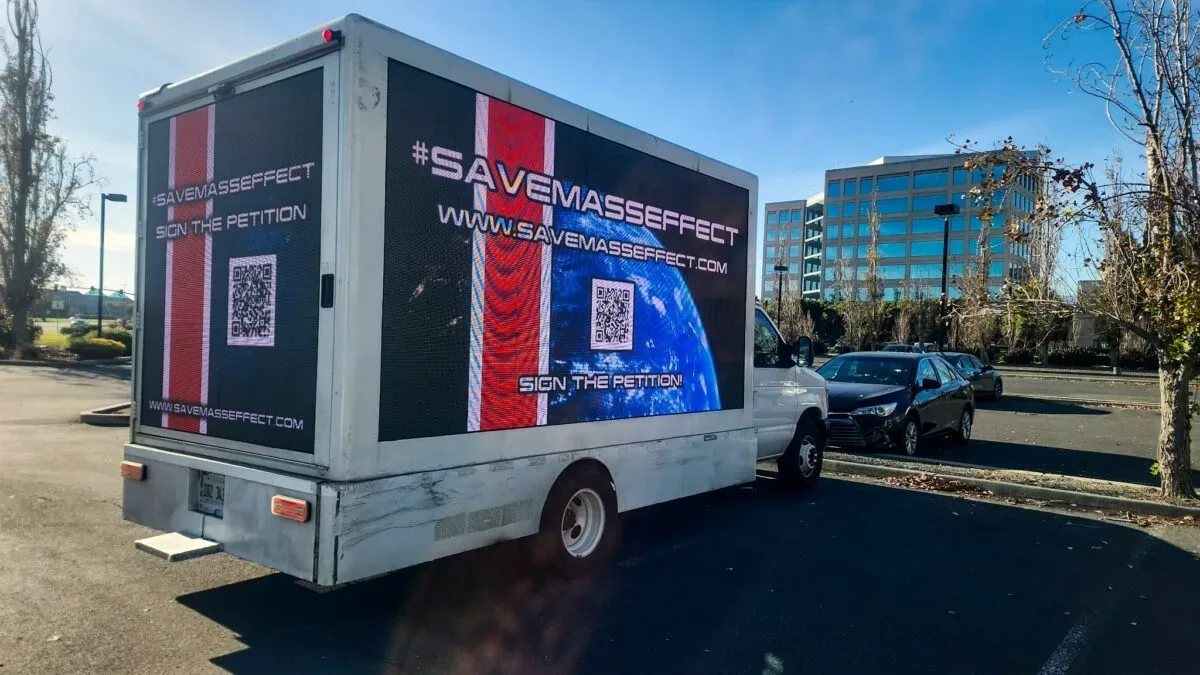
For wider context on the organized fan response around the franchise, see the Save Mass Effect campaign’s billboard-truck action near EA headquarters.
What happens next
The clearest immediate development is procedural: the petition has surpassed 500 signatures and is set to be brought before the House of Commons. The key uncertainty is what follows. Presentation creates an opportunity for the request to be considered and discussed, but no federal commitment to intervene has been established.
Davies’ public statements make the argument in direct terms: he believes the developers know how to run the studio and make the games audiences value, and that they should be given the first opportunity to buy it with federal support. The petition gives that argument an official parliamentary vehicle.
Whether it becomes policy will depend on issues far larger than a signature total. Any path toward an independent BioWare would have to reconcile public appetite, government willingness, the legal status of company assets and IP, and the financial realities of operating a game studio. For now, the petition has achieved a narrower but tangible result: a campaign that began with fans is moving into Canada’s formal political process.