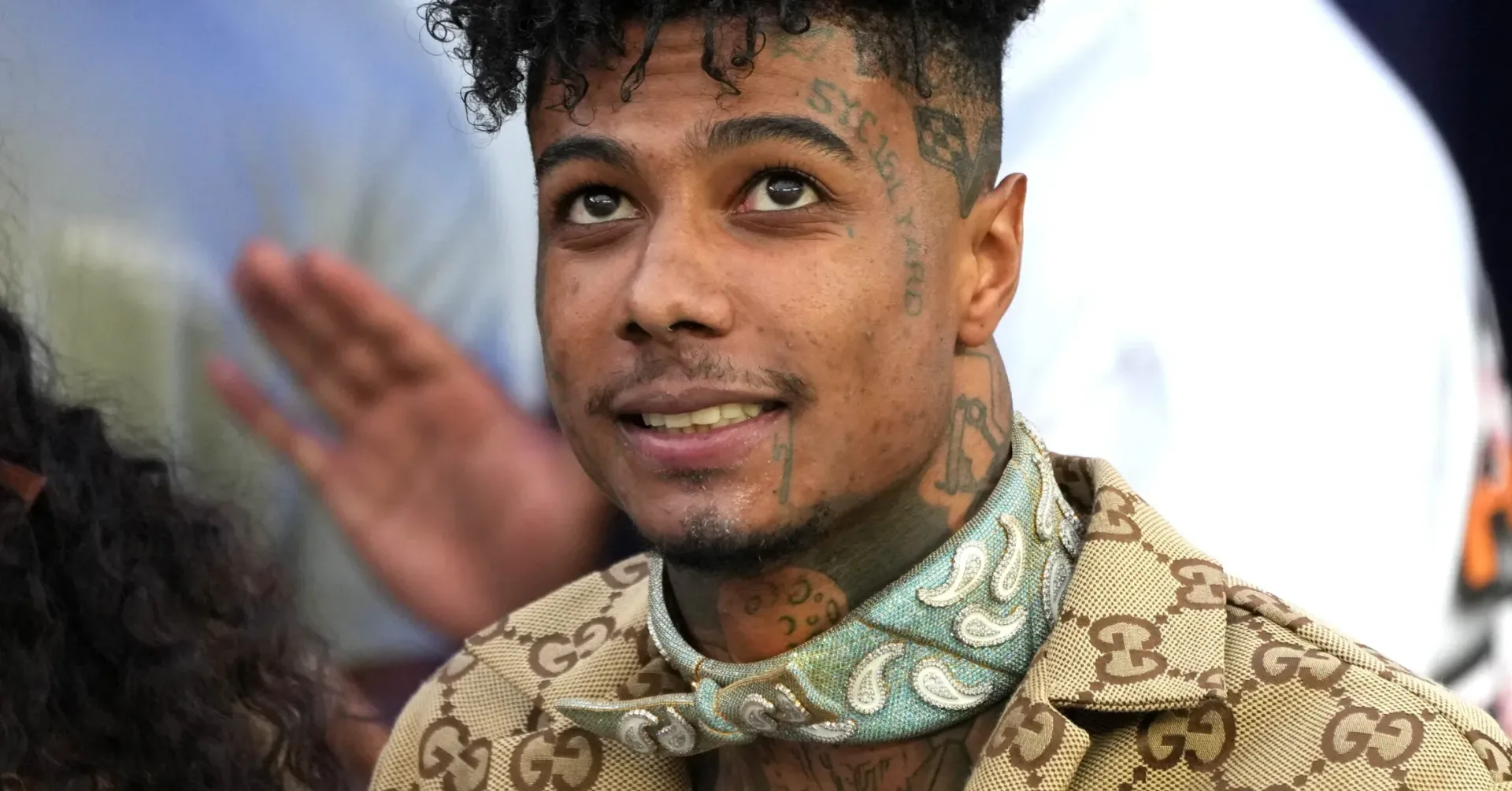
Blueface was arrested during a livestream after law enforcement responded to a reported swatting call at his location in Santa Clarita. The rapper was streaming outside with his fiancée, Chrisean Rock, on Kick when officers arrived with guns drawn.
The central fact that should not get lost in the viral-video framing is that authorities reportedly found no threat to public safety after completing their investigation. The arrest was instead tied to an allegation that Blueface did not follow law-enforcement orders and interfered with the investigation. Those are allegations, not a public finding of guilt, and it remains unclear whether formal charges will follow.
What reportedly happened during the stream
The encounter played out live, putting a police response that would normally be witnessed by only those present in front of an online audience in real time. A representative for the Los Angeles County Sheriff’s Office said Blueface refused to comply with orders, leading to his arrest.
A clip from the broadcast showed Rock crying after he was taken into custody. The situation carries particular weight because Blueface is currently on probation in connection with a 2022 shooting case in Las Vegas. The available information does not establish how, if at all, this arrest could affect that probation. That question depends on facts and legal processes that have not been made public.
It is also important to separate the reported false emergency call from the alleged conduct during the police response. A swatting call may bring officers to a location under the belief that an immediate and potentially violent danger exists. Once they arrive, their focus is on assessing that danger and securing the scene. An eventual determination that there is no threat does not erase the seriousness of the initial response, nor does it answer whether someone at the scene complied with instructions.
Swatting explained: a false report with real-world stakes
Swatting is the practice of making, or causing, a false report intended to send heavily armed police officers or emergency responders to a target’s address or current location. The term comes from the idea of deploying a tactical police response, but the core problem is broader than any one unit or agency: a false report can pull public-safety resources toward an invented crisis while placing the targeted person, people nearby, and responders in an unpredictable confrontation.
For livestreamers, the danger can be amplified by the public nature of the work. A person broadcasting in real time may be easier to identify, locate, or harass than someone whose activity is private. At the same time, a camera does not turn a police encounter into entertainment or provide viewers with the full context officers have at the scene. A livestream may show pieces of an event, but it cannot by itself establish what was reported to dispatch, what instructions were given off-camera, or why officers made particular decisions.
That distinction matters in this case. The footage’s visibility can encourage instant verdicts from spectators, but the known account is limited: police responded to a swatting call, investigated, found no public-safety threat, and arrested Blueface following an allegation that he interfered and refused orders. What happens next—whether charges are filed, what allegation might be pursued, and what consequences may result—has not been established.
A creator-safety issue, not livestream spectacle
The event lands in a wider conversation around the risks that accompany online celebrity and live broadcasting. A creator’s audience may be a community, but it can also include hostile viewers, opportunists, and people looking to convert online conflict into an offline disruption. Swatting is especially reckless because it relies on officials treating a report as potentially urgent until it can be checked.
The practical lesson is not that creators can somehow control every malicious caller. They cannot. Nor is it an argument for viewers to police an unfolding response from behind a screen. Instead, it highlights the need to treat a visible creator’s location and schedule as sensitive information, even when content is designed around immediacy. Public livestreaming can make proximity feel routine; an emergency response makes clear that real-world consequences do not remain safely inside a chat window.
There is a related issue for platforms and audiences. Viral clips often reward the most dramatic seconds of a larger event: officers arriving, people reacting, or an arrest. But replaying those moments without the surrounding uncertainty can turn a potentially dangerous false report into another content loop. Responsible discussion means avoiding guesses about motives, not treating emotional reactions as proof of legal facts, and waiting for confirmed information on any charges or court action.
The online-creator space has also had to confront how quickly digital misuse can cross into real harm, whether the issue is harassment, misuse of a person’s likeness, or disruption aimed at a public-facing figure. That broader concern is visible in the gaming-adjacent creator world as well, including a recent dispute involving an AI-generated promotional image and a creator’s likeness. The circumstances are very different, but both underline a basic point: online visibility can create risks that platforms, event organizers, audiences, and creators cannot responsibly dismiss as mere internet drama.
Why the probation context makes uncertainty especially important
Blueface’s probation status is a major part of why the arrest has drawn immediate attention. Probation generally means a person remains subject to court-imposed conditions after a criminal case, but the exact conditions vary from case to case. An arrest does not, by itself, publicly establish a violation or determine a legal outcome. Whether a probation issue arises can turn on the alleged conduct, the terms imposed by the court, evidence, and subsequent proceedings.
For now, none of those specific answers are available here. It would be inaccurate to claim that the reported arrest automatically changes Blueface’s legal status, just as it would be inaccurate to predict a charge or sentence. The responsible reading is narrower: a police encounter that followed a reported swatting incident ended in an arrest, and the rapper’s existing probation makes future official updates consequential.
Rock’s visible distress during the stream also should not be used to fill those gaps. It demonstrates that the moment was emotionally serious for those present; it does not provide a legal explanation for the arrest or confirm what may happen afterward.
Kick success and the downside of constant visibility
The arrest comes during a turbulent period for Blueface that has included a growing presence on Kick. He has reportedly become one of the platform’s biggest creators, earning more than $120,000 per week, while also becoming engaged to Rock after years of a highly public and often turbulent relationship.
That scale of attention brings obvious professional value, but it also makes boundaries harder to maintain. A lucrative live presence depends in part on direct access and immediacy—the very qualities that can leave creators exposed when viewers or bad actors treat access as entitlement. Nothing in the available account indicates who made the reported swatting call, and there is no basis to assign responsibility to any particular person or community. Still, the reported incident illustrates why swatting is not a trivial prank or an unavoidable cost of online fame.
For the moment, the firmest facts are limited. Police responded to a reported swatting call while Blueface and Rock were live in Santa Clarita. Authorities ultimately determined there was no public-safety threat. Blueface was arrested after authorities alleged that he interfered with their work and did not follow orders. Whether charges will be filed, and what the arrest means for his probation, remains unknown.