Bloomwalker, Netmarble’s adventure-crafting game formerly introduced as Project Bloomwalker, is now officially connected to the Ni no Kuni universe. A new Tokyo Game Show 2026 trailer ends with copyright information for both Ni no Kuni and Level-5, establishing a franchise relationship that had not previously been disclosed.
That is a meaningful change in how the game should be read. Its earlier reveal at Gamescom 2025 already drew attention for a hand-drawn fantasy aesthetic and imagery that strongly recalled the films associated with Studio Ghibli. Now, the resemblance to the visual language of Level-5’s Ni no Kuni games has an explicit licensing context rather than existing only as a point of comparison.
There are still crucial unknowns. Neither the trailer evidence nor the available details explain where Bloomwalker fits in the setting, whether it shares characters or locations with earlier games, or what role Level-5 has played in development. It is also not clear whether the game is a narrative spin-off, a separate adventure set in the same world, or a more limited use of the property. Fans should treat the universe connection as confirmed, but the specifics around that connection as unconfirmed.
A cozy crafting adventure with a newly named universe
Bloomwalker is framed as an adventure-crafting game: a description that generally signals exploration and resource-based activities alongside a larger journey, rather than the traditional role-playing structure associated with the main Ni no Kuni entries. That genre distinction matters. Being part of an established universe does not necessarily mean reproducing its familiar combat, party-building, or quest systems.
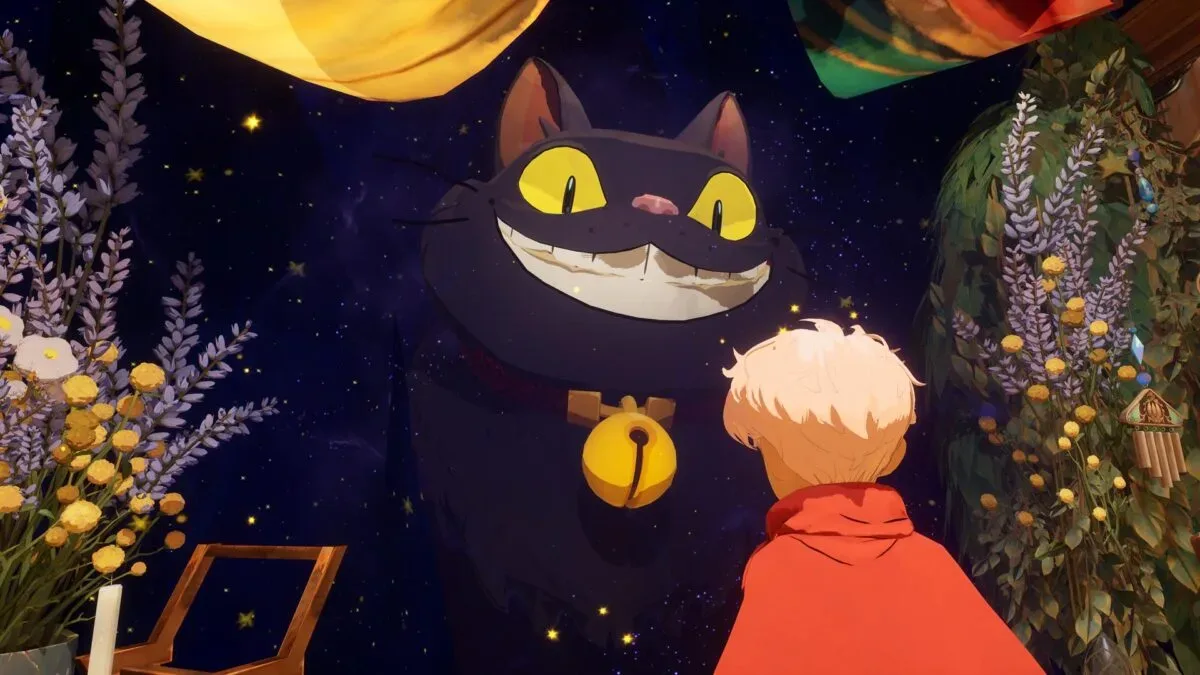
The material shown around Bloomwalker has emphasized fantastical, domestic, and environmental imagery. Its features include a house that lives and moves, a tiny sentient fire used in cooking, a large magical cat with an unsettling grin, and a forest-cleansing story with anti-pollution themes. Those elements make the game’s “cozy” label more complicated than it first appears: the home-and-cooking side suggests comfort, while the threatened natural world suggests a conflict beyond simple pastoral crafting.
The comparisons viewers have made are easy to understand. A moving home and helpful flame recall Howl’s Moving Castle; the imposing magical cat invites comparison with My Neighbor Totoro; and the cleansing of a polluted forest evokes environmental themes associated with Princess Mononoke. These are comparisons based on the game’s apparent motifs and presentation, not evidence that Bloomwalker is an adaptation of any of those films.
What is now concrete is the Ni no Kuni link. The first two games in Level-5’s RPG series were created with Studio Ghibli collaboration, a background that helps explain why Bloomwalker’s animation-forward appearance has repeatedly drawn attention. The new connection does not turn Bloomwalker into a Studio Ghibli production, but it does place its aesthetic proximity to Ni no Kuni on firmer franchise ground.
What the copyright notice establishes—and what it does not
Copyright notices are not a substitute for a full product breakdown, but their appearance is significant. In this case, the trailer’s closing information identifies both the Ni no Kuni property and Level-5. That is the clearest available indication that Bloomwalker is not merely borrowing a broadly similar fantasy style.
Related coverage includes Bloomwalker Confirmed as a Ni no Kuni Universe Spin-Off at Tokyo Game Show 2026.
However, an IP, or intellectual property, arrangement can take several forms. An IP is the protected creative identity around a work: its name, fictional world, characters, and associated elements. A developer can make a game under license without the original IP holder serving as a hands-on development partner. Conversely, an IP holder may be closely involved in story, approval, art direction, or production. The current information does not say which arrangement applies here.
Netmarble’s previous history with the franchise makes licensing a plausible possibility. The company developed and produced the mobile spin-off Ni no Kuni: Cross Worlds in 2021, and that game was developed without Level-5’s assistance. Bloomwalker could follow a comparable business structure, with Netmarble using the Ni no Kuni IP under authorization, but that remains analysis rather than a confirmed production detail.
For players, the practical implication is straightforward: do not infer Level-5 creative involvement solely from the copyright line. It confirms a relationship to the franchise; it does not confirm who is writing the game, designing its systems, setting its creative direction, or deciding how directly it intersects with prior Ni no Kuni stories.
Why the spin-off label carries extra weight
The last mainline entry, Ni no Kuni II: Revenant Kingdom, arrived in 2018. Bloomwalker therefore represents the first newly revealed official connection to the universe in some time, even if it is not positioned as the next numbered RPG. That makes the project potentially important to an audience that has had little clarity about what comes next for the broader series.
A spin-off can do useful work for a franchise when it offers a different perspective rather than trying to imitate its predecessor at every turn. Bloomwalker’s adventure-crafting premise could give the setting a slower, more place-focused angle. A mobile home, cooking companion, and forest restoration setup all suggest a game interested in inhabiting a world, not only saving it. Whether those ideas become central systems or simply visual framing remains unknown.
There is also a risk inherent in a familiar-universe reveal. The Ni no Kuni name brings recognition and expectations, especially around charm, emotional storytelling, and animation. But an explicit franchise tie will invite closer scrutiny of how Bloomwalker handles its monetization, progression, and sense of identity. A lovely art style alone will not settle those questions.
That scrutiny is amplified by Netmarble’s earlier Ni no Kuni project. Cross Worlds included blockchain-related elements that were removed only this year. Bloomwalker now has the opportunity to establish itself on its own terms, but players will reasonably be watching for clear information about how its crafting and adventure structure works—and whether any systems distract from the fantasy it is presenting.
Level-5 and Netmarble both face audience questions
The timing also puts the news against a difficult backdrop for Level-5. The company recently received backlash over a September 10 presentation described as heavily reliant on generative AI. Bloomwalker is not evidence of a connection to that presentation or its methods, and there is no basis to assume its development uses the same approach. Still, the broader reaction means that any public association with the Ni no Kuni name is likely to be evaluated more closely than usual.
For Netmarble, the issue is credibility around stewardship. The company has experience with the universe, but that history also ensures that Bloomwalker will be judged against Cross Worlds rather than introduced into a vacuum. The trailer’s end card gives the project a stronger official identity; it does not answer the questions that determine whether players will embrace it.
Those questions are especially important for a game marketed through atmosphere. “Cozy” is not a technical genre with a fixed rulebook. It commonly describes a design mood built around lower-pressure routines, inviting spaces, collecting or crafting loops, and comforting presentation. Bloomwalker’s pollution-cleansing premise may add more urgency than that label usually implies. The interesting possibility is that its cozy elements are tools for repairing a damaged world, not merely decoration around a standard adventure.
That potential contrast—warm domestic fantasy against a corrupted natural environment—could provide Bloomwalker with a clearer identity than its striking visual references alone. It may also offer a useful test of how far the Ni no Kuni universe can stretch across genres while retaining a recognizable emotional tone.
What players should watch for next
For now, the confirmed takeaway is concise: Bloomwalker belongs to the Ni no Kuni universe, and Level-5’s name appears alongside the franchise in the game’s copyright information. Beyond that, caution is warranted. No precise explanation has been given for the game’s setting, continuity, platforms, release timing, Level-5 participation, or gameplay structure.
- Franchise placement: Is Bloomwalker set in a known world, a new region, or an otherwise separate corner of the universe?
- Development roles: Is Level-5 providing a license, approvals, creative contributions, or something more extensive?
- Gameplay detail: How do crafting, exploration, the moving house, cooking, and forest restoration actually connect?
- Business model: Given the history of Cross Worlds, clarity around progression and monetization will matter.
- Creative identity: Can the game move beyond immediate film comparisons and explain what makes its own world distinct?
Bloomwalker’s reveal is therefore more than a branding footnote. It changes a visually familiar-looking new project into an official extension of a dormant RPG universe, while preserving nearly every major question about what that extension will be. As discussion continues around how games communicate their systems and intent, the wider design issue is also visible in our look at meaningful feedback in game design: players need enough information to understand what a game is asking of them. Bloomwalker has made its universe clear. Its next challenge is making the rest of its pitch just as legible.