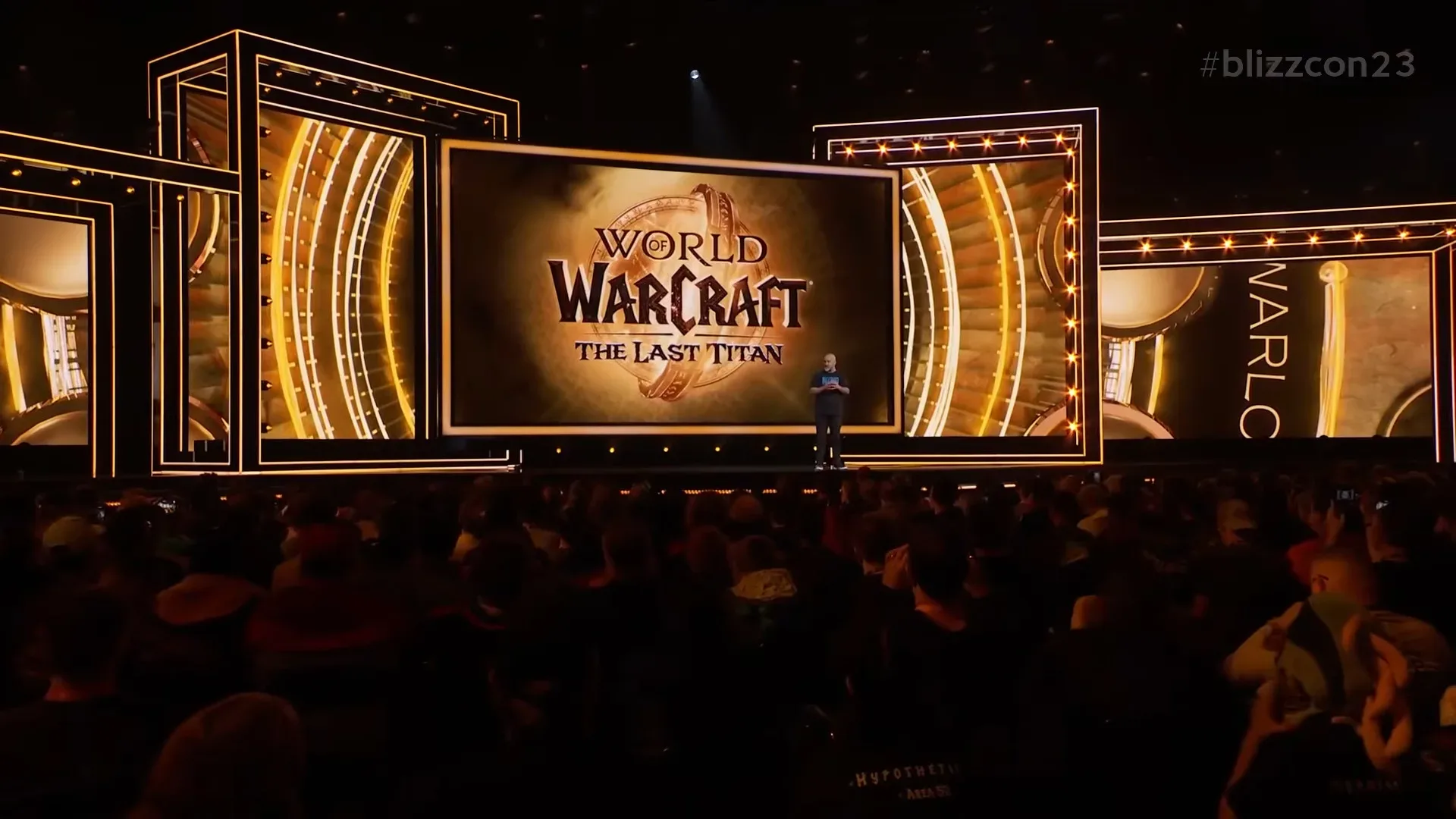
About 1,900 Blizzard workers represented by the Communications Workers of America have secured a labor contract covering employees connected to World of Warcraft, Overwatch, Diablo, and Blizzard’s story and franchise-development operations. The agreement arrives shortly before BlizzCon 2026, scheduled to begin September 12, and during a period in which parent company Microsoft is planning further Xbox layoffs.
The deal is notable not simply because it puts terms on paper for a large group of game workers, but because its provisions address two of the industry’s most persistent sources of anxiety: job cuts and the growing use of AI in workplaces. Its timing gives the agreement particular weight. Microsoft’s wider reported layoff plan is expected to total 3,200 roles, including another 1,600 positions at Xbox. For workers at a studio whose games operate as enormous, long-running services, stability is not a cosmetic perk; it is part of the machinery that keeps those worlds alive.
What the contract covers
The CWA says the new contract brings together protections for a workforce spread across several of Blizzard’s best-known franchises and internal support functions. That matters because Blizzard is not one single development team moving in lockstep from project to project. World of Warcraft, Diablo, and Overwatch each have different production needs, schedules, specialties, and player communities. The agreement creates a shared baseline for employees who might otherwise face very different circumstances depending on where they work inside the company.
Claude Cummings Jr., president of the CWA, characterized the result as a shift toward greater worker power and argued that it can support better games for players. The broader claim is easy to understand even without turning it into a promise about any future patch, expansion, or release: the people making games have more formal leverage over conditions that shape their work. A contract does not magically remove every production problem from a studio, but it establishes processes and minimum protections when difficult situations arise.
For players, labor news can feel distant right up until a beloved game suffers from reduced support, disrupted institutional knowledge, or a team suddenly having to change course. The people who understand an old system, a questline, a balance issue, a piece of localization, or the specific expectations of a years-old community are often carrying knowledge that cannot be replaced by a new org chart. A contract aimed at retention, severance, and pathways back into work speaks directly to that reality.
AI changes now require discussion
One of the agreement’s clearest provisions concerns AI technology. Senior World of Warcraft designer Paul Cox said the company must speak with the union before introducing AI tools that affect employees’ working conditions, with the union able to bargain over those effects. AI will also be a recurring subject for the labor-management committee, rather than an issue that only surfaces after a major decision has already been made.
That is a meaningful distinction. There is a considerable gap between being told that a tool is coming and having an established channel to ask how it affects roles, workloads, expectations, training, credit, evaluation, or the security of jobs. The contract language described here does not mean Blizzard employees control every company decision about technology. It does mean affected workers have a defined right to engage before workplace changes are implemented and to negotiate over their impact.
Game development has a uniquely wide range of jobs that could be touched by AI systems, from writing and editing to art production, customer-facing work, quality assurance, design documentation, and administrative tasks. The practical effects depend on the tool and the role. A standing forum for discussion gives workers an avenue to raise both major questions and ordinary workplace issues. Cox used an intentionally mundane example involving the gaps in restroom stall doors to illustrate the committee’s broad scope: the mechanism is for serious technological concerns, but also for the practical details that affect people at work every day.
Related coverage includes Blizzard Union Secures Contract Covering 1,900 Workers Ahead of BlizzCon 2026.
That combination is worth emphasizing. Contracts are not only about headline-grabbing disputes. They are also about creating a predictable route for employees to say, “This is not working,” and receive a response through a recognized process rather than hoping an informal complaint travels to the right person.
Layoff protections include severance and a route back
With more cuts anticipated at Xbox, the layoff provisions may be the most immediately important element of the contract. Eligible union members are entitled to at least four weeks of severance. The agreement also establishes recall rights lasting 14 months, giving qualified workers who lose their jobs an opportunity to return through open positions at Blizzard during that period.
The recall provision is especially consequential in a multi-franchise studio. Cox explained the basic scenario: if one game group reduces staff while another needs to expand, a qualified person laid off from the first team could be recalled into an open role on the second. In other words, a reduction on World of Warcraft need not permanently close the door on a qualified worker if a relevant opportunity later appears on Diablo.
It is not a blanket guarantee that every laid-off employee will receive another job. Qualifications and open roles still matter. Nor does it prevent a layoff from being disruptive to a person’s life. What it does provide is a documented route back into the organization, with a 14-month window in which workers can be considered for suitable positions. In an industry where layoffs often scatter teams and erase access to careers with little warning, that is a substantial protection.
It also recognizes how game studios actually function. Teams change size. A live-service project may be deep in support while another is staffing up. An expansion may enter a production stage that requires different expertise than the one before it. Recall rights give the company a mechanism to retain experienced people who already understand Blizzard’s development environment instead of treating every layoff as an irreversible separation.
BlizzCon added pressure to negotiations
Union organizing and worker mobilization had already become visible at Blizzard’s campus. Senior editor Alison Veneto described regular demonstrations by a few hundred workers near the site’s 12-foot orc statue. The impending return of BlizzCon appears to have increased the pressure around reaching an agreement.
BlizzCon is a public celebration of Blizzard’s franchises, communities, and future plans. Going into the September 12 event without a contract, while employee organizing was visibly escalating, could have created an uncomfortable contrast between the company’s stage presentation and the conditions facing its workforce. Veneto said plainly that the event was next week and suggested the absence of an agreement would have made the atmosphere difficult.
The contract means the immediate labor dispute no longer hangs over the convention in quite the same way. That does not make the wider uncertainty around Microsoft’s planned layoffs disappear, and it does not resolve every question about AI’s future role in game development. But it changes the position from which these workers face those questions. Rather than approaching them as individuals hoping to be heard, the covered employees have collectively bargained terms, a union structure, and recurring channels for discussion.
Why this matters beyond one studio
Blizzard’s games are among the industry’s most recognizable long-term franchises, and their workers are now covered by an agreement that specifically confronts job loss, technological change, and reassignment across projects. The effects will first be felt by the 1,900 people represented in the contract, but the example will be watched well beyond Blizzard. Labor agreements tend to become reference points: workers elsewhere can see which protections were won, while companies can see the kinds of obligations collective bargaining may place on them.
That does not mean every studio will adopt the same terms or that one deal remakes the industry overnight. Different employers, regions, bargaining units, and legal environments produce different outcomes. Still, the core principles here are unusually concrete. Minimum severance gives a floor. Recall rights provide a defined period for potential re-entry. AI consultation and bargaining rights create a process before workplace changes land. Together, those provisions turn broad concerns into terms employees can point to.
Games remain dependent on skilled people across disciplines, even as corporate strategies, production technologies, and team structures evolve. The contract is a reminder that the future of a major game studio is not only decided by trailers, release calendars, or executive presentations. It is also shaped by the conditions under which writers, designers, editors, developers, artists, and support staff can continue doing the work.
While Blizzard prepares for BlizzCon, the larger games business is still reckoning with layoffs and rapid experimentation around AI. Elsewhere in the PC space, projects such as the newly revealed co-op shooter Exterminauts underline how varied the release pipeline remains. Blizzard’s union agreement does not settle the industry’s instability, but it gives a large group of workers more protection as they navigate it.