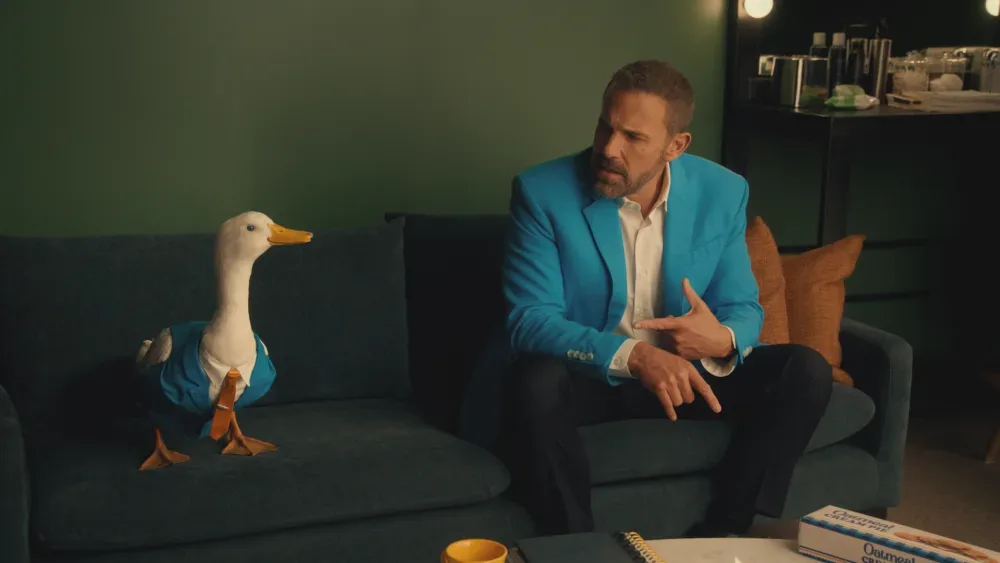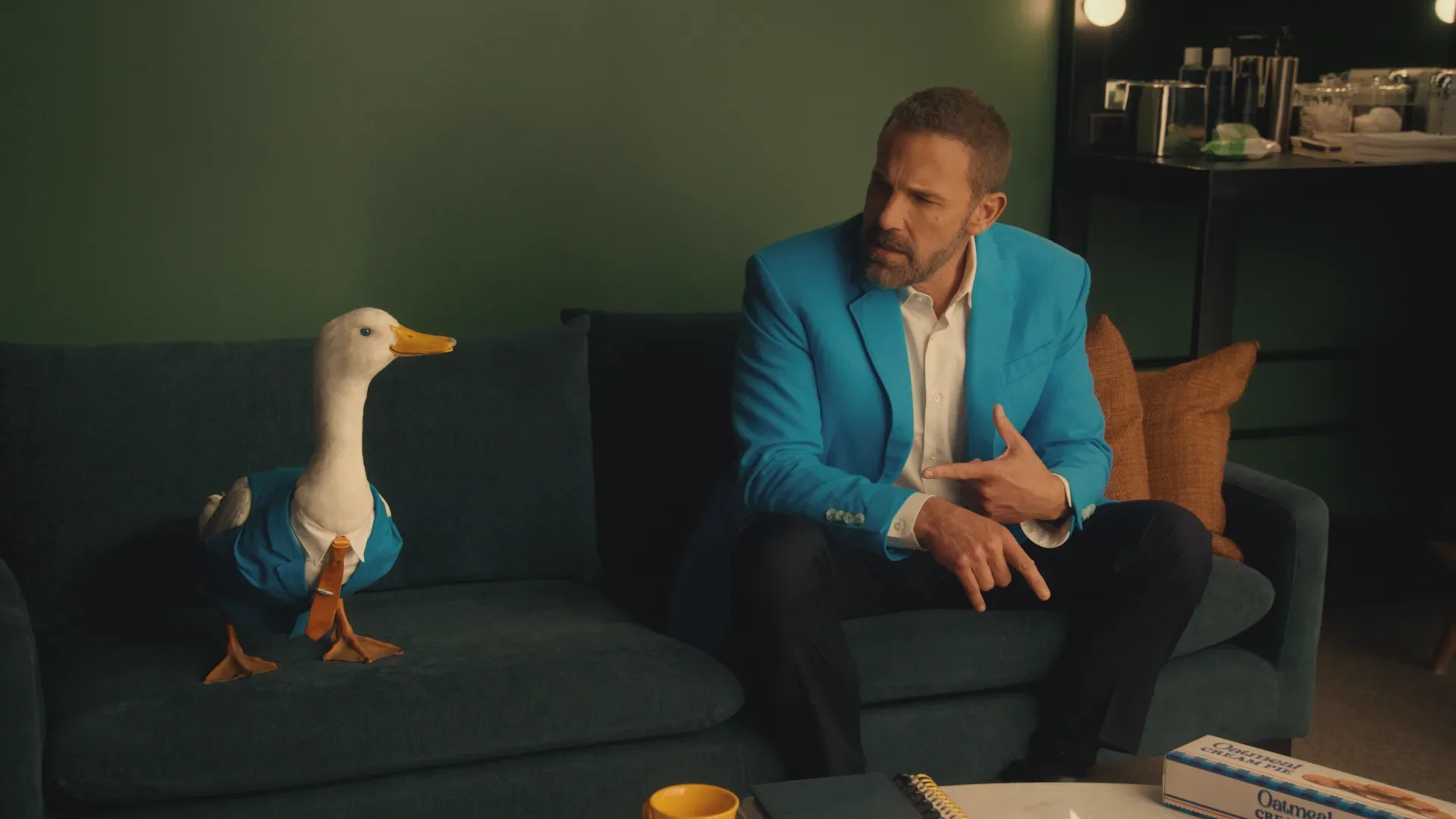
The long-running joke has finally become a commercial campaign: Ben Affleck is joining Aflac and its famously insistent Duck in a new sports-centered advertising push. The arrangement pairs the supplemental-insurance company with Artists Equity, the production studio established by Affleck, Matt Damon and Gerry Cardinale, and it turns a near-rhyme that has floated around pop culture for years into an actual marketing idea.
The first installment is scheduled to debut during ESPN’s College GameDay on Saturday, September 5, 2026. It is then expected to reach viewers through additional sports coverage, including ESPN’s Monday Night Football, as well as connected-TV placements. Affleck is not merely there to deliver a quick celebrity cameo. The central setup has him receiving a crash course in Aflac’s supplemental coverage from a striking lineup of coaches: Nick Saban, Deion “Coach Prime” Sanders and Dawn Staley.
That is a lot of high-recognition personality around one unusually durable bird mascot. It also makes sense for a company trying to communicate a product category that can need more explanation than a conventional car-insurance pitch. Aflac sells supplemental insurance, intended to provide cash benefits for eligible out-of-pocket expenses and bills that primary health coverage may not fully handle. A football pregame audience may come for forecasts and highlights, but an open-enrollment message can be useful once the game-day spectacle has gotten their attention.
A pun that took years to get on screen
Aflac’s chief marketing officer, Garth Knutson, has indicated that the Affleck-and-Aflac connection was hardly an obscure creative leap. The similarity between the actor’s surname and the brand has been an obvious source of jokes for a very long time, including jokes Affleck has made himself. That familiarity gives the partnership an immediate piece of cultural shorthand: audiences do not need much setup to understand why the actor has wandered into the Duck’s commercial universe.
What is more notable is the degree of involvement attributed to Affleck and Artists Equity in shaping the work. Knutson said Affleck participated in the first half of a dozen creative-review meetings. That is considerably earlier engagement than the standard expectation for many celebrity-fronted ad campaigns, where a famous face may arrive after much of the concept, copy and structure are already settled. Here, the actor, director and studio co-founder appears to have been part of the process while its underlying approach was still being formed.
That role fits Artists Equity’s position in commercial production. The company has already become associated with attention-grabbing celebrity campaigns, including Dunkin Super Bowl work featuring Affleck and well-known collaborators, plus a Stella Artois ad that brought Damon together with soccer star David Beckham. The Aflac assignment puts a different twist on that model. Rather than selling coffee or beer through a compact pop-culture gag, it has to make supplemental insurance memorable while keeping its explanation accessible.
The Duck’s advantage is recognition, not an unlimited budget
Aflac’s Duck has been doing the demanding work of brand recognition since 1999. The mascot arrived just months after the Geico Gecko and became part of the modern insurance-advertising arms race, where recurring characters are expected to carry humor, familiarity and product awareness all at once. Over the years, viewers have also met State Farm’s Jake, Progressive’s Flo, Jamie, Mara and Dr. Rick, Allstate’s Mayhem, Geico’s Cavemen, Farmers’ Professor Burke and Liberty Mutual’s Liberty Biberty.
For Aflac, the task is especially challenging because the wider category contains advertisers with enormous media resources. Several major insurance brands spend at least $1 billion annually on advertising, while Progressive’s outlay has exceeded $4 billion. By comparison, Aflac’s U.S. advertising spending is typically below $100 million. The company cannot simply blanket every broadcast, app, stadium stream and social feed at the volume of its biggest rivals.
Related coverage includes Aflac and Ben Affleck Launch Sports-Focused Campaign With the Duck.
That makes recall a more valuable currency. A person may see fewer Aflac spots than ads from larger insurers, but a distinctive Duck paired with Affleck and championship-level coaches has a better chance to stick. Knutson has described the objective as punching above the company’s weight: concentrating on work viewers will remember and, ideally, act upon. There is also a pragmatic joke inside the mascot strategy. The Duck is much less expensive than a human celebrity, assuming its payment can indeed be handled in bread.
Sports is an efficient environment for this kind of work because live games remain one of the rare media spaces where large audiences gather at the same moment and often watch commercials rather than skipping them entirely. The first ad’s choice of Saban, Sanders and Staley also crosses multiple generations and sports constituencies. Saban is synonymous with modern college-football success; Sanders brings a larger-than-sport persona to college football; and Staley represents elite basketball coaching and a hugely respected leadership profile. Their presence gives the commercial more texture than a simple actor-and-mascot sketch.
Why the timing matters for supplemental coverage
The campaign is intended to extend into 2027, rather than function as a one-weekend stunt. A second wave is planned around Thanksgiving, a period that overlaps with open-enrollment decision-making for many workers. That timing is logical for a company whose offering is frequently considered alongside broader workplace benefits. Aflac is also expected to appear around notable entertainment properties in March, though no further details about those placements have been disclosed.
The phased rollout suggests a straightforward communications job. The early sports spots introduce or reinforce the Affleck-Aflac premise. The Thanksgiving period can connect the now-familiar concept to a practical moment when audiences may be evaluating benefits. A later entertainment tie-in offers another route to reach people outside the weekly sports schedule. The formula is less about one viral commercial than maintaining recognition across several contexts.
It is worth separating the comic hook from the product. Supplemental coverage is not positioned as a substitute for primary health insurance. Its purpose is to provide extra cash benefits for qualifying expenses and financial pressures that can remain after primary coverage is applied. That distinction is important, especially when a commercial has only seconds to make its point. Using coaches to explain the basics gives the first spot a built-in reason to slow down long enough to address what Aflac actually does.
From a cold email to a high-profile partnership
The relationship began with a comparatively ordinary business move. Knutson discussed the Affleck idea with Aflac president Virgil Miller, then sent an unsolicited email to an Artists Equity executive he believed was the appropriate contact. When the teams met, Knutson found that Affleck’s side had substantial interest in the concept and was asking detailed questions about supplemental health insurance.
That level of curiosity matters because a campaign built solely around a phonetic joke could burn out quickly. The Duck and Affleck name connection gets the audience through the door; understanding the brand’s specialized role is what gives the campaign a reason to continue. It also helps explain why the collaboration is structured around Artists Equity rather than just a one-off endorsement deal. The studio’s involvement points toward an ongoing creative relationship, with room for sports, enrollment-season messaging and the still-unspecified entertainment activity planned for March.
For sports viewers, the new work joins the wider ritual of commercials competing with the broadcast itself. The same attention economy that drives audiences toward live football also supports other appointment viewing, whether it is a major fight card such as Katie Taylor vs. Flora Pili at Croke Park or a college-football studio show stacked with familiar analysts and coaches. Aflac’s bet is that its Duck, a Hollywood fixture and three coaching names will be enough to earn a place in that conversation.
In a market filled with beloved mascots, massive budgets and repeatable catchphrases, the company is leaning into an association people already knew was there. Now it has a broadcast schedule, a production partner and a Duck ready to make sure nobody mishears the name.